An excellent little haul yesterday.
I went into a secondhand book shop near my home. There were no Ladybirds on the shelves, but just as I was leaving, I spotted these tucked behind a pillar on the counter.
The buzz never goes away 😊
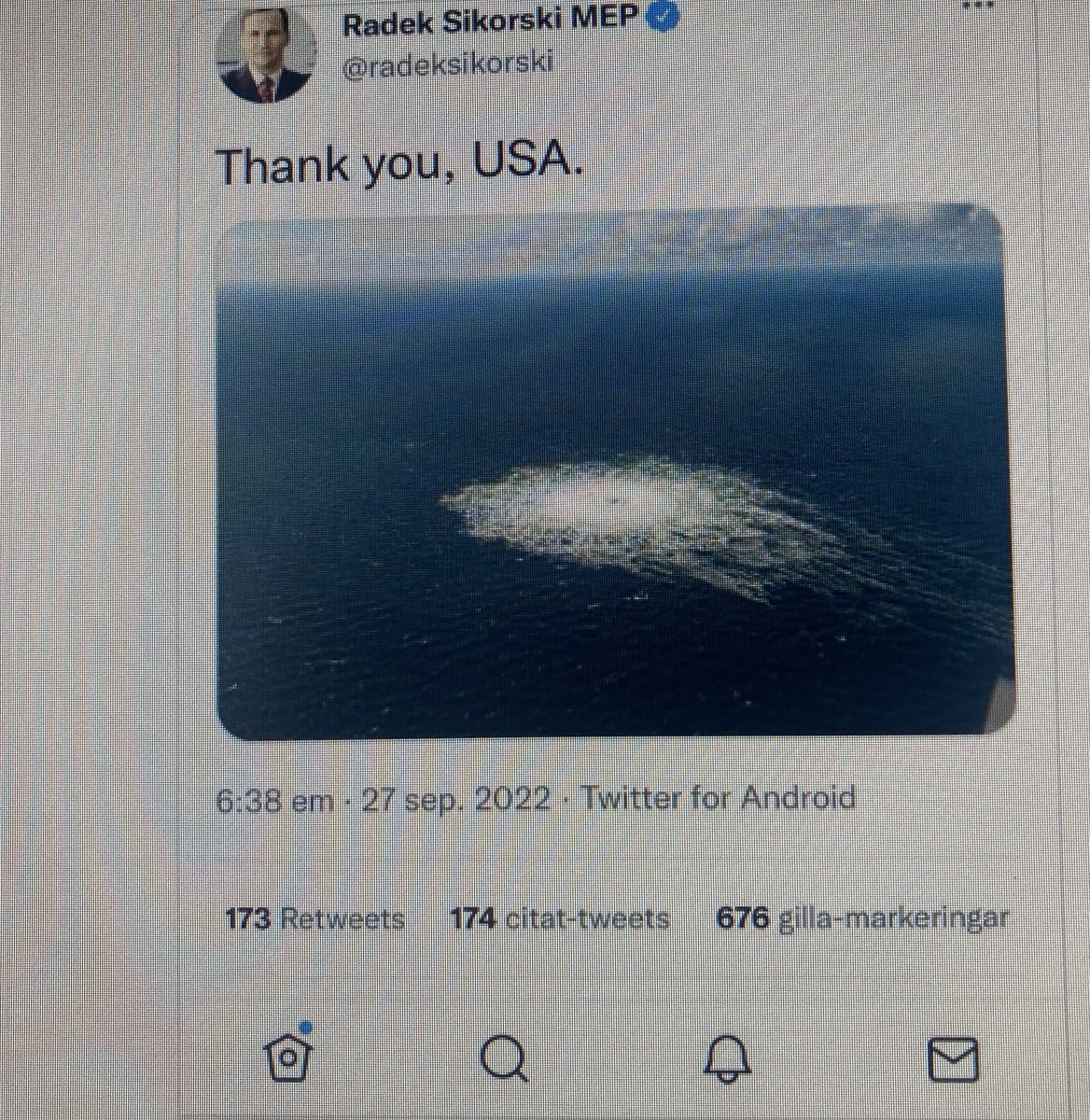
Wouldn’t it be nice if this mysteriously deleted tweet (by Polish Russia hawk Radek Sikorski) about the blowing up of the Nordstream pipelines, got a really huge number of retweets?
June 8, 1940. Four days after Dunkirk, Britain lost 1,519 sailors in the Arctic Ocean. Almost no one talked about it. The government made sure of that.
Here's the full story, and it gets darker the deeper you go.
HMS Glorious was an aircraft carrier returning from Norway, where she had just pulled off something genuinely miraculous. RAF Hurricane pilots, flying planes never designed to land on a carrier, with no tail hooks and no training, somehow put their aircraft down on her deck anyway. It had never been done before. They saved the planes that would go on to fight in the Battle of Britain.
The ship should have been sailing home as a hero.
Instead, Captain Guy D'Oyly-Hughes had stripped her of her defenses.
D'Oyly-Hughes was a decorated WWI submarine legend, the kind of officer whose reputation had become a shield against criticism. But aboard Glorious, he had spent months feuding with his senior aviator, Commander Heath, who had refused to send his planes on a vague and suicidal attack run against German shore targets. D'Oyly-Hughes considered this insubordination. He had Heath arrested and thrown off the ship.
That decision had a consequence nobody predicted.
With Heath gone, Glorious had no combat air patrol flying. No planes in the sky watching for threats. And because D'Oyly-Hughes was in a hurry to get back to Scotland to personally oversee Heath's court martial, he requested permission to detach from the convoy and race home independently, with only two small destroyers for escort.
The Admiralty said yes.
On June 8, two German battlecruisers, Scharnhorst and Gneisenau, spotted a wisp of smoke on the Arctic horizon. They closed at full speed. Glorious had no radar. No aircraft up. No warning at all. By the time her crew understood what was happening, German shells were already tearing through the flight deck.
The battle lasted less than two hours. Glorious went down. Then Ardent. Then Acasta, though not before Acasta's crew, knowing they were dead, turned back toward the German fleet and fired their last torpedoes. One hit Scharnhorst. A final defiant act from men who had no chance.
1,519 men went into the Arctic water.
The sea temperature was just above freezing.
Norwegian vessels found survivors nearly three days later.
40 men were still alive.
The Admiralty convened a Board of Inquiry within days. Then they sealed the findings until 2041.
Not until the 1980s did naval historian Captain Stephen Roskill publish testimony suggesting the entire disaster traced back to one captain's personal vendetta against one officer, and to an institution too proud to question a war hero's judgment. The inquiry findings that could confirm or deny this remain classified for another 15 years.
1,519 people. A captain racing home for a court martial. A government that buried the story under Dunkirk's shadow.
We still don't know everything.
Joan of Navarre, Queen of England, was accused of witchcraft by her stepson Henry V in a likely political move to seize her wealth and help fund his wars in France. After years under house arrest, she was released and eventually had her lands and fortune restored.
“She was definitely the sort of girl who puts her hands over a husband's eyes, as he is crawling in to breakfast with a morning head, and says ‘Guess who!’”
P.G. Wodehouse, The Code of the Woosters
Leopold I transformed Austria into a great power. He helped repel the 1683 Ottoman Siege of Vienna, reclaimed most of Hungary, and checked Louis XIV’s expansionist ambitions in the West. A gifted patron of the arts, he also helped transform Vienna into a great Baroque capital.