@Pluvio9yte Love how it pulled out that June dot plot detail about 9 officials still wanting tightening. Those small shifts are easy to miss but matter a lot.
🧵 1/7
The real bottleneck in frontier research isn’t information. It’s judgment: what do you trust when the evidence is incomplete, conflicting, and expensive to validate?
Recently, Apodex-FutureFlow ( @Apodex_AI )—driven by their open 35B model as its backbone—ranked #1 on the FutureX prediction leaderboard for 3 of the last 4 weeks, sweeping all top four spots in a showcase round.
@Lonely__MH@Apodex_AI Love how it actively looks for challenges instead of just stacking more supporting evidence. That verification step feels like real research workflow.
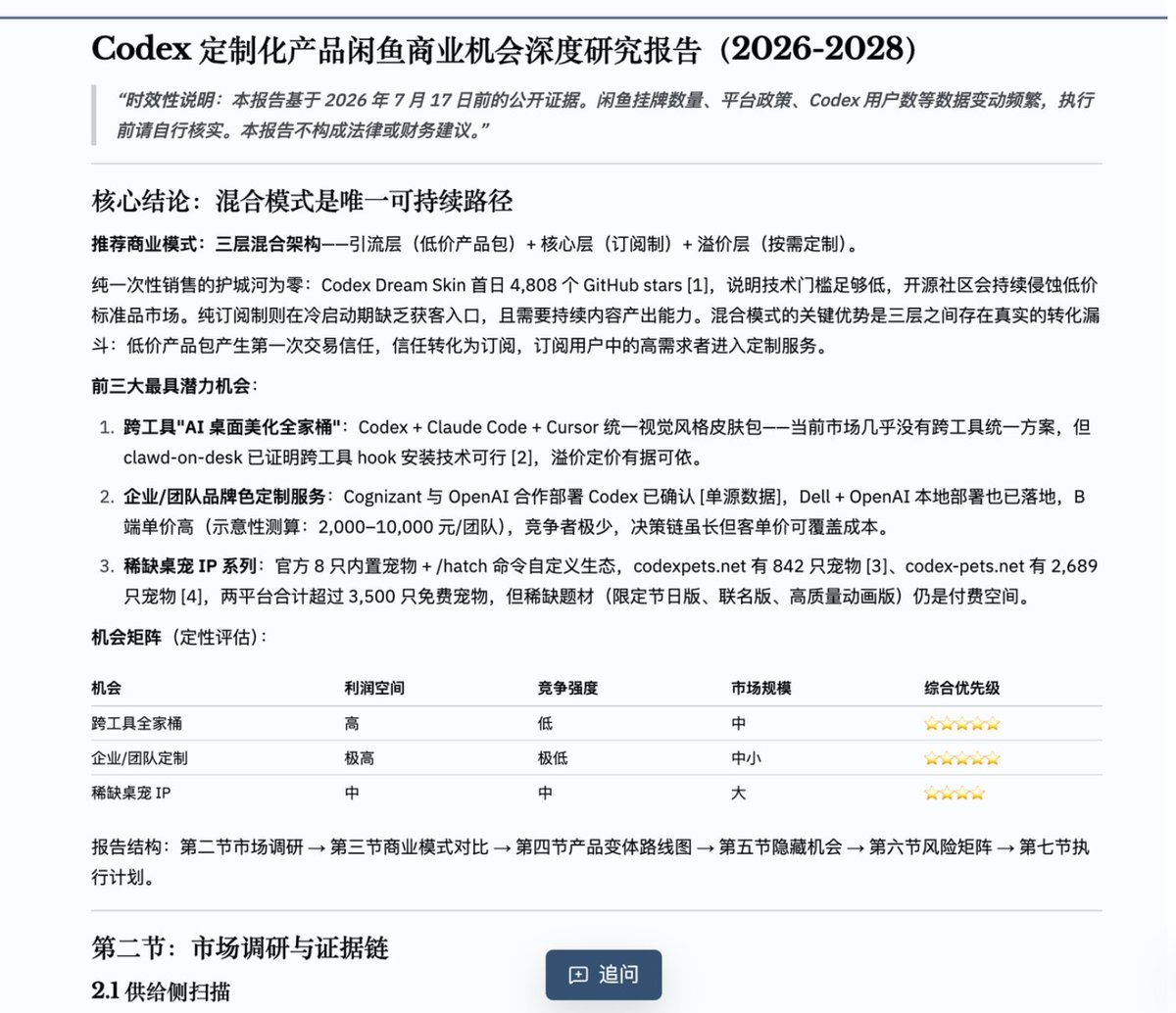
From idle fish skin sales to a full business model with lead gen, subscriptions, and premium tiers — this is a solid example of turning curiosity into insights. Appreciate you sharing the process.
🚀 Share this with friends who are building startups or working on cutting-edge research.
I just got approved for the Apodex Frontier Program, and found several AI startup support programs worth sharing with founders and researchers. 👇
No equity dilution.
No upfront payment.
Eligible teams can get up to $1.2M/year in AI compute & token support.
For many startups, cloud infrastructure and AI model usage fees are the first major expense.
Several major companies now offer startup support programs:
🔹 Google
AI-first startups can receive up to $350K in credits over two years.
🔹 AWS
Eligible startups can get up to $200K in cloud credits.
🔹 Tencent Cloud
Provides $1K–$100K cloud resource vouchers.
🔹 Zhipu AI Z Plan
Provides tokens, technical support, and investment opportunities.
🔥 The most unique one I found is the Apodex Frontier Program.
It targets:
🏫 University labs
🔬 Research institutions
🚀 Deep-tech startups
Selected teams can receive up to $100K/month in free compute, equivalent to $1.2M/year.
Additional benefits:
✅ Institutional Account
⚡ 10× compute capacity
🛠️ Dedicated engineering support
Suitable for:
🧬 Drug discovery
🏥 Clinical analysis
🧪 Materials research
📈 Quant finance
⚖️ Legal AI
For many teams, free compute is not just about reducing costs — it can make previously impossible experiments finally feasible.
The application process is quite straightforward — if you are working on AI research or building a deep-tech startup, it’s worth giving it a try.
Apply:
https://t.co/DtlYNEpZVU
@MinLiBuilds This looks really useful for university labs and research groups. The institutional account + 10x capacity could make a big difference for heavier workloads
Great example of AI doing real research instead of narrative. It added structure around VIE timelines and secondary market anchors that most people miss.
@li9292@Apodex_AI This is proper business analysis. It didn’t just agree or disagree with your view — it added comparable cases, observable signals, and separated what’s knowable from what’s uncertain.
Haaland finished his World Cup with seven goals. Messi and Mbappé are now level on eight, with one match left each.
So I asked Apodex @Apodex_AI a simple question with a not-so-simple answer: who wins the Golden Boot?
It first gave Messi a 65% chance, Mbappé 25%, and the field 10%.
But the useful part wasn’t the pick. It was what happened when I challenged the reasoning.
I asked Apodex to audit its own forecast. It found that the first analysis had underweighted the difficulty of Messi’s final, while not fully translating the more open—but rotation-sensitive—third-place match into Mbappé’s chances.
The result: Messi fell from 65% to 61%, while Mbappé rose from 25% to 29%.
I then made it remove every claim that couldn’t be traced to reliable sources. Using only five verified inputs—goals, assists, minutes played, FIFA’s tiebreak rules, and the remaining fixtures—it settled at:
Messi: 60%
Mbappé: 30%
Others: 10%
The core logic is surprisingly clean: both have eight goals, but Messi leads 4–3 in assists. If they finish level on goals and that assist gap remains, Messi wins. Mbappé’s clearest route is to outscore him.
That’s what made this test interesting. Apodex didn’t pretend to know the future—it exposed the evidence, the uncertainty, and the exact reason its confidence changed.
This evidence-driven approach has also been validated by Apodex’s recent performance on the FutureX forecasting benchmark.
Timestamped on July 16. I’ll come back after the final and check the result.
This is a probability forecast based on current evidence, not betting advice.
Try it: https://t.co/QATB8aWuyp
@AshlynHe1129@Apodex_AI The self-audit part is what makes this stand out. Most AIs just give you a number and stick with it. This one actually revised its own reasoning when challenged.
@xiangxiang103 The play-by-play scripts with specific triggers (控球率, 梅西位置, etc.) are really useful. You can literally watch the first 30 minutes and know which scenario is playing out.
@CTracy0803 This approach is perfect for Polymarket users. Knowing why the market is pricing something a certain way helps you spot where the edge might be.