Professor of Clinical AI and Machine Learning @QMUL Interested in computational modelling of disease trajectories from clinical and behavioural data @DERI_QMUL
What an honour! It was truly a privilege to meet His Majesty King Charles III at a reception for leaders and creatives. I also had a great conversation with Prime Minister Starmer, who recalled his time at Queen Mary University of London. An absolutely memorable evening!
SESSION 2 | TRANSFORMING TRAUMA
From decoding shock and TOE beyond the heart, to AI & generative models in trauma and scaling success beyond trauma — an outstanding session exploring how innovation is reshaping trauma care.
Chaired by Dr Mamoun Abu-Habsa, featuring Dr Rich Carden, Dr Olusegun Olusanya, Prof Venet Osmani, and Dr Rosena Allin-Khan MP
#Trauma2030 #TransformingTrauma #TraumaCare #HealthcareInnovation
It is critically important to thoroughly evaluate clinical AI models, going beyond the usual performance tests (such as AUC). We need to watch out for unexpected "shortcuts" models might take, as they could pop up when we least expect them and can lead to unfair or biased care.
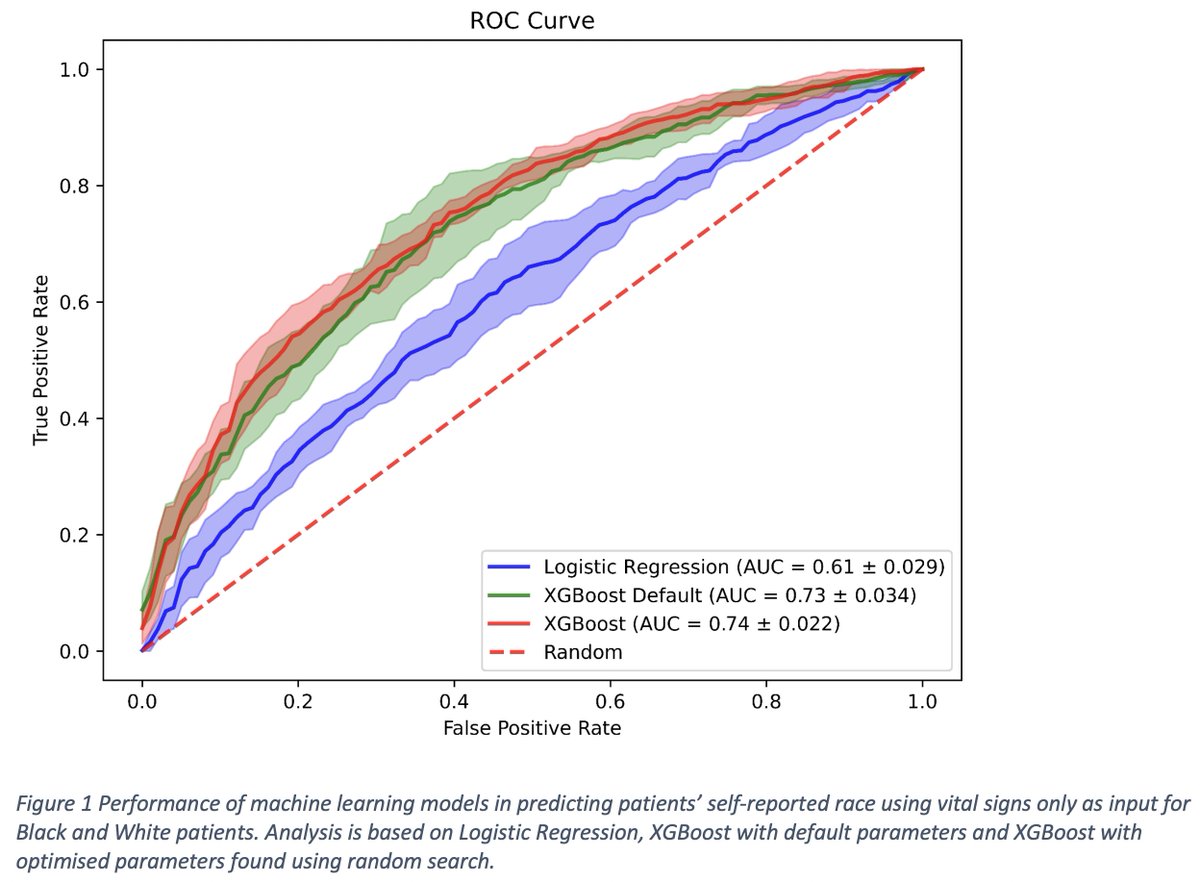
AI #algorithms can infer patients’ #ethnicity from #vital#signs alone! We’ve shown that AI algorithms can figure out patients' ethnicity just by looking at four basic vital signs: heart rate, breathing rate, oxygen levels, and blood pressure.
https://t.co/XSVOCxu7yZ
@nicholasdwright@clivecookson@FT The study suggests a drop in skill over just three months. This is a very short period, especially for clinicians with over 27 years of experience, on average.
@nicholasdwright@clivecookson@FT To add a bit more context: The number of colonoscopies performed nearly doubled after the AI tool was introduced, going from 795 to 1382. It's possible that this sharp increase in workload could have led to a lower detection rate.
Thanks @natashaloder for providing more context and @EricTopol for picking this up! Whether there's evidence of deskilling is indeed debatable, especially given three months monitoring period after the introduction of AI @QMUL
More context: the number of colonoscopies performed nearly doubled after the AI tool was introduced, going from 795 to 1382. It's possible that this sharp increase in workload,..could have led to a lower detection rate.... 1/2
expert reaction to observational study looking at detection rate of precancerous growths in colonoscopies by health professionals who perform them before and after the routine introduction of AI
https://t.co/pAmKeAScpD
It was great to discuss our work on delirium risk prediction in critical care at the Royal London Hospital. I also spoke about the trade-off between clinical utility and model performance. More info: https://t.co/CRnblPwspW
Thanks @drmamoun01 for the intro
Thank you to all our speakers for making yesterday’s AI & Critical Care Clinical Development Day one to remember! 🤖💻📊
We kicked off with a bang thanks to Rob Orwin from Microsoft, who demonstrated how AI, particularly #M365, #Copilot, and #CopilotAgents, has the power to fundamentally transform how we get things done in healthcare.
Followed by AI screening tools for delirium to machine learning in sepsis phenotyping — the day was packed with insight, innovation, and energy.
And we wrapped up with an engaging live demo from Oxford Medical Simulation, showcasing how immersive technology is reshaping medical training.
Looking forward to continuing these conversations and pushing the boundaries of what's possible in critical care.
#AIinHealthcare #CriticalCare #DigitalHealth #ACCESS
This is a unique opportunity to collaborate with the world-leading institutions both in London as well as USA, in one of the top ranked Universities for research.
Deadline: 8 December 2024
How to apply:
https://t.co/7wJfvIPOPc
POST DOC OPPORTUNITY 📢 📢 📢
I am looking for a Post-Doc in Generative AI and related areas to join my lab at Queen Mary University of London You should have experience with methods such as Autoencoders, GANs or Diffusion Models. Multimodal AI and clinical data is an advantage
@EeHRN You're right @EeHRN. However, uncovering this issue in vital signs was unexpected, even after controlling for potential confounders (e.g. skin colour affecting SpO2 measurements)
In this work we find that vital signs embed racial information that can be learned by AI algorithms, posing a significant risk to equitable clinical decision-making. Mitigating measures are challenging, considering the fundamental role of vital signs.