It’s easy to think about through a town of 10 people who each own a shop, with only $100 between them all. If one person finds an additional $10… they can buy more goods from another store owner than anyone else. Then who he bought from first has more money to buy more than normal, etc. Prices won’t go up until everyone realizes via math or supply/demand. Eventually they understand there is more money in circulation, for the same amount of goods.
Plucking 1 person from each, I would say 2,3, &7 have the broadest demographics with experience of firearms. Accounting for placement in unknown climate, 2, or 3 could weather more. Physical health is likely higher at higher altitude, so I think Section 2 has the highest chance for winning.
Section 2 has wild animals common enough to be prepared for and fearful of. Also, probably have a larger population more self-reliant given the spacing.
So after all these hours talking about AI, in these last five minutes I am going to talk about:
Horses.
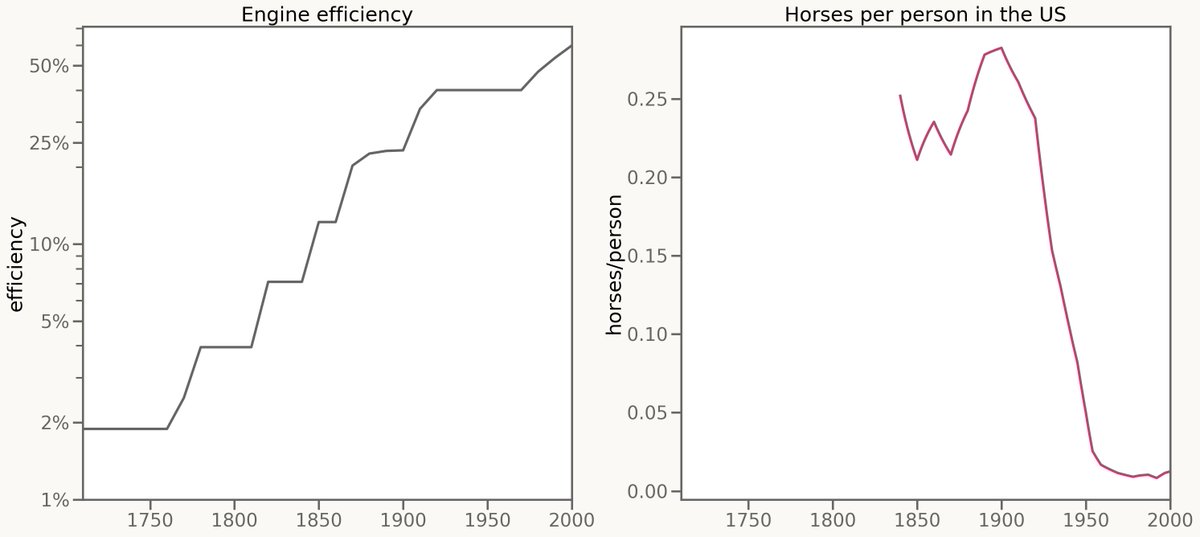
Engines, steam engines, were invented in 1700.
And what followed was 200 years of steady improvement, with engines getting 20% better a decade.
For the first 120 years of that steady improvement, horses didn't notice at all.
Then, between 1930 and 1950, 90% of the horses in the US disappeared.
Progress in engines was steady. Equivalence to horses was sudden.
BREAKING: Walt Disney Imagineering reveals their free-roaming Olaf robotic figure coming to World of Frozen at both Hong Kong Disneyland and Disneyland Paris.
Immense planning and technical precision was required for this absolutely preposterous (but real) view: I captured my friend @BlackGryph0n transiting the sun during a skydive.
This might be the first photo of it's kind in existence. See a video of this moment in the reply 👇
A math professor noticed his kitchen sink at home was leaking.
He called a plumber.
The plumber came the next day, tightened a couple of nuts, and the sink worked perfectly again. The professor was delighted. But when, a minute later, the plumber handed him the bill, he was shocked.
“This is a third of my monthly salary!”
“Yeah, I get it…” said the plumber. “Why don’t you come work for our company as a plumber? You’ll make three times more than you do as a professor. Just remember: when you apply, say you only finished seventh grade. They don’t like hiring educated people.”
So the professor got a job as a plumber, and his life really did improve. All he had to do was tighten a nut here and there every so often, and his salary was much higher.
One day, the management of the plumbing company decided that every plumber had to attend evening classes to finish eighth grade. So our professor had to go too.
By chance, the very first class was math.
The evening school teacher, wanting to check what the students knew, asked for the formula for the area of a circle.
They called the professor up to the board, and he suddenly realized he’d forgotten it. He started frantically reasoning it out, covering the board with integrals, differentials, and all sorts of fancy formulas to re-derive the result. In the end, he got:
S = –π r²
He didn’t like the minus sign, so he started again.
Again he got a minus. No matter what he did, it kept coming out negative.
He cast a panicked look at the class, and all the plumbers were whispering:
“Swap the limits of integration!”
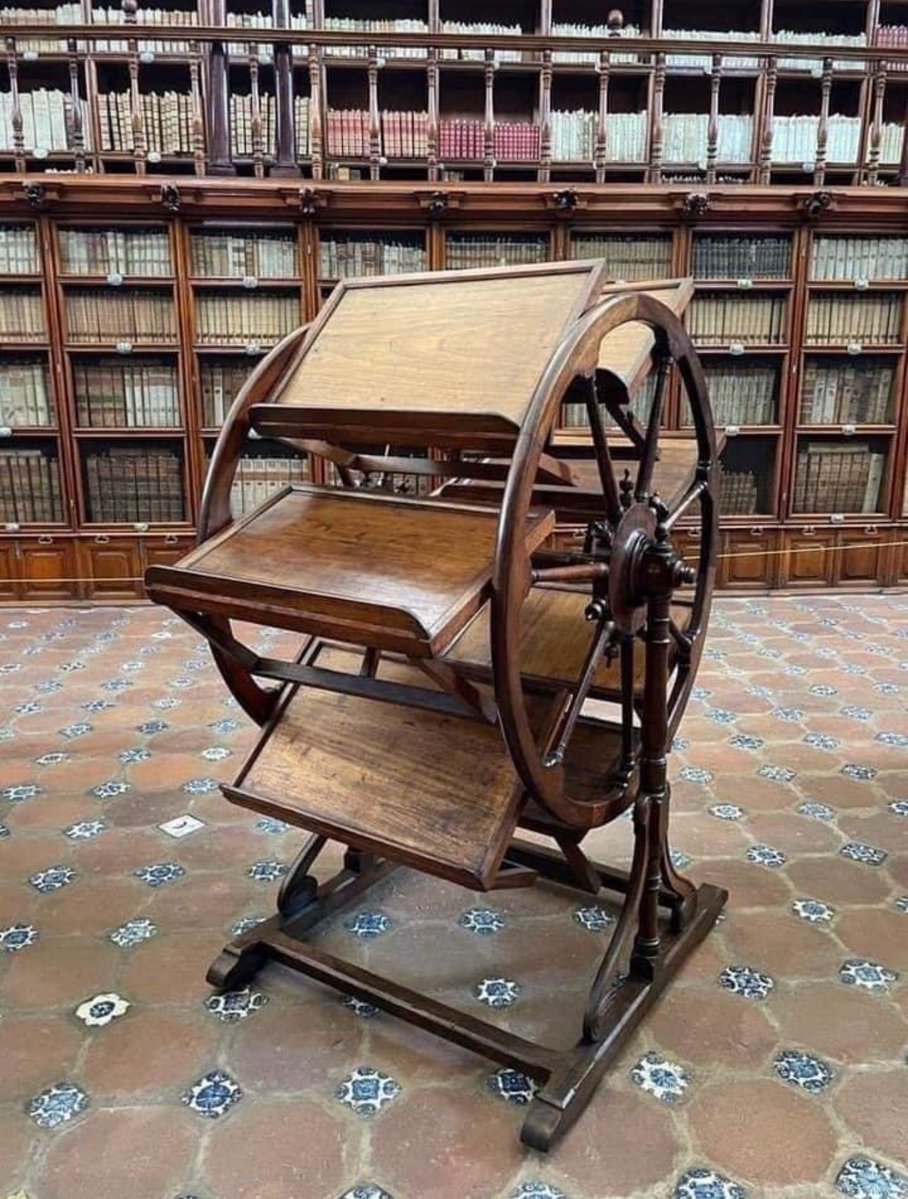
My web browser has a few hundred of these open…
That device is called a bookwheel (also known as a reading wheel).
It was invented in the late 16th century by Italian engineer Agostino Ramelli and was designed so scholars could consult multiple books at once without having to constantly stand up and retrieve them.
The wheel’s design keeps each book’s angle constant as it turns, so you don’t lose your page—basically an analog version of having multiple browser tabs open.
Thomas Jefferson has a version he uses later on.