What’s happening with the U.S.-Iran MOU, and why is it so fragile?
The short version: the deal is being tested on two major fronts: Hormuz and Lebanon. And the prospect that it leads to a broader deal through ongoing negotiations is currently growing more remote by the day.
1. The MOU left Hormuz ambiguous.
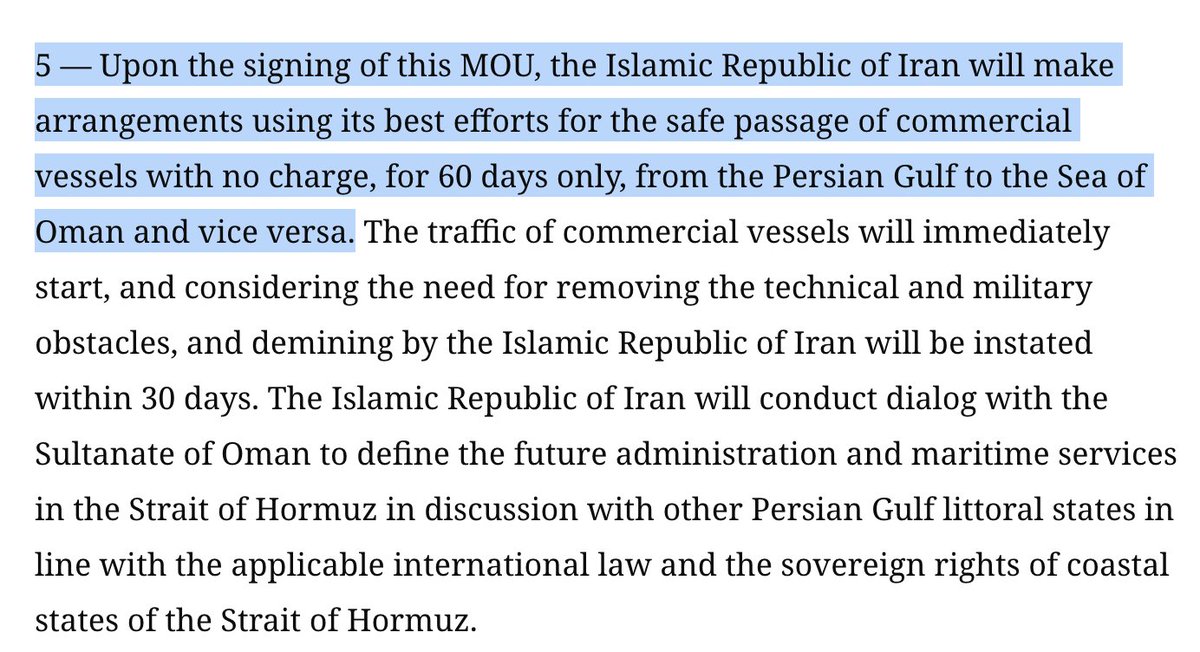
Clause 5 says Iran will make “arrangements” for safe commercial passage through the Strait of Hormuz with no charge for 60 days. Iran reads this to mean ships must use routes Tehran designates, and that Iran will eventually help administer the Strait and collect fees for maritime "services".
2. The U.S. is challenging that.
Ships backed or encouraged by Washington have been using a southern route near Oman, outside Iran’s preferred corridor.
3. Iran warned those ships, then struck them.
Tehran’s message was clear: if ships ignore Iranian arrangements, safe passage is not guaranteed.
4. The U.S. responded by bombing targets inside Iran.
This is why the situation is so dangerous. What Washington framed as a response to Iran’s attack on shipping, many in Tehran see as not just a direct violation of the MOU but a restarting of the war.
5. Iran then hit U.S. bases in Bahrain and Kuwait.
This cycle repeated over two nights: Iran pressures shipping, the U.S. strikes Iranian territory, Iran retaliates against U.S. regional bases.
6. For now, more ships appear to be using Iran’s preferred route.
But the underlying fight is unresolved: who actually gets to define the rules of passage through Hormuz?
7. Lebanon is the other major problem.
The new Israel-Lebanon framework pushes Hezbollah’s disarmament while making Israeli withdrawal, reconstruction, and civilian return conditional on that outcome. It also preserves Israel’s broad ability to keep using force in Lebanon under “self-defense.”
8. That clashes with the logic of the U.S.-Iran MOU.
The MOU was supposed to end the regional war, including in Lebanon, and respect Lebanon’s sovereignty.
But the Lebanon deal may instead lock in a new phase of conflict by demanding an outcome Hezbollah will not accept and the Lebanese state is unable to impose.
Bottom line:
The MOU is fragile because both sides are now trying to impose their interpretation of it in practice.
Iran sees the agreement as locking in gains it made during the war, especially over Hormuz.
Washington appears to be trying to limit those gains while also advancing a Lebanon framework that is incompatible with the MOU.
"The head of the US technical team and his Iranian counterpart will meet separately with the Qatari and Pakistani mediators."
Indirect technical talks won't lead to a detailed nuclear agreement. 20% of the way through the supposed 60-day period and the negotiators are still playing telephone https://t.co/GwoRtg3PwD
It seems that the U.S. strategy for dealing with the the apparently lopsided terms of the MOU is to do everything possible not to adhere to its own aspects of the agreement just as it did with the JCPOA, while also working to erode Iranian leverage around the region as much as possible to alter the terms of the next round of confrontation.
It was entirely predictable this would happen which is why some voices in the Iranian establishment advocated continuing the conflict and blockade to create a punitive deterrent since the thesis of having durable agreement has already been disproven on so many occasions. https://t.co/32mFSwUtXS
The CPJ decision to functionally change the definition of journalist - while our news industry in the U.S. is filled with former IDF soldiers covering the occupation & genocide they helped build and justify, including Barak Ravid who was in the IDF reserves until March 2023 - is not only indicative of the racism under which the entire western journalism order functions but also of the extent of the complicity of this industry in the slaughter of Palestinian journalists.
A dark, shameful day and proof that no, things are not getting “better” - the whole project is to erase and minimize these crimes until everyone forgets and moves on.
Despite the Trump administration’s repeated dehumanization of Latin communities, Iran’s national soccer coach stood before the press and told the Mexican people:
“We thank you for the love you gave us. Our country is also your second home. You gave us hope. Mexico, you humanized our pain.”
In a moment defined by so much cruelty, that kind of solidarity is powerful, wow.
I told Aljazeera that Gaza and Lebanon ceasefires are inherently imperfect because they involve non-state actors with fragmented command structures, and multiple competing centres of power.
In contrast, the MoU between the US and Iran shows clear chains of command and the ability to negotiate directly.
Also both states face catastrophic economic deterrents. Renewed fighting could once again threaten the Strait of Hormuz, disrupt global energy markets, and impose enormous costs not only on themselves but on the wider international economy.
Key difference is that both Washington and Tehran now have more to lose from the collapse of diplomacy than from the compromises required to sustain it.
https://t.co/QM3P7PYIXV
Told Aljazeera that the 2015 JCPOA was a Reformist-Democratic diplomatic project, diplomatically elegant but domestically fragile for both Iran and the US, due to opposition in both countries to the deal.
This MoU is the mirror image: it is a bargain between Iran’s hardline security establishment and a Republican White House. That makes it less polished, but potentially more durable.
The paradox is that a less liberal agreement may be more sustainable, because it is rooted in the power centres that can actually enforce it or sabotage it.
Despite the Iran-US ceasefire officially being on hold, limited strikes and mutual accusations in the region persist, including strikes on southern Iranian ports by the US and Iran’s targeting of Kuwait and Bahrainthis week.
Rather than viewing these skirmishes as the immediate collapse of the framework, analysts suggest they are merely a violent extension of diplomacy.
Mortazavi describes the situation as a “dangerous but familiar phase of post-war bargaining” where both sides are testing the boundaries, but careful not to restart the war. This is being done by each side to maximise benefits and minimise concessions for the next stage of the deal.
The risk is that this kind of coercive bargaining can easily spiral. The key test is not whether all violence stops immediately. The key test is whether these incidents remain contained and whether the negotiating channel stays open.
Mortazavi agrees that the most realistic outcome is neither war nor friendship. It’s a managed rivalry with rules, and that’s a significant improvement over open conflict.
https://t.co/QM3P7PYIXV
Israel routinely kidnaps, tortures, starves and imprisons Palestinian children in the West Bank for no reason other than intimidation.
Here is the story of one of them, Ahmad Hasan from Qusra:
It's obvious to anyone who actually follows Iran that plenty of Iranian dissidents, political prisoners, and families of those killed by the Islamic Republic both opposed this war from the beginning and support their national soccer team.
What Nazanin Boniadi's question actually reveals is that she isn't interested in them or their views. She and those like her want to decide which Iranians count and which don't.
And here's a genuine question: lets say there is regime change tomorrow, what exactly do they want to do with these players? Will they be judged as footballers based on their talent and merit? Or are they to be subjected to political loyalty tests or punished for failing to meet the ideological expectations of the fascist spectrum of the current Iranian opposition?
For people like @NazaninBoniadi, who claims to speak for "human rights", that's a question that must be answered.
CPJ fired Dr. Nika Soon-Shiong, as part of CPJ's racist coverup of Israel's journalist mass-murder spree.
The letter Dr. Soon-Shiong was fired for is a very good letter.
Iran’s World Cup 2026 campaign is over, but the team’s farewell has sparked an outpouring of support that stretches far beyond the results on the pitch
https://t.co/WyAJ6Yrg7V
🇬🇧 British journalists reporting from countries such as Iran could face “terrorism” prosecutions under a UK national security bill expected to complete its final stages in Parliament this week, according to legal experts cited by The Guardian.
Expert David Anderson warned the legislation could criminalize foreign correspondents for obtaining information from sources within state-designated groups because it lacks explicit protections for journalists.
Press freedom groups are urging ministers to amend the bill, but the Home Office insists legitimate journalism is protected and that claims to the contrary are false.
🔗 Story is linked below.
As I have addressed several times over the past 2 weeks, it does not appear that the United States has released any frozen assets yet to Iran.
This is a critical chess match that we are seeing play out in real time. On one hand, refusing to release the first tranche of frozen assets to Iran risks a total collapse of the MOU, and a potential complete and LASTING closure of the Strait of Hormuz. If the United States continues to play games on these assets, Iran is unlikely to “take it on trust” again in the future.
On the other hand, every day that the Strait is even partially more open is a day that slowly moves the needle in favor of the United States. Without question, the “joint blockades” favored Iran… this slowly bleeds their leverage.
It is a VERY high risk play for the United States, but every day it DOESN’T collapse the peace deal, it turns the tables ever so slightly for the U.S.
But all of this is purely due to the acceptance of the Iranians. If they choose to stop playing ball, things could go south FAST.
https://t.co/IRWNX2sqNE
“Google’s aiding of Israel’s genocide against Palestinians exposes company and its leadership to potential legal liability.”
Abolitionist Law Center, Center for Constitutional Rights, and Tech Justice Law notify Google’s leadership in historic move of legal accountability.
This unprecedented legal notice to Google follows years of organizing by Google workers with @NoTechApartheid (NoTA).
⭕️ More than 9,400 Palestinians are currently imprisoned by Israel, including approximately 90 women, 360 children, and 3,324 Palestinians held without charge or trial under administrative detention, according to new figures released by Palestinian prisoner institutions.
The report says between 9,400 and 9,500 Palestinians have remained in Israeli prisons throughout much of 2026, among the highest prisoner populations on record.
Among detainees from Gaza, the report says 1,316 remain imprisoned under Israel’s “unlawful combatant” law, while 2,249 have been identified through documentation by the Palestinian Commission of Detainees’ Affairs.
It estimates that more than 11,000 people from Gaza have been detained since October 7, though that figure includes those later released or killed and is not considered precise.
The report also notes that no official figures or names have been released for alleged members of Hamas’ Nukhba unit held in the Rakafet section of Ramla Prison, saying no accurate statistics are available. Human rights groups and former detainees have documented the most severe torture and abuse against prisoners held under Israel’s “unlawful combatant” regime, including those accused of belonging to Hamas’ Nukhba unit.
Since 2025, the report says 2,724 Palestinian prisoners have been released through prisoner exchange agreements, with many more released outside those exchanges.
Trita Parsi, executive vice president of the Quincy Institute for Responsible Statecraft, said the Oman-Iran discussions should be seen as the start of a process, not as an immediate decision to charge vessels.
“Unlike some reporting, they are not announcing that they will collect tolls,” Parsi told The Media Line. Rather, he said, the two countries were laying the groundwork for “future navigation” of the strait and the “services” provided, as well as the cost of those services.
In Parsi’s view, the Oman-Iran statement points to negotiations over how the strait will be administered after the 60-day window, rather than to a decision to impose charges now. He also noted that the statement refers to consultations with other littoral states, suggesting an attempt to make the strait's management “a regional affair” rather than an arrangement handled solely by Iran and Oman.
https://t.co/QSGnguaMOb
Los jugadores de la selección de Irán aprovecharon su estancia en Tijuana para recorrer el centro comercial Distrito Península durante la tarde de este domingo, donde convivieron con decenas de aficionados que se acercaron para saludarlos, tomarse fotografías y solicitar autógrafos.
Más en La Jornada: https://t.co/BQGCTmEbMx
Louise Adler analyses Royal Commission testimonies re antisemitism, separating paranoia and uncomfortable feelings from threat. 👇While this is emphatically understandable post Bondi, Virginia Bell SC must determine if Netanyahu’s Gaza overkill (“genocide”) has in fact exacerbated antisemitism here.