DTCC has now processed real production trades using DTC-tokenized U.S. Treasury and equity securities on @CantonNetwork, advancing the partnership announced in December 2025.
These were real assets processed through live institutional production workflows today. Every completed use case ran on Canton, with assets on the network represented directly onchain.
This milestone shows what becomes possible when established market infrastructure and blockchain technology operate together in production, and it creates the foundation for more participants, more use cases, and sustained transaction activity to follow.
@The_DTCC Tokenization Service is on track to launch in October 2026.
Full announcement: https://t.co/0Hv0dYHRIx
Grayscale has filed an S-1 with the US Securities and Exchange Commission to launch an ETF that would hold canton-network:native.
https://t.co/rn9VuQpMRY
Bitcoin und ein Goldbarren stehen im selben Steuerparagraphen.
Wortwörtlich. Im selben Satz.
Trotzdem will die Politik offenbar nur einen davon härter besteuern.
Das ist juristisch nicht so einfach, wie sie tut.
Der entscheidende Paragraph heißt § 23 EStG.
Dort sammelt der Staat alles, was Privatleute kaufen und später
verkaufen können. Edelmetalle. Schmuck. Antiquitäten. Kunst.
Fremdwährungen. Münzsammlungen. Bitcoin.
Eine einzige Regel für alle:
Wer länger als ein Jahr hält, zahlt keine Steuer auf den Gewinn.
Diese Regel ist über 90 Jahre alt. Sie galt für Goldbarren genauso wie für Bitcoin.
Jetzt will die Bundesregierung die Regel kippen. Aber nur für
Bitcoin. Nicht für Gold. Nicht für Kunst. Nicht für die
Münzsammlung.
Genau hier liegt das Problem.
Das Grundgesetz hat einen Artikel 3. Gleiches muss gleich
behandelt werden. Wer in derselben Schublade liegt, darf nicht
willkürlich anders besteuert werden.
Bitcoin und Gold liegen in derselben Schublade. Beides wird
gekauft, gehalten, verkauft. Beides wirft keine Zinsen ab.
Beides ist knapp. Beides schützt vor Geldentwertung.
Der Bundesfinanzhof hat 2023 ausdrücklich entschieden: Bitcoin
ist ein Wirtschaftsgut wie jedes andere. Deshalb gilt § 23 EStG.
Genau wie bei Gold.
Die Politik hat jetzt drei Möglichkeiten.
Möglichkeit eins: Nur Bitcoin besteuern. Eine Klagewelle ist
vorprogrammiert. Verfassungsbeschwerden landen in Karlsruhe.
Möglichkeit zwei: Alle anderen Wirtschaftsgüter mitbesteuern.
Dann zahlt auch der CDU-Wähler aus Düsseldorf Steuer auf seinen
Goldbarren. Und auf den Picasso im Wohnzimmer.
Möglichkeit drei: Bitcoin künstlich aus § 23 EStG herausschneiden
und wie eine Aktie behandeln. Juristisch fragwürdig. Aber
politisch der bequemste Weg.
Niemand spricht offen über diese drei Optionen.
Stattdessen wird so getan, als sei die Sache einfach.
Sie ist es nicht.
Wer Bitcoin hart besteuern will, ohne die deutsche Mittelschicht
am Goldbarren anzufassen, muss tricksen.
Und Tricks fallen vor Gericht selten gut aus.
Wenn dich solche Insights interessieren und dir helfen,
interagiere gerne mit dem Post. 🧡
@YuvalRooz Do you know where I could find a chart of the daily burn in USD? (daily CC burn x average CC token price)? That would reflect the usage growth of the chain even better because it won't be influenced by the fluctuation of the token price.
We are happy to welcome @Ledger as a Super Validator on @CantonNetwork (CIP-0069 | Weight 5), reinforcing the network’s security and institutional-grade custody stack.🎊
Ledger brings distribution and trust at real scale: 6M+ devices sold, ~$1T secured, and 5M+ monthly active users on Ledger Live plus enterprise custody via Ledger Enterprise.
Canton Token Standard support in Ledger Live & Enterprise, with milestone-based weight tied to real mainnet usage and adoption.
Day 12 of 30: Why $CC?
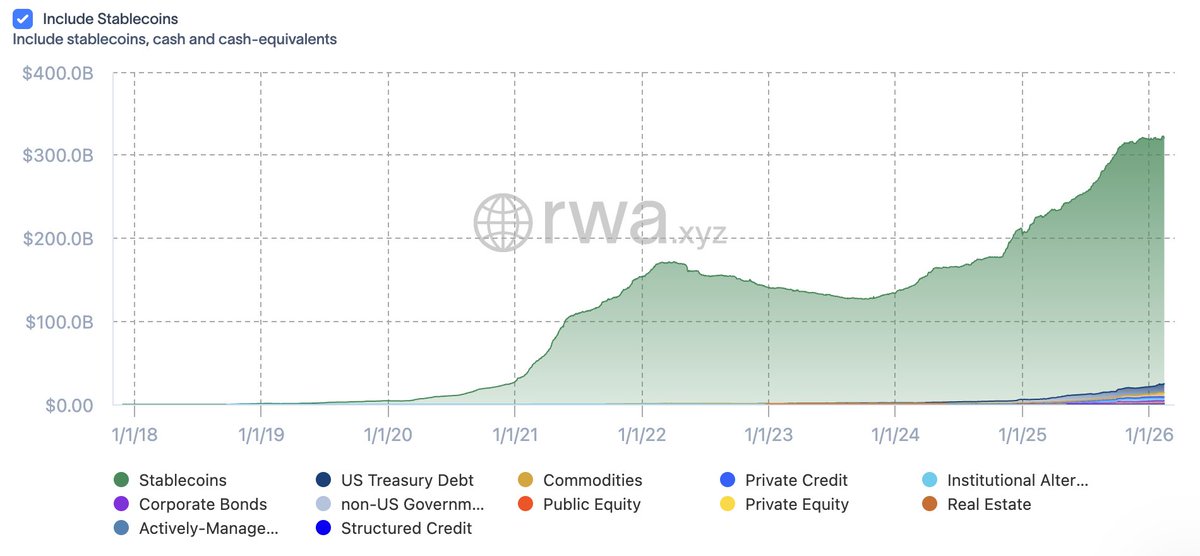
RWA tokenization is going parabolic. First chart shows $350B+ including stablecoins. Second chart shows $20B+ in non-stablecoin RWAs like treasuries, commodities, private credit, real estate. All up and to the right since 2024.
If you believe everything will be tokenized, the question is which rails these assets will live on. You want exposure to the infrastructure layer, not just the assets themselves.
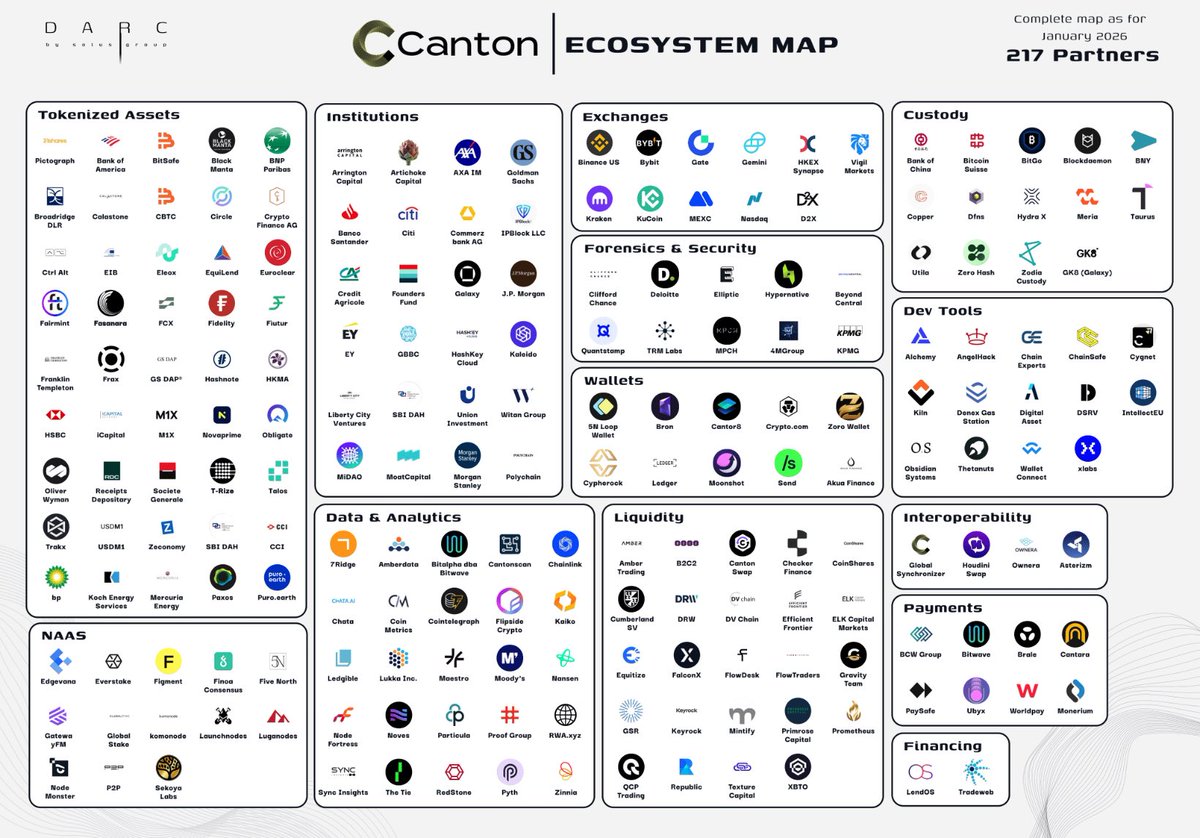
Canton has the execution. Broadridge, DTCC, Goldman, DRW, JPM - the institutions actually moving real assets on-chain are building on Canton. And unlike other public chains, Canton has privacy baked in. Institutions aren't going to broadcast their transactions to the world.
The RWA wave is here and growing. Canton is the settlement layer.
When capital returns to crypto after a prolonged alt winter, it won 't spread evenly across 15,000 tokens again.
It'll concentrate into whatever has demonstrable traction. The 2020 recovery didn't lift the 2017 dead, it created entirely new winners.
This cycle's version of that is probably even more brutal because the market is more sophisticated at identifying what's real.
That's why when capital rotates back in again, Canton will be well positioned to take the lion's share.
$CC
There's a $230T securities market and a $25.5T collateral market.
That gap is the biggest unlock in finance and @CantonNetwork is quietly building the pipes to close it.
- DTCC tokenizing Treasuries
- Euroclear running gold collateral
- JPMorgan deploying JPM Coin
They also just powered the first private stablecoin payroll for a real enterprise.
This is what institutional crypto actually looks like.
@r_benk@ElonTrades When the user pays in USD instead of $CC, it will be automatically converted into CC by the super validator and then burned. So it doesn't really matter which currency the enduser choses.
Coming soon to Kraken ⚡️
$VTHO by @vechainofficial is the utility token of the VeChainThor blockchain, used to settle transaction fees and smart contract execution costs.
Trading starts January 16 at 15:00 UTC
Get ready → https://t.co/F0zq5JpASe
🇪🇺 EU just made it official
By July 2026, Digital Product Passports become mandatory across 30+ industries
#VeChain is already live with 300+ enterprise cases and is positioned to capture a slice of a $44B market
Regulation -> adoption -> real demand
$VET will win big in 26