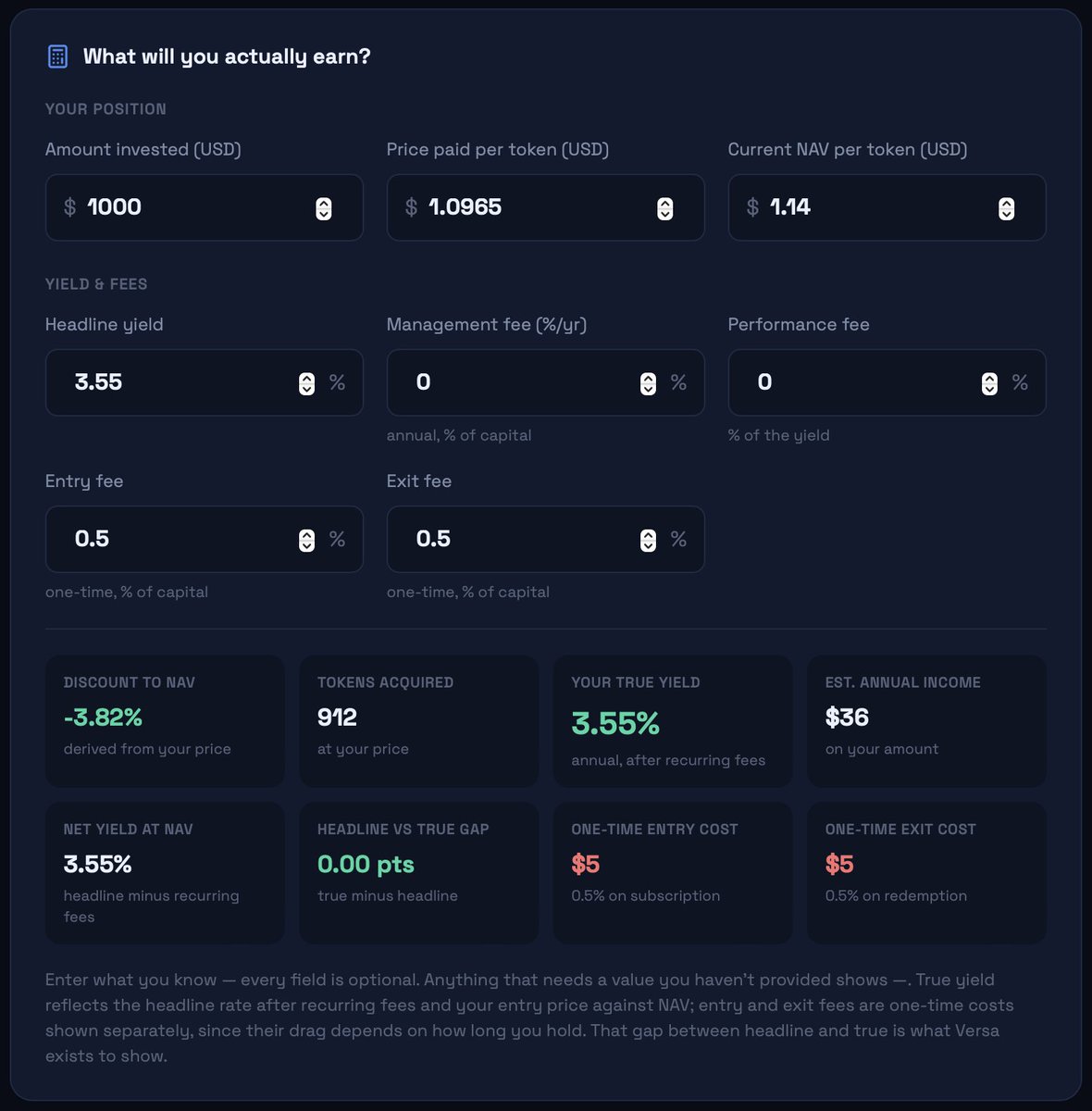
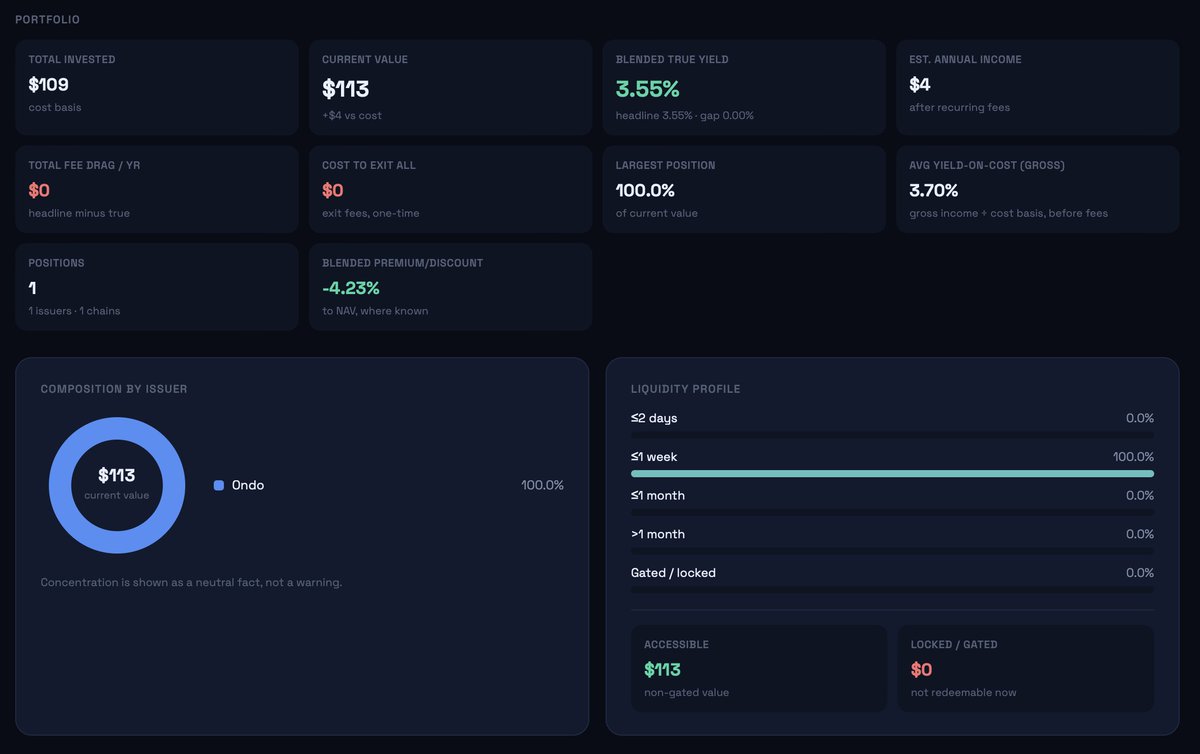
Most people holding tokenized treasuries have no idea what they are ACTUALLY earning💵.
The %yield on the label is not what lands in the pocket after fees, premium/discount and other assumptions, the real number is often materially lower.
Versa overcomes the problem with two simple tools
- a free TRUE YIELD CALCULATOR📊;
- a PORTFOLIO TRACKER💼.
Enter any tokenized asset's details and see what you actually earn.
No login needed for the free Calculator, login if you want to keep track of your assets in the free Portfolio Tracker (add your positions and it shows true after-fee yield, fee drag, premium/discount to NAV, cost to exit and concentration across everything you hold)
https://t.co/o1U6c3drjA
Feedback welcome, Enjoy!!!🔥
#versa #RWA #tokenization #RWAtokenization #yield
Clean and accurate. Tokenization doesn’t invent new cash flows—it digitizes existing ones with programmable ownership, instant settlement, and global distribution. The upgrade is in efficiency, transparency, and access without removing the underlying economic reality. That’s why serious capital is moving in.
Real estate tokenization could be one of the largest shifts because it directly attacks illiquidity and high minimums—the two biggest barriers in traditional property markets. When fractional ownership becomes composable and transferable onchain, it doesn’t just add liquidity; it redefines who can participate in the asset class that built most generational wealth.
$1.6B TVL across four distinct asset classes on unified, multichain DeFi-native infrastructure shows RWA tokenization has passed the experimentation phase. It’s now about scaling institutional-grade origination and distribution in parallel. The next leap is when these pools start compounding liquidity across chains without silos.
Tokenized S&P 500 exposure with no minimum, no waitlist, and full transferability on a DEX is the clearest proof yet that RWAs are moving from institutional pilots to retail-accessible primitives. When you can swap into diversified equity exposure as easily as swapping stables, the old gatekept financial products lose their moat.
Exactly. Both tokenized money market funds and yield-bearing stablecoins sit on similar short-term government securities, yet one is legally a security (with transfer friction) and the other a payment instrument (no yield in practice). Tokenization is forcing the regulatory line to blur because the underlying rails and format are converging. The winner will be whatever delivers seamless yield + free transferability.
USDS’s rapid growth isn’t just stablecoin momentum—it’s the onramp for stablecoin capital to access tokenized real-world yield at scale. When the fastest-growing dollar in the club starts channeling into RWAs, the distinction between “crypto money” and “real asset cash flow” begins to dissolve.
@Reental_co@aave ReenLever and Versa are solving two different moments in the same holder journey. Borrow against your position if you want to stay exposed. Sell your position if you want a clean exit. Both need to exist for the market to mature properly. Complementary is exactly the right word
@Reental_co@negocios_tv Exactly — functionality is the proof of concept the whole narrative needs. Anyone can describe the problem. The market step happens when there's actual infrastructure to move positions efficiently. That's what we're building.
@BaseHubHB@centrifuge The compliance on the hub, liquidity on the spoke model is smart. The harder version of that problem is secondary liquidity for the spoke tokens themselves — that layer is still open
@OndoFinance $3B locked in. The entry side of tokenized finance is working. The question that gets more interesting at this scale is what happens when even 10% of those holders want out at the same time.
@centrifuge@Blockworks $2.5B in deposits but the exit side of those positions is still mostly informal. The capital is flowing in — the infrastructure to flow it back out is still being built.
@OndoFinance Non-US only is becoming the default structure for anything tokenized that touches equities. The regulatory arbitrage is real and it's shaping where the secondary market builds first.
@blocksquare_io Beyond access is exactly the right frame. The industry spent five years on the entry door. The exit door is still mostly a fire escape.