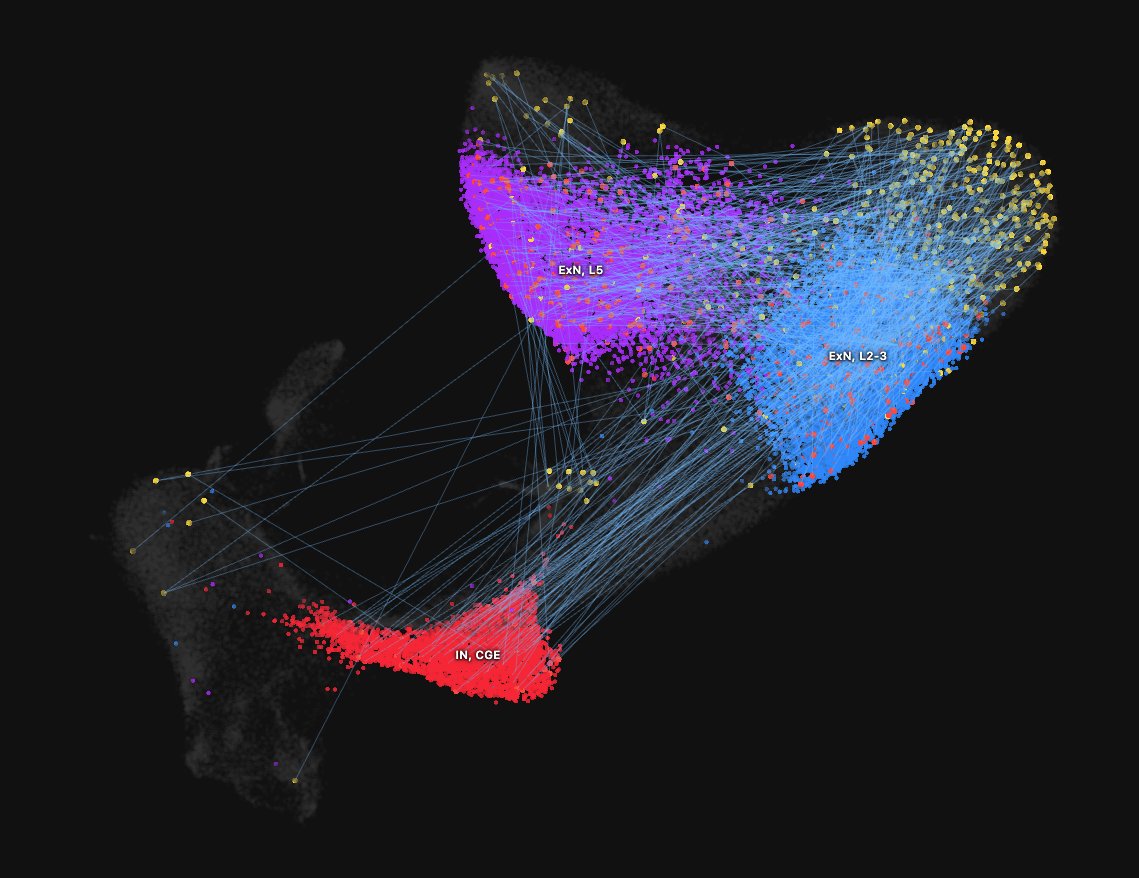
[6/6] I got invaluable help from many colleagues, including @sv_isaev, Michael Zabolocki, Maria Novatchkova and @ChongLi_cl. I’m also grateful to my mentors: Juergen A. Knoblich, Alexander van Oudenaarden, @EddaKlipp, Ursula Kummer, @vmullerHUN and Peter Csermely.
[1/6] Excited to share our work on bioRxiv! https://t.co/eqgEmhSJkW at @Knoblich_lab. This project has been a huge part of my life, through some hard years, so seeing it come together feels special. I’ve long been fascinated by networks—especially the brain.
[5/6] We found those elementary, cell-type-intrinsic wiring rules—and much more: reproducible network assembly, recurrent motifs and molecular signatures of connectivity. In TSC, these rules broke down, shifting networks toward less constrained wiring and altered Ca²⁺ dynamics.
[4/6] Complex structures arise through external instructions (Eiffel Tower) or self-organization (termite hills). How much developing cortical networks rely on self-organization is unclear. Organoids minimize external input and let us ask what rules single neurons follow.
[3/6] COSCO maps single-neuron synaptic connectivity together with transcriptomes using barcodes + sequencing. We recovered >86,000 neurons and >10,000 networks from 50+ human brain organoids across 6 cell lines—giving us the statistical power to find robust patterns.
[2/6] I thought the best way to understand its complexity was bottom-up & population-scale: map single-neuron connections across 1000s of networks, then use machine learning to find rules. Inspired by @TonyZador’s idea, we developed COSCO with @ramsey_najm and Bálint Doleschall.
Paying peer reviewers pays off. I’ve argued this for years, and a well-designed experiment now supports it: much faster reviews and better quality. As with open access, we’ll need to learn how to use the model well – and watch for unintended consequences.
https://t.co/VIDhArRzaL
The #Austrian gov. plans to cut university funding (2028–2030) by ~-6%. Inflation heads to ~+4%. Our world & AT is changing ever faster (technology, society, the planet). To adapt, we need more education & research. #UnisRetten
https://t.co/wNMb3Td677
https://t.co/Y6uf0YLw7t
😶🌫️🤩 It's out!
So happy to share a big piece of my PhD work with the world. 🧩
Using human neural #organoids, we investigated corpus callosum agenesis, a disconnection between the two #brain hemispheres. 🧠
What we found was surprising and exciting... Curious? 📃 👇
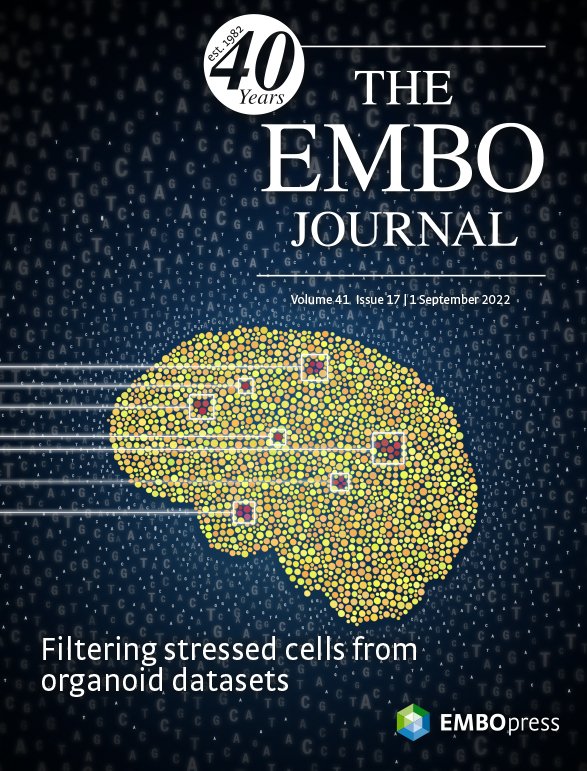
How does in-vitro stress influence #brain#organoids? What cell types are affected, and how can we deal with stressed cells? Our new work now published in @embojournal provides answers! https://t.co/qnWSYj6ytH 1/3
@SciPaulie@Knoblich_lab Thanks, it's online: https://t.co/ueoDXyhpSL (let's say it's in beta :-) )
About mouse: you may need to find the right stress-GO-terms. It is not because of the organism, but the many varieties of stress that exists! Good luck & let me know if u need help!
@alon_douek@Knoblich_lab Thank you! Stress comes in many flavors. If it's exactly the same, it will catch them. Also, you can change the GO-terms & gene-sets to isolate a disease phenotype, we did a similar step in Fig.EV3, by 'unselecting' a secretory cell type with high physiological ER-stress.