An Indian engineer in Bengaluru got tired of potholes destroying his car.
So he built an app with Codex that detects them, finds who is responsible, and files a complaint.
Here is how it works. He installed a dashcam with GPS and an accelerometer. The app records everything while he drives.
A vision model classifies every pothole by size. Small, medium, large.
But here is the clever part. Most Indian roads are under warranty.
The contractor who built them is legally responsible for fixing potholes for free.
His app searches through 2,900 government contracts, finds the exact tender number, identifies the officer responsible, attaches the photo and geolocation, and generates a ready-to-file complaint.
One drive to work. 12 potholes detected. 12 complaints ready.
--
vc: @gkcs_
🚨INDIAN GARMENT WORKERS WERE TOLD THE CAMERAS ON THEIR HEADS WOULD GET THEM A PAY RISE.
THEY WERE ACTUALLY TRAINING THE ROBOTS BUILT TO REPLACE THEM. THEY WERE PAID IN WARM MANGO JUICE.
The pitch from HR was that clients would finally see the quality of the stitching coming off the floor. More orders would follow. Better pay for everyone. So wear the headset.
That floor belongs to Pearl Global, a multinational with more than 30,000 workers across India, Bangladesh, Vietnam, Indonesia and Guatemala. It stitches for Zara, Ralph Lauren, Gap and Primark. The tailors wearing the cameras were earning 15,108 rupees a month, around £115.
Nobody on the floor believed the story about the orders.
So a young tailor named Ankush Yadav and a few friends took one of the cameras, pried it open, pulled the memory card out and put it in a phone.
It was full of three-minute clips recording on a loop. Their hands, their work, every word they said to each other across a full shift. "After every three minutes, it would record afresh," Yadav said.
A team of six to ten young men and women arrived around 9am, split up across five floors and handed headsets to the tailors, the helpers, the people who cut threads and pack garments. At 5:30pm they collected everything and left.
The headsets belonged to https://t.co/jhqg5R0eRS, started in January 2026 by two Indian teenagers living abroad, one of them a dropout from an American engineering course. Two months later they sold it to Build AI, a Delaware company run by a 19-year-old and a 21-year-old that calls itself the largest egocentric data collection effort in history.
The deal they offered factory owners explains why any of this worked.
Let us record your workers, and you get free AI efficiency reports on them.
A sample report found 51% of idle time was socialising. It named the worker everyone kept drifting toward and the exact half hour of the afternoon they did it.
The same pitch deck said workers opt in voluntarily and can withdraw at any time.
openDemocracy spoke to 20 workers across two factories. Not one had been told what the footage was for. They asked. Their supervisors didn't know either. HR had been handed a line about "output and time calculation" and were repeating it.
Veena Devi kept taking hers off because it gave her headaches. Her supervisor kept telling her to put it back on.
For handing over skills built across years of work, everyone got a warm tetrapak of Mango Frooti.
That was when the workers stopped cooperating.
They began removing the headsets and putting them back on, over and over, all day, until the footage was too fragmented to analyse. Anyone who took one off for the toilet mostly never put it back. "Not even one worker wore it all eight hours," one manager said.
Two weeks in, it was quietly shelved at both factories.
Robotics labs are projected to spend over $1.5 billion in the next three years buying up to a billion hours of footage of human hands. Almost nothing stands in the way in India. The consent provisions of its data protection law don't come into force until 2027.
Egolab and Build AI did not respond to requests for comment.
One tailor was asked what happens if the machines really do learn to sew.
"I think they are not able to make such machines right now. Or else, they would feel no need for a kaarigar." A skilled craftsman. The first thing they would do, he said, is chase the poor away.
Then he thought about it for a few seconds.
"I believe this might already be happening in China."
A tap in a Ladakh village was left running all winter. If you close it the water inside freezes, and the pipe bursts.
So it dripped all day, and the water pooled on the ground and turned into a sheet of ice.
A retired engineer sat in his garden looking at that ice, and worked out how to save the farms of Ladakh.
His name is Chewang Norphel.
He was born in Leh in 1935. He studied science at Amar Singh College in Srinagar and became a civil engineer with the rural development department of Jammu and Kashmir.
He worked there for about 36 years. He built roads, culverts, bridges, buildings and irrigation channels across Ladakh.
Then he retired, and the problem he had watched all his life was still there.
Ladakh gets almost no rain. It is a cold desert. Farming there depends entirely on water from melting glaciers.
The trouble is timing. The real glaciers sit very high up, so they only start melting properly in June and July. But a farmer has to sow in April. So the water arrives 2 months after it is needed, and then arrives in a rush nobody can use.
On top of that, the glaciers are shrinking. He has said the Stok glacier once covered half the mountain range he could see from his village. Now it is a thin cap at the top.
His idea came from the leaking tap.
If dripping water freezes into ice on its own, then water can be made to freeze on purpose, in a chosen place.
So he took the stream water that runs to waste in autumn and diverted it into a shaded side valley. He slowed it down with small check walls so it spread thin instead of rushing. Through winter it froze, layer on layer, into a sheet of ice.
The crucial part is where he built them. He put them low down the mountain, much lower than the natural glaciers. Lower means warmer, and warmer means it melts earlier.
So the water comes down in April, when the sowing happens.
He built about 15 of them. The biggest, at Phuktsey, is 1,000 feet long, 150 feet wide and 4 feet deep. It supplies water to a village of 700 people. It cost about 90,000 rupees.
Villagers carried the stone and cement up those slopes on their own backs to help build them.
Some villages that could grow 1 crop a year now grow 2. Potatoes and peas grow where they could not before, and those sell for more than barley. Young people who would have left for the cities have a reason to stay on the land.
He got the Padma Shri in 2015.
He has made one comparison more than once. India spends crores of rupees every day maintaining troops on the Siachen glacier. One day of that money, he says, could build 50 glaciers for the people of Ladakh.
UP: चावल में रंग मिलाकर नकली हल्दी बनायी जा रही है। पूरी छापामारी में असली हल्दी का एक टुकड़ा भी नहीं मिला है।
कानपुर में पीतांबरा इंटरप्राइजेज नाम की मसाला फैक्ट्री पर खाद्य विभाग ने छापा मारा। वहाँ चावल के टुकड़ों में हल्दी जैसा रंग मिलाकर नकली हल्दी पाउडर तैयार किया जा रहा था। 77 बोरी चावल के टुकड़े, 42 बोरी नकली हल्दी पाउडर, मिर्च-धनिया पाउडर और लिक्विड कलर मिला। पकड़े गए माल की कीमत 5.86 लाख रुपये बताई जा रही है।
गुजरात में नकली देशी घी की बड़ी फैक्ट्री पकड़ी गई है। 30 हजार लीटर नकली देशी घी भी मिला है। इस कंपनी में पॉमोलिन ऑयल में कैमिकल मिलाकर देशी घी बनाया जाता था और उसमें एक भी बूंद शुद्ध देशी घी नहीं होता था। पचास हजार लीटर घी बनाने वाला चाइनीज कैमिकल भी पकड़ा है।
इस केमिकल से बनाए घी कि शुद्धता को खाद्य विभाग की जनरल मशीन भी नहीं बता पाती थी। FDA डिपार्टमेंट के लोग ख़ुद इस बात से ��ैरान थे।गुजरात के अलावा पंजाब, राजस्थान, महाराष्ट्र जैसे कई राज्यों में इस नक़ली घी की सप्लाई अलग-अलग ब्रांड के नाम से होती थी।
Front-of-pack label(FOPL) warnings are the simplest and most effective way to help people make better food choices in India.
A clear “High in Sugar” or “High in Salt” or "High in Fat" warning takes seconds to understand. No calculations. No nutrition knowledge. Just a simple signal that says, “Think twice.”
The problem with systems like Nutri-Score or Health Star Ratings is that they average everything into one score. A product loaded with sugar can still look “healthy” because it has added protein, fiber, or vitamins.
That’s where warning labels are different.
A sugary breakfast cereal still gets HIGH IN SUGAR, even if fibre and vitamins are added to it.
An instant noodle high in sodium still gets HIGH IN SODIUM even if protein and vitamins are added to it.
A packaged fruit juice with excessive free sugars still gets HIGH IN SUGAR, though it's directly from the fruit.
The unhealthy ingredient isn’t hidden behind a better-looking overall FOPL warnings are used.
For a country as diverse as India, warning labels also work across languages and literacy levels. A bold symbol is easier to recognize than interpreting letters, colors, or star ratings.
Sometimes, the simplest system is the one people actually use.
Please tag @fssaiindia and @MoHFW_INDIA and ask that FOPL warnings be implemented with urgency!
#Diabetes #Obesity #Hypertension #FOPLwarnings #Nutriscore #HealthStarRating
Industrial marvel for economies of scale.✅
Total dharti ka bojh. ✅
All of this is ending up in landfills and subsequently our bodies.
Innovation is awesome. So is mindfulness. A combination of the 2 is what is needed.
I ran across this video a few days ago and couldn’t stop watching it.
It’s about something ordinary & boring, a plastic gas lighter. But it changes how one thinks about manufacturing.
That lighter in so many of our homes, holds pressurised gas. It has over 30 microscopic parts, has to pass international safety codes, & travel 10,000 miles by sea, & the total cost of doing all that, materials, labour, freight, every middleman along the way, comes to fifteen U.S cents.
So how does anyone make money on this?
Turns out almost the entire world’s supply comes from one place: a county called Shaodong, in China’s Hunan province.
It wasn’t always there.
But today, Shaodong has 114 lighter-related companies packed into the place & between them they source more than 200 different components from each other, all within a 20-kilometre radius. They supply something like seventy percent of the world’s disposable lighters. And the industry alone employs over 80,000 people locally.
Nobody there is winning on cheap labour anymore. They’re winning by shaving a thousandth of a cent off the thickness of a plastic wall, or redesigning a base so a few thousand more units fit into the same shipping container.
It took my thoughts back to an old professor of mine, Michael Porter.
His 1980 book, Competitive Strategy, is still the 1st book most MBAs read, the one that gave the world the Five Forces and basically invented modern strategic thinking.
But there’s a quieter piece of his work, on industrial clusters, that never got nearly the same attention, and it is the one that explains exactly what is happening in Shaodong.
His argument was that nations and regions rarely win because of cheap inputs. They win when rival firms and specialist suppliers crowd into the same small geography for long enough that they keep pushing each other past what any one of them could manage alone. He found it in the Swiss watchmaking towns of the Jura, in the German printing press industry and in Italy’s ceramic tile and footwear districts (interestingly, it’s the SAME blueprint which built Morbi, in Gujarat, into the world’s second-largest ceramic cluster, now outproducing Italy by volume. I have posted before, about Morbi)
None of these started out as giants. The neighbourhood made them giants.
Which is exactly why it’s so relevant to India’s climb up the global manufacturing table
I’ve also attached a slide with this post that I saw recently and which shows us breaking into the top 5 manufacturing globally. (A quick reference check told me that we may not have overtaken Korea yet, but the trajectory’s clear)
That climb has happened on the back of scale: bigger plants, bigger parks, more FDI.
I should declare an interest here, because the Mahindra Group set up 2 of India’s first integrated, plug-and-play business cities, in Chennai in 2002 & Jaipur in 2006.
Both have been extremely successful. Chennai’s business zone alone today employs 45,000 people..
But I admit that we need to think differently.
A park brings in investors and hands them a ready plot, power, water & roads
A cluster is a completely different animal: hundreds of small, specialised suppliers, each obsessed with doing a tiny thing better than anyone else, feeding off each other’s presence for years until no outsider can compete with the whole.
I think that’s the work ahead of us now.
Not just more factories, and not just more parks.
Policymakers & developers like us need to start consciously pulling as many of the inputs and resources a sector needs, the toolmakers, the component suppliers, the testing labs, the logistics specialists, into the same neighbourhood.
Shaodong and Morbi both got there by accident, one town stumbling onto a way to shave a thousandth of a cent off a lighter wall, the other discovering it had the clay and, later, the gas pipeline for tiles.
We don’t have the luxury of waiting for accidents anymore.
We need to do it on purpose
@anandmahindra@manoj_naandi Industrial marvel for economies of scale.✅
Total dharti ka bojh. ✅
All of this is ending up in landfills and subsequently our bodies.
The combination of materials used and cost of separating out to find recyclable bits costs more than dumping it because of how cheap it is.
#HyderabadRains
Rain of 4cms in this season, City is on the knees . Unplanned growth + removal of FSI and concentration of companies at just west of Hyderabad. In this same area recently one acre of Govt land was sold for 240 Crores
1987. A room in New Delhi is thick with the smell of old files & cold tea. The United States has just delivered a stinging slap to the face of the Indian Republic. They have officially refused to sell India the 'Cray X-MP' Supercomputer, the most powerful machine on Earth, claiming that India would use it for nuclear weapons.
The American officials mockingly suggest that India does not even have the electricity to keep such a machine running. In the middle of this national humiliation, a young, soft-spoken engineer named Vijay Bhatkar is asked by then Prime Minister Rajiv Gandhi: "Can we build our own?" Bhatkar does not hesitate. He looks at the No of the West & says: "We will not just build it; we will build it faster than you can ship it."
The Americans did not just stop at refusing the sale; they actively lobbied other nations to ensure India remained digitally blind. They believed that w/o their Logic Gates, India would remain a 3rd world backwater.
Bhatkar realized he could not replicate the Single-Processor behemoth of the Cray. Instead, he turned to Parallel Processing. He decided to stitch together 1000s of low-cost, off-the-shelf microprocessors. It was like building a giant's brain out of the neurons of ants.
In 1991, while the West was still celebrating its monopoly, Bhatkar unveiled the PARAM 8000. It was not just a computer; it was a Gigaflop monster.
To prove the PARAM was real, Bhatkar ran a standard global benchmark test. The results were sent to an international conference in Zurich. The PARAM 8000 was ranked as the 2nd most powerful supercomputer in the world, behind only the American machines. But there was a twist: the PARAM cost a fraction of the Cray, performed better in tropical heat, & was built in just 3 years.
When the PARAM 8000 was 1st turned on, the team did not have a high-tech cooling system like the Americans. They used industrial-grade desert coolers & adjusted the airflow manually. It was the ultimate Jugaad that defeated the most sophisticated tech embargo in history.
A major US newspaper ran a story with the headline: "Denied supercomputer, Angry India does it!" The ghost of the Native Engineer had officially entered the silicon temple. Vijay Bhatkar’s history is the story of how India became the IT Capital of the world.
Bhatkar founded the Centre for Development of Advanced Computing (C-DAC). He did not just build a machine; he built an ecosystem. Every software engineer in India today stands on the shoulders of the man who proved we did not need the West's permission to compute. Bhatkar was the 1 who realized that if computers only spoke English, 90% of India would be left behind. He led the development of GIST (Graphics & Intelligence Based Script Technology), allowing computers to work in Indian languages. He gave the Machine a local tongue.
Today, Bhatkar is a Padma Bhushan awardee, but he lives a life of deep spirituality & simplicity. He vanished from the corporate headlines to become a philosopher of the digital age.
The West thought they could freeze India’s future by withholding a single machine. They forgot that the Indian mind does not need a 'Cray' to think; it only needs a 'No' to ignite. Forget building a supercomputer; Bhatkar built a mirror, & for the 1st time, the West had to look into it & see that the primitive colony had become the master of the code.
Cornell University ran a study.
Spent years. Spent money.
Found the number one reason adult children cut off their parents.
They called it "parental enmeshment."
Too much control.
Too little space.
Congratulations, West.
5,000 years late. But welcome.
Your Dadi figured this out before Cornell had a postal address.
In India, we had the Guru-Shishya Parampara.
The Guru did not optimize the Shishya.
He saw a soul.
Not a scorecard.
He guided.
He did not grip.
The joint family was not enmeshment.
It was a civilizational immune system.
Dharma. Artha, Kama. Moksha.
Four goals. One life.
Not one of them asks you to succeed alone.
Now look at the West's report card.
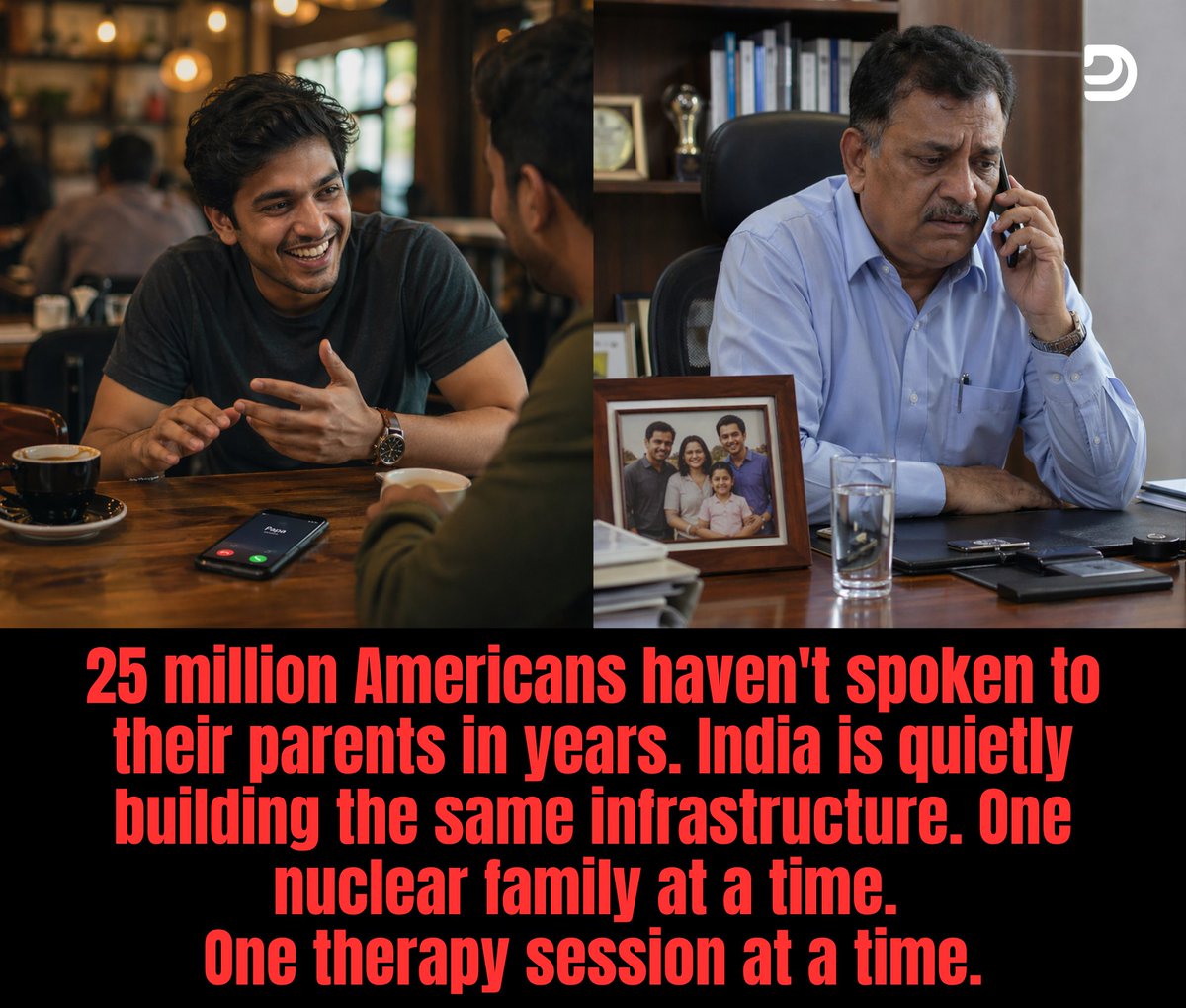
38% of Americans are estranged from family.
25 million people.
No contact with a parent or child.
Average estrangement from a father: 7.9 years.
That is not a social problem.
That is a civilization disaster.
Now look at India's report card.
57% of Indians feel lonely at least sometimes.
24% of youth report loneliness.
Single-person households nearly doubled since 1992.
We looked at their wreckage.
And called it progress.
Wah India Wah!!!
How did we get into this Western Mess?
One man. One document. On record.
Thomas Babington Macaulay.
His stated goal: create Indians who are
"Indian in blood, English in taste, morals, and intellect."
He did not come to educate India.
He came to orphan it.
He replaced the Gurukul with a grading system.
Replaced the joint family with individual ambition.
Replaced Dharma with a performance review.
And it worked.
And then came Hollywood.
The hero always has a abondend father,
or estranged father.
The protagonist is always broken at home.
Rocky.
Batman.
Iron Man.
Spider-Man.
Broken family is not a backstory.
It is a blueprint.
Bollywood followed.
Then OTT finished the job.
Mirzapur.
Sacred Games.
Panchayat even.
Dysfunction is the new normal.
Estrangement is the new character depth.
This is not storytelling.
This is programming.
A Psyop so subtle, so consistent, so total.
That we now feel the hero must be broken to be real.
Today, Indian parents feel guilty for caring too much.
Western therapy says: "You are enmeshed."
Your child's therapist says: "Set boundaries."
Meanwhile, 25 million Westerners haven't spoken to their parents in years.
Whose model is broken?
Our government copies western education templates.
Our urban youth call joint family "toxic."
Our parents apologize for loving with structure.
And somewhere in a Cornell lab.
A researcher is writing a paper.
About what your grandmother already practiced.
We didn't have a parenting problem.
We imported one.
@anandmahindra He was a beautiful beautiful person and authentically humble. An inspiring Vipassana practitioner . Had the good fortune to spend some time with him last year. Blessed.
I am sure he is and is in peace now. 🙏
@reach_anupam Oh lord!! We just texted a couple of weeks ago !! What happened ?! I’m Unable to get through to his family :( first his father. Now him ! May he rest in peace. May he be peaceful happy and liberated.