I'm a theoretical physicist working on quantum gravity, black holes, cosmology & high energy physics. I follow the developments in Astronomy, Math & Physics.
To all those interested in quantum gravity, here is the link to register for the second edition of the online lecture series on the basics of quantum gravity, organized by the International Society for Quantum Gravity. https://t.co/6Uq8Er77Ge
#QuantumGravity#QuantumCosmology
Just heard of the passing away of Prof. Naresh Dadhich, a stalwart of @IUCAApune from its early days. His recent interview published only a few days ago, gives a wonderful first person account of his remarkable life in science. Om Shanti. https://t.co/c1MfjmIDqi
My first ever research project was with Naresh Dadhich at IUCAA in the summer of 2003. He introduced me to General Relativity and asked me to reproduce some calculations in Chandasekhar's Mathematical Theory of Black Holes.
Deeply saddened by the news of
the passing of Prof Naresh Dadhich,
former Director of IUCAA 😔 He was a colleague, friend and guide who continued to inspire many of us. Will miss the discussions with him everyday 🙏🏻
LIGO–Virgo–KAGRA just announced plans for a new 6-month observing run starting late summer/early fall 2026. O4 wraps up this November, then upgrades begin. If all goes according to plan (!), we’ll be back to catching spacetime ripples in 2026–27 https://t.co/cozx8F524k
The passing of the physicist Chen-Ning Yang (https://t.co/FaQoCrNSOD) saddens me. He has been a long-time hero and role model for me. Below is a short essay I wrote yesterday about Yang that I shared with many of my friends. I translated it into English using Gemini:
```
The passing of Professor Chen-Ning Yang has left me with an inexplicable sense of loss, a feeling that a familiar era is slowly coming to an end. When Kolmogorov passed away in 1987, Kiyosi Itô wrote in his eulogy, "When I learned that the great Soviet mathematician Kolmogorov had left this world, I felt a sadness and loneliness as if I had lost a pillar of support." My relationship with Professor Yang was certainly not as direct as Itô's with Kolmogorov, but his influence, transmitted through his books, articles, and recorded lectures, profoundly changed the course of my life.
When I first came to the U.S., I would often introduce myself in the physics department by saying, "Yang from Yang-Mills." Later, when I was struggling to choose between physics and mathematics, I came across an interview with Yang and Jim Simons where he said two things that stuck with me (Figure 1): "Mathematics is precise, but there is no flesh to it," and "There are two kinds of books in math. The first one you read the first page and you stop reading. The second one that you read the first sentence and stop reading." Those words resonated with me so deeply that I decisively gave up on mathematics. This choice filled my university life with many more interesting physics pictures, making it much more vivid.
Later, as I contemplated my future path, I read online about Yang's famous advice against going into particle physics ("the party is over"). He remarked, "When I compare people who entered graduate school in the same year, I find that they all started in more or less the same state, but their developments ten years later were vastly different. This wasn't because some were smarter or more diligent than others, but because some had entered fields with growth potential, while others had entered fields that were already in decline, or even at their very end." This deeply struck me. Indeed, gauge theory is a more vital direction than particle physics because it naturally builds connections with many different disciplines. Inspired by this, I began to seriously ask myself: what is the "gauge theory" of our time? That's what led me to start researching neural networks in my junior year.
As I gained more experience in research, I found numerous inspirations in Yang's annotated collection, "Sixty Years of My Career Path." Right now, this book is on my bedside table. What resonated with me most was his note on his paper about the two-dimensional Ising Model (Figure 2): "In the spring of 1951, Oppenheimer showed me a preprint he had just received. For this, I carried out a very long calculation, the longest of my life. The calculation was tortuous, full of obstacles at every turn, requiring many strategies and tricks to solve. Often, after days of intense thought, I would suddenly discover a new technique, a new path would appear. The trouble was that I would soon feel lost in a maze again, unable to be sure if I was any closer to the goal than when I started." Yang's description here was so relatable that later, whenever my research stalled, I would share this quote with my collaborators to encourage everyone. I often found myself translating this passage into English for them.
As I spent more time living in the United States, I inevitably encountered some prejudice and discrimination against Chinese people. This reminded me of a story I had read about Yang from 1954. By then, he had already secured a tenured position at Princeton and was only three years away from winning the Nobel Prize. Yet, a real estate agent refused to sell him a house simply because he was Chinese, fearing that his presence would lower property values in the area. Even a man of Yang's stature could not escape such baseless and absurd prejudice. Later, while working at Google's New York office, I made a memorable trip to Long Island to visit the area where he used to live. This brought to mind his speech at the Nobel banquet in 1957: "I am in more than one sense a product of both the Chinese and Western cultures, in harmony and in conflict. I should like to say that I am as proud of my Chinese heritage and background as I am devoted to modern science, a part of human civilization of Western origin."
And now, life has come full circle. This semester, I've begun studying the derivation of the mass gap in three-dimensional Euclidean Yang-Mills theory (Figure 3) to fulfill my last graduation requirement. A familiar and friendly intuition returns. Although Professor Yang has passed away, his work, his ideas, and his intuition have been distilled across the entire internet. I randomly sampled 10B tokens from the DCLM dataset and found 1392 documents containing variations of his name in English and Chinese (Figure 4). His thoughts have genuinely become a part of humanity's collective knowledge. Finally, in his outlook on physics, Yang cautioned against the optimism that "the power of human intellect is infinite, while the depth of natural phenomena is finite". In this unique era of artificial intelligence development, this sixty-year-old debate seems particularly interesting.
```
Parity violation is one of the most surprising discoveries in modern physics — that nature is not perfectly symmetrical between left and right when it comes to certain fundamental forces. To understand what this means, imagine watching an event in a mirror: if the physical laws of the universe treat both versions equally, then those laws are said to conserve parity. For most interactions, such as gravity and electromagnetism, this is true — their mirror images behave exactly as expected. But in the mid-20th century, a deep mystery arose regarding the weak nuclear force, the force responsible for processes like beta decay (where a neutron transforms into a proton, emitting an electron and a neutrino). Experimental data hinted at inconsistencies that couldn’t be explained if parity symmetry held true.
By 1956, Chen-Ning Yang and Tsung-Dao Lee carefully examined all available experimental evidence concerning weak interactions. To their surprise, they realized that physicists had never actually tested whether parity was conserved in weak nuclear processes. Up to that point, parity conservation was simply assumed, based on its success in other forces. Yang and Lee proposed a daring idea — that perhaps parity symmetry was violated by the weak interaction, meaning that nature could distinguish between left-handed and right-handed coordinate systems. This was a bold and counterintuitive suggestion at the time, as symmetry principles were deeply ingrained in physics and regarded as universal.
Yang and Lee didn’t stop at proposing the idea — they outlined a series of concrete experimental tests to verify it. One of these involved studying the beta decay of cobalt-60 nuclei. They predicted that if parity were violated, the emitted electrons would preferentially move in a direction related to the spin orientation of the cobalt nuclei, showing a clear left–right asymmetry. They shared this proposal with Chien-Shiung Wu, an experimental physicist with deep expertise in low-temperature nuclear measurements. Wu and her collaborators at the National Bureau of Standards performed the experiment in late 1956 under extreme cryogenic conditions. When the results came in, they were astonishing: electrons were indeed emitted more in one direction than the other relative to the nucleus’s spin. This asymmetry meant that mirror symmetry failed in nature — the universe does distinguish between left and right.
The confirmation of parity violation shattered one of the most fundamental assumptions in physics. It forced a complete reformulation of the weak interaction theory and reshaped the framework of particle physics. It also laid the foundation for the V–A (vector minus axial vector) theory of weak interactions, which later became an essential part of the electroweak theory unifying electromagnetic and weak forces. The discovery was so profound that Yang and Lee were awarded the 1957 Nobel Prize in Physics, only a year after their paper.
Recently Chen Ning Yang passed away at the age of 103. Photographed here is Yang and Richard Feynman in the 1950s.
Aside from Yang-Mills theory and parity nonconservation, Yang made so many profound contributions to physics! One that deeply impressed me as I was starting grad school: a 1975 paper with T. T. Wu highlighting the role of fiber bundles in gauge theory.
https://t.co/kKP738L2sy
The Office of @PrinSciAdvGoI remembers astrophysicist Prof. Meghnad Saha on his birth anniversary.
His most celebrated work is the Ionisation Equation, also known as the ‘Saha Equation’, a breakthrough that links the colours and spectra of stars to their internal temperature and pressure. The equation allows astronomers to determine a star's temperature and chemical composition by studying its light.
“In the shadow of the Earth, the Moon blushed red..a silent reminder of the cosmic dance above” 🥰👌. Lunar eclipse 2025 of 7 Sept,2025.
-Dr.Shanti Priya, Dept. of Astronomy, Osmania University. @osmania1917@asipoec@IIABengaluru@IAU_org@IUCAAScipop
Today is July 29. #OTD in 1898 physicist Isidor Rabi was born. He received the @NobelPrize in Physics in 1944 "for his resonance method for recording the magnetic properties of atomic nuclei". Also one of the 1st to work on the cavity magnetron, used in radar and microwave ovens.
I had a wonderful week with Subir Sarkar, with a bit of adventure. Learned a lot of cosmology and life. Subir is full of wisdom, not just great physics.
The paper is out here: https://t.co/MZ4pcUiHkj
Of personal interest: the full range of neutrino masses allowed by neutrino oscillations are now excluded at 98% confidence.
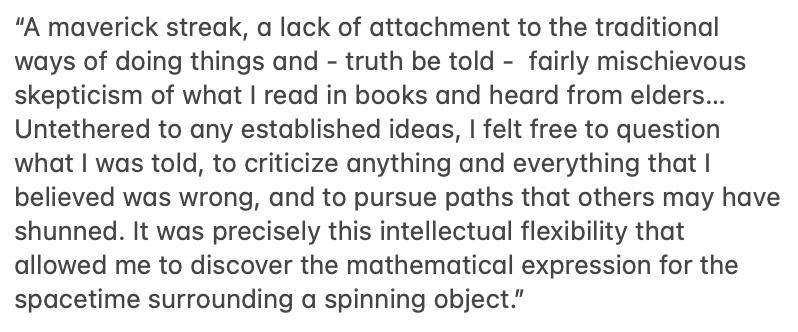
This is wonderful: Roy Kerr who discovered an exact solution to Einstein's field equations for spinning black holes - a solution that Subrahmanyan Chandrasekhar called "shuddering before the beautiful" - attributes his success (where others had failed) to his maverick approach.
The Indian astronomy community mourns the passing of Prof. J.V. Narlikar, a luminary in astrophysics & cosmology, institution builder, science communicator par excellence. His founding of IUCAA & efforts to promote astronomy in universities transformed Indian science.
@IUCAAstro
Dr Jayant Vishnu Narlikar is no more.
A celestial flame has dimmed on Earth, only to shine brighter among the stars he once deciphered.
I begin my tribute to recalling the blessings that I received from Mrs Taratai Bole, when I returned to India 50 years ago.
She said, “You should aspire to become Jayant Narlikar. That is the ultimate you can reach”
That is the respect Jayant holds even today after 50 years - as a pioneering astrophysicist, who challenged the prevailing Big Bang theory.
A great institution builder @IUCAAstro
But above all, one of world’s greatest science communicators, making complex scientific concepts accessible to the general public, inspiring countless individuals to explore the wonders of the universe.
I have watched Jayant beyond as a scientist and science communicator.
Both Jayant and I were members of the very first Science Advisory Committee to the Prime Minister during mid 1980s. I was also a member of the Governing council of IUAACA for a number of years.
His penchant for excellence, his vision beyond the visible - and may I say- his infinite calm & patience - were incredible.
We were very very close friends. I do not remember Mangala and him missing a single Ganeshotsav celebration at our home for decades.
Never realised that what you see below 👇will be their last visit to us.
Mangala (2023) left us and within 2 years, Jayant has joined he’s now.
Two hearts that beat as one on Earth are now reunited in heaven, forever together in peace.
My respectful Pranams to them. May you enjoy the eternal peace - and together.
🙏🙏🙏
The passing of Dr. Jayant Narlikar is a monumental loss to the scientific community. He was a luminary, especially in the field of astrophysics. His pioneering works, especially key theoretical frameworks will be valued by generations of researchers. He made a mark as an institution builder, grooming centres of learning and innovation for young minds. His writings have also gone a long way in making science accessible to common citizens. Condolences to his family and friends in this hour of grief. Om Shanti.