You've tried gurus and signal groups. ⛔️
Now try a plan that actually works ✅
Trade with clarity. Trade with VICI.
https://t.co/rUyQp0db4r
#ES_F $SPX $SPY #DayTrading
🚨 NEW: The SPX Brief is LIVE 🚨
Your morning edge on the S&P 500 — before the bell.
✅ Daily/Weekly/Monthly Key Levels
✅ TWAP Scanner
✅ Pattern Intelligence (150+ indicators)
✅ Bull/Bear sentiment
✅ Top 5 market headlines by 4 AM
FREE for Charter Readers 👇
https://t.co/PREGV0z7et
#ES_F #DayTrading #SNPEdge
A 2.68 Sharpe, 186% backtested return, and live results since April 1 — how VICI’s first automated ES futures system actually works.
#ES_F#DayTrading#Trading
https://t.co/7zLVyGVQnZ
CPI days have a way of messing with even the most seasoned traders. This last release was no exception—headline inflation surprised to the upside, shelter and energy driving over 60% of the move. S&P futures snapped in seconds. Been there... caught deer-in-headlights as positions whip, and the urge to make it back kicks in.
Here’s the thing: these macro event spikes are tailor-made for revenge trading. All that volatility shoves FOMO into overdrive, especially in futures or crypto where reversals can erase gains in minutes. I’ve seen disciplined gameplans get shredded right after the number drops—usually not by bad setup, but by bad reactions.
A couple impacts I’ve noticed over the years:
- 📈 Fast swings lure you into thinking every tick is opportunity—when it’s actually heightened risk.
- FOMC, CPI, NFP—it’s always the same story: if your process depends on predicting the print, you’re guessing, not trading.
- Energy shocks (like that latest +2.3% jump) throw an extra layer of chaos, and most aren’t ready for how that tilts the macro picture.
What shifted things for me was routine. Pre-set rules for news sessions: scale size down, define a loss cap, and—most importantly—walk away if I’m tilted after a volatile open. If you’re new, one of the toughest lessons is learning that some sessions are made for defense, not attack.
My suggestion: Don’t chase the afterglow or try to “get it back” in the post-CPI chop. Instead, lock down your own triggers—set a session stop, simplify your playbook, and treat event days as survival, not hero-making.
Markets always give another chance if you protect your capital and your mindset. That’s the real edge—being prepared before, and disciplined after.
If this strikes a chord, maybe it’s time to rethink how you handle high-volatility data. #TradingInsights #Futures #CPI #VICIInsights
Stubborn core inflation isn’t just a headline—it's a daily reality for anyone trading in today's markets. Watching February’s Core CPI tick up 0.4%, with shelter and services both stubbornly above 4%, I can feel the weight every time the Fed pushes back on rate-cut expectations.
This limbo isn’t just an economic trend. It reshapes our risk:
- Forces carry traders to rethink which forex pairs are worth holding overnight
- Throws a wrench into duration bets on Treasuries futures
- Leaves new traders second-guessing every hint and nuance in FOMC statements
It messes with our heads, too. Uncertainty grows. Confidence wobbles. You start chasing clarity in every Fed headline—often at the expense of your own process.
If you’re feeling this, you’re not alone. I started journaling every time I found myself overreacting to Fed talk—just to document my own biases. It’s been humbling, but it helps:
- Spot emotional triggers before they become costly mistakes
- Slow down and separate signal from noise—especially during market chop
- Refocus on what I can actually control: my position sizing, my risk, my patience
Seasoned traders are already rotating into short-end yield curve steepeners and adapting to the new normal. The lesson? When macro trends feel untradeable, your personal discipline becomes your real edge.
How are you adapting your strategy with inflation sticking around? Share your take—there’s value in honest discussion right now.
#TradingInsights #MacroTrends #TeamVICI #FedWatch
Most people don't fail at trading.
They fail at committing to it. 💯
Taking a few trades isn't being a trader. YouTube at 2 AM isn't studying the craft.
Being a trader is a decision you make once — and then prove every single day.
The market rewards identity, not interest. 🔥
#DayTrading #ES_F
Markets don’t hand out second chances when you ignore a hot CPI print—especially one like February’s. 0.4% monthly might sound ordinary until you look under the hood: energy up big, gasoline leading, shelter costs relentless. Year-over-year headline CPI just ticked up to 3.2%, erasing weeks of “disinflation” hope in a single release.
This is how a war-fueled energy jolt ripples through everything—FOMC dovish bets instantly repriced, and the floor dropped out from under risk assets. It’s not just about lost opportunity; it’s about whipsaw moves that can knock the wind out of even seasoned traders. Scott Anderson said it best—the economy’s “swerving,” and that means capital is, too.
What to actually do with this? Two things jump out from experience.
- If you’re trying to front-run moves before CPI, don’t cling to the tape when the number prints—the fade is real, and post-report flushes trap late chasers every time.
- If you’re newer, set your stops even tighter. CPI whipsaws aren’t about precision, they’re about survival. There’s no shame getting clipped when the market is trading on headline risk, not logic.
Every inflation surprise is a lesson in humility. I’ve been on both sides—holding too long, overestimating the Fed, thinking volatility would stall. Now, I watch for the traps and play defense first. Chasing narratives rarely pays in these conditions. Instead, focus on risk controls and process—not just the potential for reward.
Markets evolve. Traders should too. Stay sharp out there.
#CPIWatch #MacroTrading #RiskManagement #VICIInsights
When VLCC and suezmax charter rates explode like we just saw—$423K+ for VLCCs, Suezmax to Med spiking 3x in a weekend—it’s not just noise on the margin. That kind of move is the market screaming “physical oil stress,” long before futures catch the scent. Forget waiting for spot Brent to react; freight futures are flashing the supply squeeze as tankers queue up, dark fleet risks snowball, and the Hormuz chokepoint turns into a geopolitical minefield.
The lesson here? Freight isn’t just cost—it’s alpha, it’s positioning, it’s early intel in a tightening market. Over years chasing oil & shipping spreads, I’ve seen how charter curves can break from crude prices when infrastructure snaps or war insurance (P&I) pulls out, like we’re seeing now. Everyone talks oil volatility, but the real tell is when you can arb the freight-oil spread and see convexity coming—a veteran’s edge in front of major price surges.
How do you use this? If you’re newer, watch the Baltic Dirty Tanker Index like a hawk, and don’t let “cheap” oil tempt you into knife-catching until bottlenecks clear. Let the freight market be your stress gauge—even when headlines miss the story. For experienced hands, lean into freight spreads and volatility before the crowd catches on; it’s not always about the price, but the flow. Take care of your risk—the last place you want to be early is in a bottlenecked market when insurance dries up and exits close fast.
Markets won’t warn you twice. Stay sharp, trust what the flows are showin’ you, and keep your risk moves ahead of the pack.
#VICIInsights #TradingInsights #OilMarkets #FreightFutures
Geopolitical risk isn’t theory—it’s suddenly the only thing that matters when chokepoints like the Strait of Hormuz go down. I’ve seen wild oil spikes before, but when tanker traffic drops from 138 ships a day to almost zero (and VLCC charters triple), you realize how quickly the "rules" of market structure can evaporate.
When you get war risk insurance pulled and alternate supply lines hit overnight, every position sizing rule I learned was stress-tested. I’ve had trades blow through stop-losses in this kind of chaos—no textbook prepares you for a single node rerouting 20% of global oil.
The market right now: huge volatility, limited liquidity, and emotional headlines everywhere. That’s where even seasoned traders can slip—either by freezing up or chasing every headline spike. Here’s what’s worked (and what I’ve learned from scars, not just theory):
- Geopolitical overlays HAVE to become part of your risk model, not just an afterthought.
- Scaling into options spreads has helped me hedge asymmetrically without risking the blowup you get from naked futures.
- If you’re newer, this is not the time to “learn on the job” with size—tighten stops on oil ETFs and accept you’ll miss some rallies, but you’ll sleep at night.
Experience teaches humility when market structure melts down. Smart money right now adapts, sizes down, and asks, “How could this go even more wrong?” before looking for that next edge.
If you think it can’t get wilder, remember—when a single chokepoint fails, the old playbook is gone. New rules get written in real time.
You don’t need to predict every move—just survive the volatility, so you’re around for the next regime. Stay nimble, size honestly, and let your process—not your gut—guide decisions. If this resonates, it’s time to rethink how you manage geopolitical risk.
#OilMarkets #TradingInsights #StraitOfHormuz #VICIInsights
Fear can hijack your trading decisions faster than any chart pattern. The latest Iran strikes were a textbook case—tech dips sparked instant bargain hunting, while defense stocks rallied as everyone scrambled back to their comfort zones. Suddenly, fundamentals took a back seat to emotion. I watched airline names get crushed, while “safe” favorites barely flinched. S&P 500 ended nearly flat, the Dow dipped, and Nasdaq crept up thanks to dip-buyers—meanwhile, global markets tanked on oil anxiety.
But here’s what really stands out: when the headlines get scary, even veteran traders find themselves clinging to familiar sectors or names. That comfort-seeking bias? It’s not just a beginner trap. It’s one of the main reasons promising setups get ignored, or positions get cut for the wrong reasons.
- Pushes traders into herd moves—justifying exits because “everyone else feels it too”
- Makes us blind to real edge, in favor of past winners
- Erodes discipline and clouds decision-making, especially in mixed markets
What helps me navigate these moments isn’t just reading news or technicals—it’s journaling. Writing down WHY I’m tempted to deviate, or what feels “safe” during the chaos, often flags emotional trades before they happen. Pro traders lean on these notes to spot contrarian opportunities. For newer traders, the key is using a checklist: “Did this fit my plan, or am I chasing comfort?”
Turning emotional triggers into data—that’s where the edge is. What felt like panic yesterday often becomes clarity after the fact. The more honest we get with ourselves, the fewer times we repeat the same mistakes.
Have you noticed your own comfort biases lately? How do you stay objective during volatility?
#TradingPsychology #MarketMindset #VICIInsights #FuturesTrading
There are moments when you realize how little control you really have—like the spring when oil gapped up overnight on Iran headlines, and I found myself short gas refiners into the open. It was one of those trades where the market forces you to stare risk straight in the face. That gut-punch—from sudden price spikes and the scramble for hedges—reminded me: volatility punishes hesitation, but also exposes fragile strategies.
Here’s what I keep seeing: the world treats energy shocks as headlines, but for us, it’s daily reality. A prolonged Iran conflict could block 20-30% of global seaborne oil, meaning oil over $100 isn’t just theory—it’s an asymmetric risk. Short-term, tankers and refiners might fly. But drag it out? Even strong economies could buckle under runaway costs and inflation, while the Fed stares at an impossible job.
If you’re trading this, don’t just chase spikes—respect the tail risk.
- Professionals: hedge inflation risk with energy futures or quality equities outside the direct blast radius (think Brazil, lithium, niche plays).
- If you’re still learning: embrace scenario-planning. Map out both the “fast spike” and “prolonged squeeze” and ask—what survives if the black swan refuses to leave? Build strategies that don’t assume calm seas.
You learn the hard way that true edge isn’t prediction—it’s resilience. Every war headline is a test. Prepare accordingly, and keep your risk honest. #VICIInsights #TradingInsights #Macro #OilMarkets
Every time a geopolitical conflict erupts, it reorders the market’s priorities overnight. This week was a perfect example: U.S. and Israeli strikes on Iran didn’t just make headlines—they triggered an instant, aggressive sector rotation. Defense stocks (LMT up 6%) and energy names surged as oil spiked 6% on fear and supply risk. Meanwhile, anything sensitive to fuel costs—airlines, travel, consumer discretionary—took a hard hit.
If you’ve traded through a few of these “headline-driven” moments, you know how quickly the market can punish anyone stuck holding yesterday’s winners. I’ve been caught on the wrong side of those moves before, and it’s brutal. The difference between chasing noise and reading rotation can make or break your week.
Here’s what stood out in this rotation:
- Defense ETFs and stocks ran hard as traders sought safety in multi-year government spending themes.
- Energy names benefited directly from a price shock—while airlines got hammered over rising jet fuel costs and airspace risks.
- Cash shifted out of growth and consumer stocks, which suddenly looked fragile in the face of macro shocks.
Bill Smead nailed it: “When people get scared, they go back to what is comfortable.” In a panic, old themes (defense, energy, tech) feel like safe ground—but that comfort comes at a price if you buy too late.
My advice for traders watching this unfold—especially newer folks:
- Know your position sizing, especially in high-beta rotations. Don’t FOMO in after a ten-standard-deviation move.
- If you want to play “conflict themes,” have a plan before the catalyst hits, not after.
- Move quickly, but protect your downside. Tighter stops and a willingness to get flat go a long way in this kind of tape.
Most importantly, be honest with yourself about what you don’t know. Nobody perfectly predicts headline risk—your job is to manage what you can control and avoid turning short-term opportunity into long-term regret.
If this resonates, rethink how you approach sector rotation and capital allocation the next time the world shifts overnight.
#TradingInsights #MarketVolatility #VICIInsights #SectorRotation
Every trader has that moment: staring at Oracle’s latest numbers, wondering if the AI cloud narrative is enough to justify stretched valuations and short-term pain. If you’ve ever chased sector momentum—or hesitated as stocks like Oracle dipped nearly a third in a year—you know the anxiety that comes with betting on “the next big thing”.
Missed earnings?
- Fuels worry that AI hype is overblown
- Triggers knee-jerk exits, locking in losses
- Brings FOMO roaring back the next green candle
Chasing the upside?
- Leaves little room for error when margin compression hits
- Forces you to weigh today’s pain versus tomorrow’s promised demand
- Can push you into “all or nothing” positions, especially as analysts cut their targets, yet keep saying “Buy”
I’ve learned the hard way: real conviction in trades like this comes from reading between the lines—not just the top or bottom, but the quality of the backlog, actual spending velocity, and how management guides through macro noise.
What helps?
- Sizing positions so you can hold through the storm, not just the headline
- Watching for guidance shifts and institutional flows, not just the numbers
- Accepting that sometimes “missing out” is better than blindly chasing the trend
When software stocks get tested by big names like Oracle, it’s not just about wins and losses—it’s about learning which narratives actually hold up in volatile cycles. Be ready for the moves, but don’t build your trading identity around headlines alone.
How do you decide when the AI/on-cloud story is worth weathering the volatility? Curious to hear real strategies from other traders—what keeps you steady when the market tries to shake you out?
#TradingInsights #EarningsPlaybook #Oracle #VICIInsights
What more could you ask for? 🎯📈
We mapped the "Deep Squeeze Zone" this morning right down to the 6723.50 Untested Daily.
The plan was clear: monitor the first touch, get back above 6730.00, and look for the massive squeeze above 6765.00.
The result? A flawless 120-point ripper straight off our level.
Plan the trade. Execute the map. 🦁
#ES_F #DayTrading #SNPEdge
6:00 AM Call ➡️ 4:00 PM Close. ⏱️🎯
How did we do today, everyone?
"We may come test the highs of this leg today."
We called the exact destination before the sun was even up. Not too shabby at all.
#ES_F#DayTrading#SNPEdge
Quality rises to the top. 🥛🔝
You can't fake results in this game.
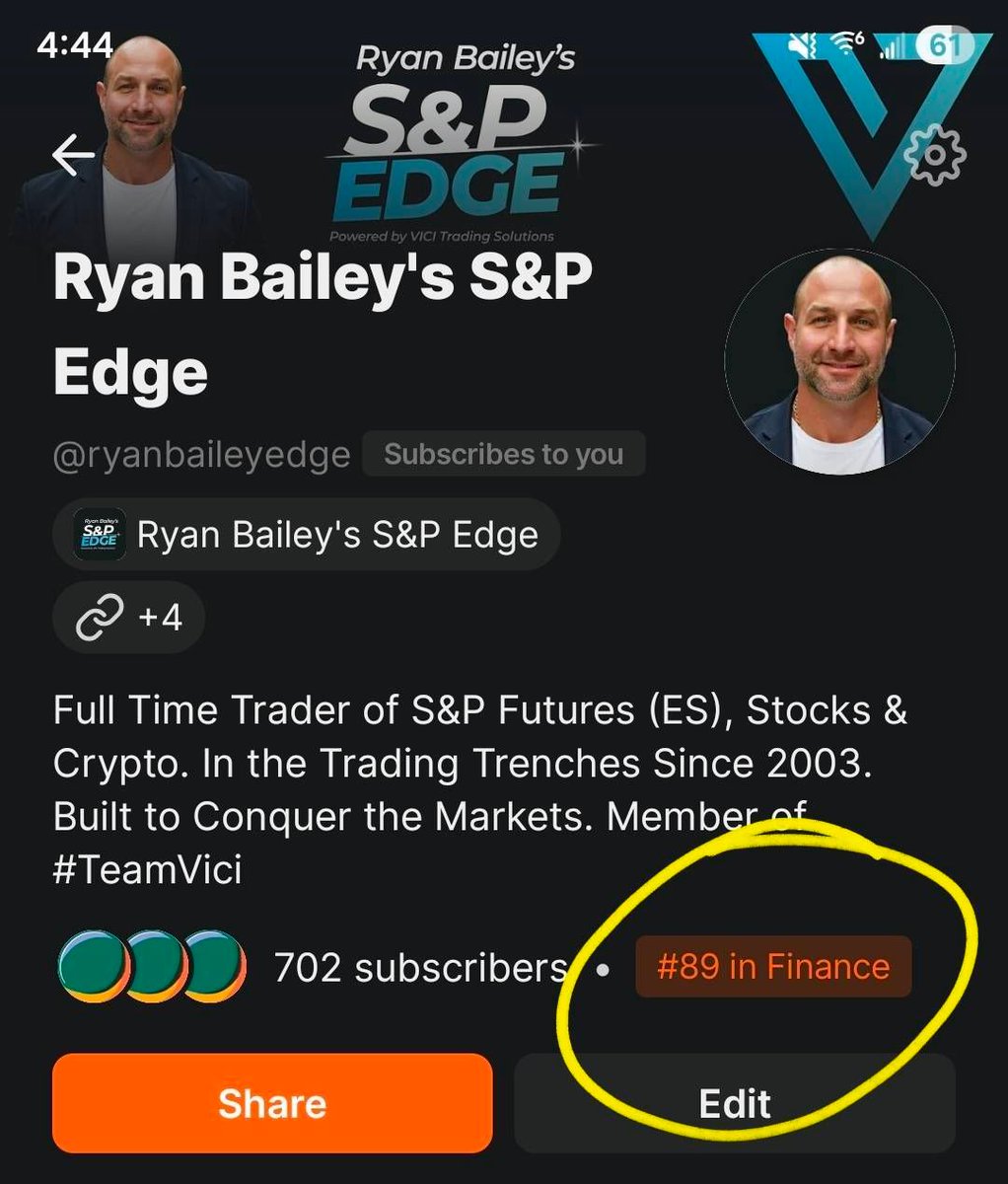
We hit #89 in Finance today because the VICI community is making money, passing evals, and conquering the markets.
The scoreboard doesn't lie.
We are climbing over the "gurus" because we have the receipts.
The New Goal: Top 10.
If you are tired of losing, come join the winning team.
See you at the top. 🦅
#ES_F #DayTrading #SNPEdge
An INCREDIBLE Trade Plan Strikes Again! I talk S&P Futures (#ES_F) Trade Plan Action, $SPX, and $VIX. Don't Miss This Unbeatable Live Session.
Huge Shoutout to @edgeful for the Confidence to hold 89% probability BANGER short worth 25pt to the gap fill! 🔥🔥🔥🔥
Seeing Robinhood surge 200% this year to a $153 high is the kind of move that tempts even experienced traders to chase—I've been there myself, riding momentum only to get burned by steep pullbacks. But one thing that’s tested me over the years? Letting valuations get out of hand while everyone is caught up in the hype.
Right now, Robinhood trades at a 25x price-to-sales ratio when the historical norm is closer to 11x. That’s a flag I can’t ignore—especially with big earnings lined up this week. Coinbase is still swinging hard after its $444 peak, and both have become playgrounds for traders who treat volatility like a badge of honor. It’s tempting, but I can’t stress enough: after moves like these, gravity always kicks in.
I’ve seen sharp round-trips wipe out months of gains when I ignored stretched valuations:
- High-beta names invite FOMO but punish poor timing.
- In fast, speculative markets, pullbacks are often swift and ruthless.
- Even seasoned analysts are calling for caution—Needham just cut HOOD’s target to $135, and others advise waiting for better entry points.
If I could give my younger self—or any trader learning this game—one piece of practical advice here:
- Don’t chase after stocks just because they’re hot. Use the data to plan short-side setups, or step aside until the froth dies down.
- Position sizing matters more than ever when trading high-flyers. Keep risk in check so you’re around for the next round.
This isn’t about predicting tops, or being “right.” It’s about surviving another day and hitting only the best pitches. If you’re tracking Robinhood or Coinbase, use valuations and broad context as your edge, not just price action.
If this resonates, step back and ask: Am I trading what’s moving—or what’s worth the risk? #TradingInsights #CryptoMarkets #VICIInsights #TradeWithVICI
If you’re betting on consumer strength through Q4 earnings, don’t ignore what’s beneath the headlines. I’ve traded enough cycles to know: even the best blue-chips—Coca-Cola, Ford, McDonald's—are only as resilient as the wallets they're trying to reach. This round, the real story isn’t just in EPS beats or revenue surprise. It’s about whose spending shapes those numbers—and the cracks you spot before the consensus.
When McDonald’s CEO admits low-income visits are down nearly double digits while high-income traffic is UP, that’s not just color for analysts. That’s a flashing signal for anyone trading post-earnings volatility. Ford has to fend off Tesla while fighting margin compression. Coca-Cola’s 4% revenue growth expectation looks healthy, but with rent, groceries, and childcare still squeezing wallets, I’ll be watching if volume can keep up, or if pricing power is finally tapped out.
Here’s how this has shaped my playbook:
- For post-earnings setups, I lean on options straddles when expectations diverge sharply (think KO and rate-sensitive names) to ride the volatility—never assume “safe” blue-chips can’t get rocked by macro currents. 📉📈
- Before the numbers hit, I run a hard checklist: comp sales, guidance, management tone, and—crucially—segment breakdowns to see who’s still buying and who’s tapped out.
- I no longer chase CPI or earnings moves out of FOMO. If you’re still learning, don’t let macro noise push you into trades you can’t risk-manage. Control your entries, especially in this headline-driven tape.
The market cares less about last quarter’s wins and more about signals for the next consumer pivot—especially with sticky service inflation and Fed expectations in the background. If you trade these names or broader indices, zoom out and connect the dots across sectors. Earnings are a mirror for Main Street’s mood as much as Wall Street’s ambition.
If this resonates, it might be time to go beyond the surface numbers and ask: "Who’s really driving these results—and what does that mean for my next move?"
#TradingInsights #MacroTrading #VICIInsights #Stocks
Market conviction: The more I trade, the more I realize that edges come from seeing beneath the surface—like how fast food chains thrive overseas while US spending stalls. Last quarter, I watched MCD’s Europe and China strength send a ripple through EUR/USD—even as US CPI came in soft and Ford warned about affordability pressure on car buyers.
There’s a lesson here I had to learn the hard way. My first reaction to split earnings data was always to chase the headline—until I missed how international growth (while US households tighten up) can signal both currency rotation and commodity dislocation. Sometimes, my best trades come from *not* following the crowd obsessed with the US consumer, but tracking where the capital is really flowing.
A few insights I’ve picked up:
- International revenue surges—especially when US low-end demand is weak—aren’t just about corporate winners. They flag potential forex pairs or commodity contracts prepping for an unwind.
- When the wealth gap grows, cross-border money and consumption matter more. EUR/USD straddles, or metals futures tied to auto and EV updates, can outperform headline stocks—if you connect the right dots early.
- Beginners: Every COT report or earnings call is another “map” if you’re willing to map spending patterns to pairs or contracts. High conviction, low frequency. Fewer trades, stronger setups. 📈
Bottom line: If you’re only looking at the US consumer, you’re missing the real money shifts. Start linking earnings divergence to macro flows—the kind that bend the DXY or spike volatility around Treasury auctions. That’s how professionals get in front of the big moves, not just react after the fact.
Every setup comes down to this: Are you curious enough to go beyond the headlines? Start journaling divergences—watch how EUR/USD or metals jump when retail stories split. That small habit is where my edge started.
Keep questioning—keep connecting. That’s the trader’s advantage. #TradingInsights #ForexEdge #TeamVICI #VICIInsights