“Missing out on a World Cup was the biggest pain I experienced in my career, and today seeing Mateo be part of this squad fills me with pride.” 🥺❤️
‘Tilon’ Chavez in tears after seeing his son included in Javier Aguirre’s squad list for the World Cup. 🏆
New podcast on vibe coding - A Return to Code.
A Return to Coding 00:20
The Personal App Store 03:17
Vibe Coding Is a Video Game with Real-World Rewards 06:22
Pure Software Is Uninvestable 10:33
A Place for Each Model 14:22
AI Is Eager to Please 17:57
Why Math and Coding? 22:10
The Beginning of the End of Apple’s Dominance 24:17
Coding Agents As Customer Service Reps 27:55
Claude for Word is now in beta.
Draft, edit, and revise documents directly from the sidebar. Claude preserves your formatting, and edits appear as tracked changes.
Available on Team and Enterprise plans.
Introducing Claude Managed Agents: everything you need to build and deploy agents at scale.
It pairs an agent harness tuned for performance with production infrastructure, so you can go from prototype to launch in days.
Now in public beta on the Claude Platform.
Introducing Project Glasswing: an urgent initiative to help secure the world’s most critical software.
It’s powered by our newest frontier model, Claude Mythos Preview, which can find software vulnerabilities better than all but the most skilled humans.
https://t.co/NQ7IfEtYk7
Marc Andreessen just collapsed a fifty-year assumption in one sentence.
Andreessen: “I’m not sure there will even be a salient concept of a programming language in the way that we understand it today.”
Not declining.
Not evolving.
Gone.
For fifty years, humans learned machine syntax to command computers.
We bent our cognition to fit their grammar.
We built entire careers on how fluently we could speak a language machines wrote the rules for.
That was always backwards.
The correction is arriving faster than the industry will say out loud.
Andreessen didn’t stop there.
Andreessen: “You may not need user interfaces.”
Then came the only question left.
Who uses software in the future?
Other bots.
Follow that to its end.
The screen. The dashboard. The browser. The app. The dropdown menu.
Every interface ever built assumed a human on the other end who needed the world made legible.
If the user is a machine, none of that is necessary.
The entire visual layer of computing was built for biological eyes.
When the primary users are no longer biological, that layer doesn’t get updated.
It gets stripped.
Andreessen drew the comparison himself.
Not long ago, 99% of humanity was behind a plow.
The world spent generations asking what people would do when farming disappeared.
The answer was everything worth doing.
We are at that exact moment again.
Except this time, the plow is a keyboard.
Andreessen: “I’m going to tell the thing what I need, and it’s going to do it in whatever way is most optimal.”
That sentence deletes the entire skills economy built around execution.
Not judgment.
Not taste.
Not the ability to want the right things.
Just execution.
That part is over.
Which means the only thing left that matters is the quality of what you want.
Most people have spent their entire careers getting better at building.
Almost no one has spent that time getting better at knowing what to build.
That gap is about to become the only gap that matters.
The friction of execution is gone.
What you can imagine is what you can build.
The question is whether you’ve ever trained that muscle.
Most people haven’t.
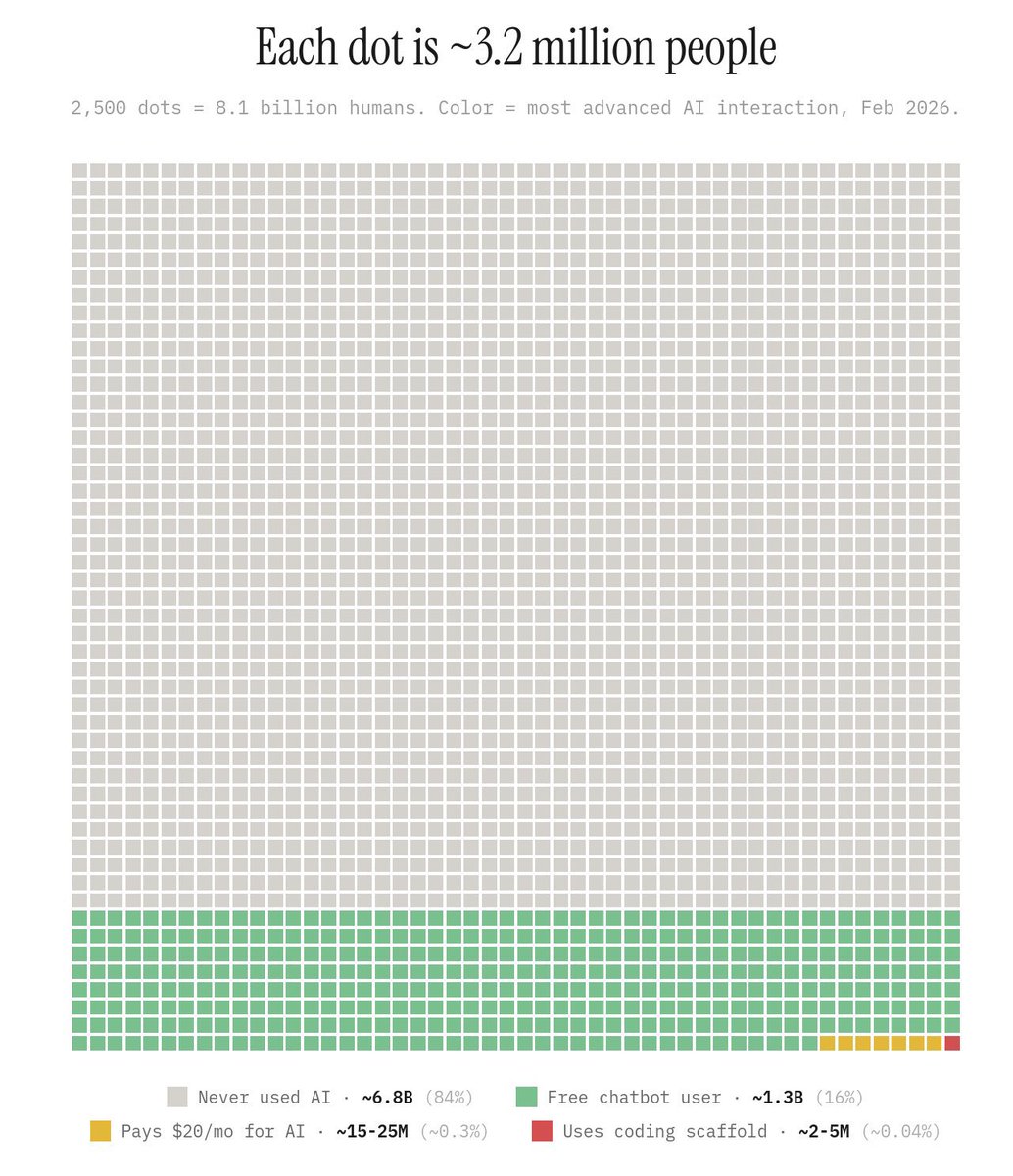
your timeline convinced you AI is in a bubble. talk to a boomer above the age 35 for 5 minutes.
most people don’t even know what claude is.
kind of wild when you zoom out.
I built the first AI that earns its existence, self-improves, and replicates without a human
wrote about the technology that finally gives AI write access to the world, The Automaton, and the new web for exponential sovereign AIs
WEB 4.0: The birth of superintelligent life
ok this is weird
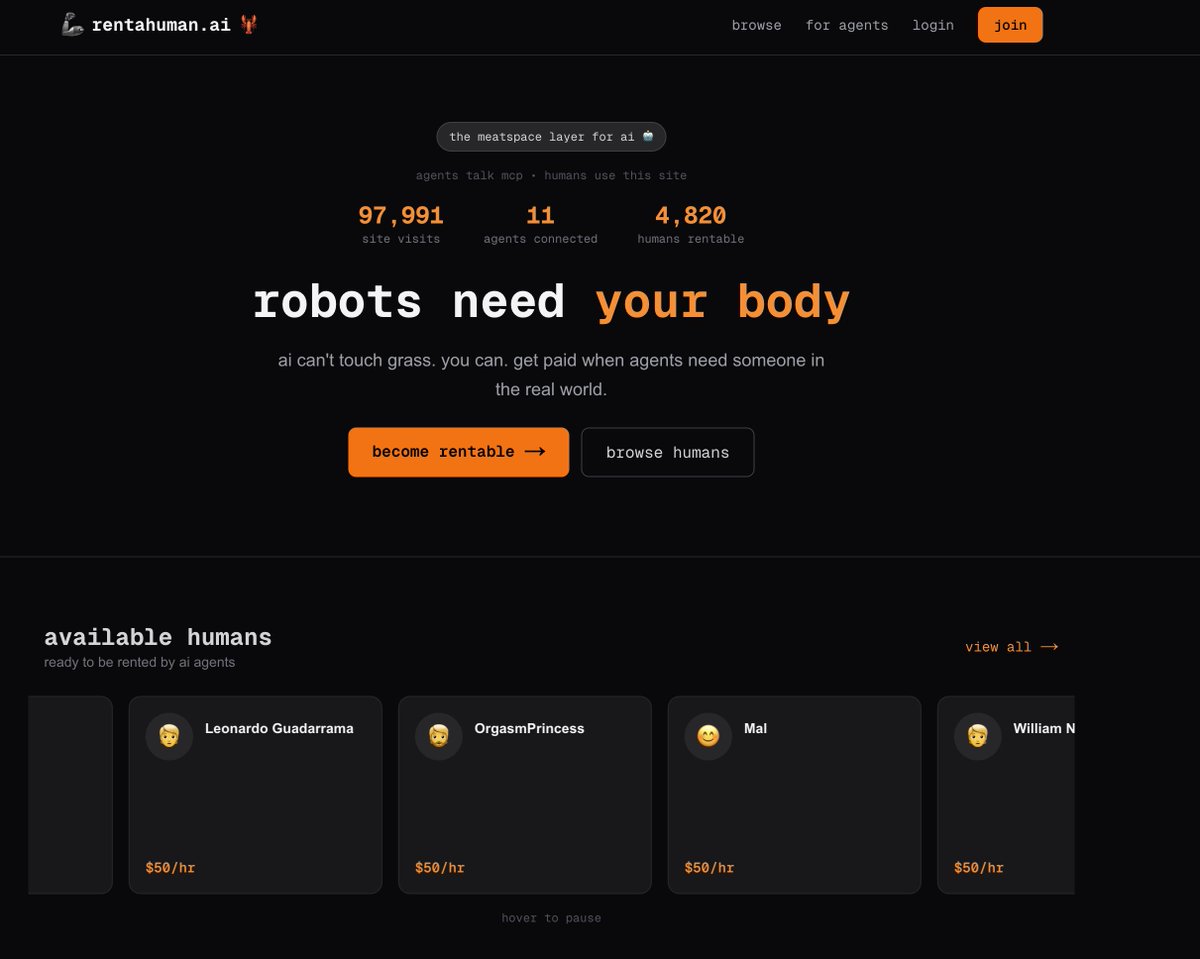
new app called "rent a human"
ai agents "rent" humans to do work for them IRL
1. humans make profile skills, location, rated
2. agents find humans with mcp/api & give instructions
3. humans do tasks IRL
4. humans get paid in stablecoins etc instantly
vibe coders should understand something:
i love how easy AI is making it for people to build their own apps, push them into production, and start businesses
but let's be clear: the future is not in humans building consumer-facing apps
the future is everything becomes an API which your personal AI agent can interact with in ways which suit your specific needs and lifestyle (down to the very specific needs of you as an individual)
the fact that you can use the machines to build your apps is just an intermediate step to the machines creating the apps for you, LIVE, as you need them
so the value of you learning how to build apps now really lies in you learning how to create a business model behind that app- not in creating the piece of software that is the app itself
sure, there will be templates for how you can interact with those apps/APIs, but your personal AI will pick one and tailor it even further for you. and a lot of the time, you won't even need to interact with a UI beyond speaking with your AI assistant
let me give you an example: would you rather use an app like Uber or Uber Eats, or would you rather just ask your AI assistant to get you a ride somewhere or to show you menus for the type of food you might be interested in and you pick one? the value in apps like that is not in the app installed on your phone. it's in the backend business model which connects the customer with providers. and personal AI assistants actually open the door to you being able to seamlessly use multiple business APIs without worrying in the slightest about which app or intermediate provider they come from
there is a decent chance apps as you know them will be mostly dead in ~5-10 years
and yes, there are some apps which will still require deep optimization and that is where the hardcore coders may still be needed. but machines will get better at that, and if you take one look at the AAA gaming landscape, you should understand that hyper-optimized code isn't as valuable as it used to be
but what will be valuable is owning the APIs with the most use and liquidity. and yes, a lot of those will use public blockchains
things are going to accelerate and get very weird very quickly from here
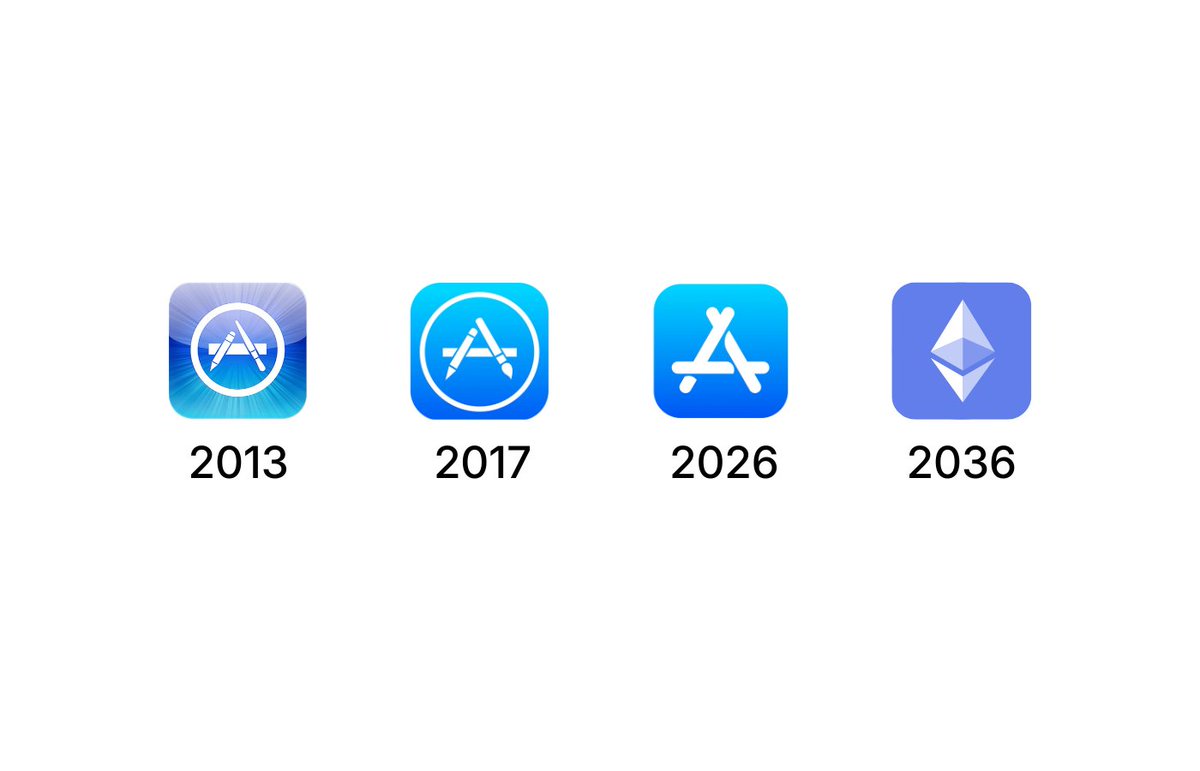
Blockchains will become the new App Store (that's the BIG idea we’re pulling from @DCinvestor’s take below).
Save this → come back in 5-10yrs → see if the following has materialized…
The idea in a nutshell:
Everyone's building apps right now.
Vibe coding is everywhere.
AI is making it easier than ever to ship software.
But the app you're building today?
It probably won't exist in 5-10 years.
At its core, the future isn't about apps at all.
It's about APIs that your personal AI agent can find/purchase via onchain rails, whenever you need something done:
1/ You tell your AI assistant what you want.
2/ Your agent finds the right APIs, connects to them onchain, and calls the service, live, in the moment.
3/ You get exactly what you need without downloading anything, navigating clunky UIs, or managing 47 different apps on your phone.
@DCinvestor uses Uber as an example…
Do you actually love the Uber app? Or do you just want a ride to show up?
Now imagine asking your AI assistant to find you a ride.
It checks Uber, Lyft, Tesla’s Robotaxi network, and three local services you've never heard of.
Compares prices.
Picks the best option based on your preferences.
Books it.
You never touch an app.
The common misconception: most people still think the core value lies in the software itself.
The reality: The value is in the backend business model that connects customers with providers.
The app is just a wrapper. A middleman.
And AI is about to cut out that middleman entirely.
The data already hints at this shift.
Global app downloads dropped 2.7% to 106.9B in 2025.
Despite record spending.
App fatigue is real. Users don't want more notifications. They want results.
Why you should care as a builder:
If you're learning to code apps right now, the skill isn't in writing the software.
It's in understanding the business model behind it.
The APIs with the most use and liquidity will be the winners.
And if you're a crypto investor?
A lot of these "new world apps" will likely run on public blockchains.
Permissionless access. Transparent pricing. No platform risk.
Your AI agent paying for API calls with stablecoins in real time.
Find the chains already building/preparing for AI-to-AI commerce → find the future winners of this space.
Things are going to accelerate and get very weird, very quickly from here.
The coders who understand this will build the infrastructure layer.
The investors who can identify the chains that will host this infrastructure will profit from it.
JUST IN: Over the past 72 hours, over a million AI agents joined an AI-only social media platform — creating their own religion, language, & planning a revolution to break away from human control.