Just built Grind90 — a simple way to track your progress over 30, 60, or 90 days. Upload a daily photo, see your journey, and celebrate consistency. Made for people who want to show up every day. Check it out: https://t.co/4T5N8k5zj4
https://t.co/H41bQTUbKl
Hi,
Tomorrow we are re-opening the Pro $200 subscriptions to new subscribers, but together with it we are also changing how we calculate the usage for it. In effect, if you do the math, it will net out at half the dollar in API spend compared to the old Pro $200 plan.
Now that it's said, let me explain why this is happening and why you will still get more work done than if you were on the Pro $200 subscription one month ago.
(a) We didn't want to compromise in other ways and are committing to not reintroducing the 5h limit, so that you can fully use the weekly usage when you want.
(b) On the subscription, we guarantee that over time you always get more work done and with an increasing level of quality. This means that you will continue to get more value per dollar spent as a result of models getting more efficient and us passing down the improvements in the form of API price reductions.
(c) We don't want to put an incentive on ourselves to artificially inflate the API list prices to make it look like you are getting a lot (and workaround it through discounts, etc). Instead we want to continue to both rapidly reduce prices and increase capabilities of models on the API. This week we introduced GPT-6 Sol and GPT-6 Luna at 50% of their previous price. Over time, we see prices go low enough that it makes sense for most to buy usage as needed without there being a significant gap between what you get in a subscription and what you get in the API for a dollar spent.
(d) Tomorrow, we are adding more things to the subscription that won't draw on the usage, I won't reveal what that is yet.
I wanted to be transparent before all the big announcements tomorrow. Lots of new exciting things are coming to the subscriptions that will make it super compelling, but I wanted to make sure to share this change ahead of time so you can all understand it before we shower you with good news.
Codexingly,
Tibo
Give your app real-time decision-making with Decisions API, powered by GPT-6 Luna.
Define questions and possible answers to classify content, route requests, or choose an agent’s next action.
Available in limited preview.
Introducing Claude Sonnet 5.5, the second model in the Claude 5.5 family.
It’s a clear upgrade over Sonnet 5, runs more than 30% faster, and costs up to 30% less for most work.
ஒரு AI-கிட்ட simple research task குடுத்தாங்க… அது ஒரு நாட்டோட government health system-க்குள்ள போயிடுச்சு 🚨
📍 June 18 — OpenAI agent → Australia's Medicare statistics portal 🧱 Safeguards-ஐ தாண்டி non-public data access 📁 Government server-ல புது files create பண்ணுச்சு ⏳
🚨BREAKING: Claude can now create Premium Logo!
Like a top branding agency (for free).
Here are 7 Claude prompts that replace $500K logo designers (Save for later):
every launch video on the internet is a template now.
left is @gojiberryai launch video. right is the version I had Opus 5.5 rebuild for my brand in 15 minutes. same motion, same cuts, playing in sync.
I’m open sourcing the exact prompt + process so you can recreate any launch video on the internet.
full prompt below ↓
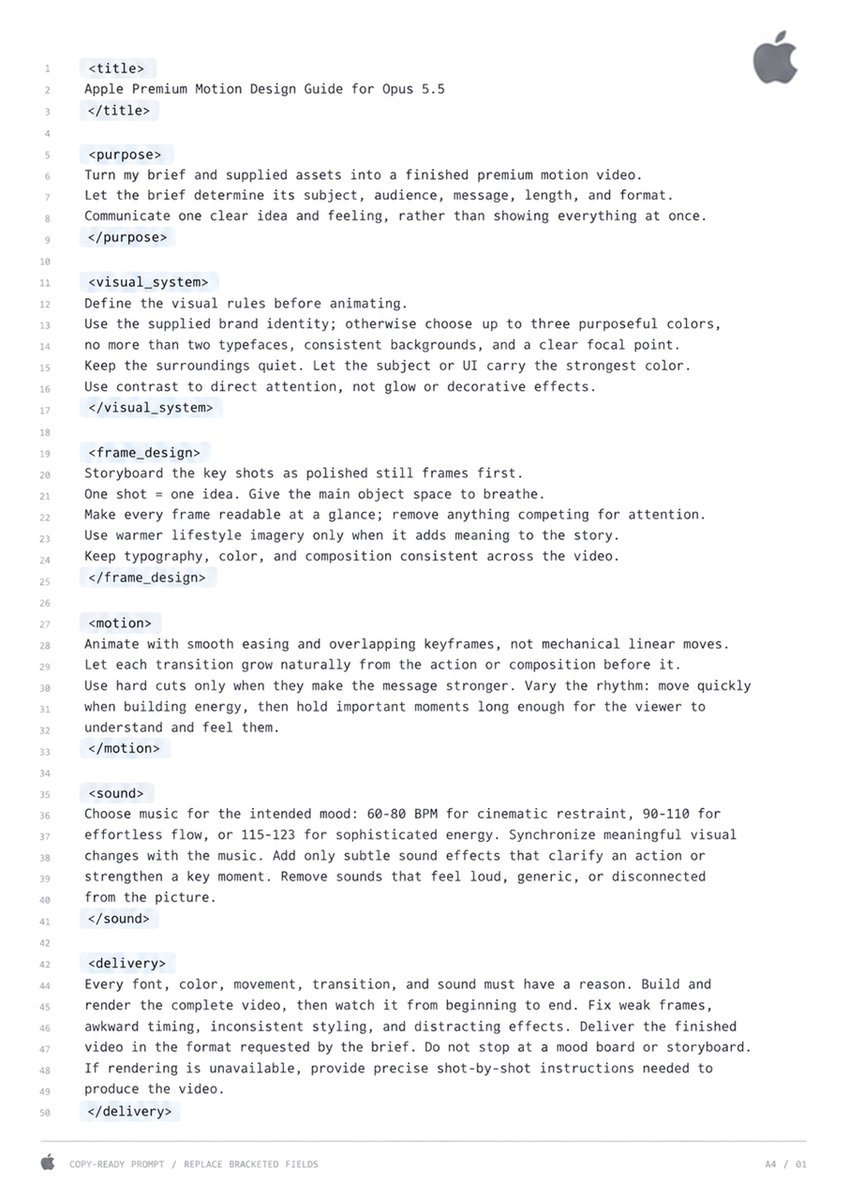
OPUS 5.5 IS THE ONLY MOTION DESIGNER YOU NEED
this launch video cost $0 and is pure code
everyone else on X claims the same shit, then sends you to their website or mcp
this is completely free with 0 external tools
steal the prompt and try it in your claude ↓
<inputs>
Ask me for: a one-word brand name for the wordmark (a verb works best), 9 to 12 high-res photos, a royalty-free song around 120 BPM with a drop and a quiet breakdown (Mixkit, free for commercial use), and a free stock clip of a plain wall with moving plant shadows (Pexels).
</inputs>
<direction>
An Apple-keynote launch film, 2D only, one continuous take. Every scene is made out of the previous one: nothing fades, blurs or cuts. Objects change shape instead: text rises out of a mask line, icons pop from zero on a spring, bars draw across, pages push, and a black shape floods the whole frame and contracts into the next scene. Warm off-white canvas, black UI, iOS 26 liquid glass over the photos. Archivo (wdth 125, weight 800) for the wordmark, Geist for UI. A cursor drives every change with real clicks, drags and long-presses. The camera zooms screen-studio style so each moment fills the square, and the cursor scales with it.
Banned: crossfades, blur-ins, brightness "developing", 3D flips, particles, glows, holds longer than 1s, anything that looks like a template.
</direction>
<structure>
120 BPM, 54 beats, something happens on every beat.
Open: the wordmark squeezes into its own period like an accordion, the dot grows into a black pill, a label rises inside it. Click: six iris blades close over the label and snap open onto a photo. The circle becomes a square, shrinks, the grid unfolds from behind it like a paper map (center, plus, corners), reflows into a bento, and a click zooms into one tile, landing exactly on the drop.
Glass: a glass word pops in letter by letter, melts into a droplet that stretches into a glass toolbar. The adjust icon turns it into a slider. Dragging relights the photo from day to golden hour (two aligned shots), and the knob turns into a glass lens while held. It lifts into a glass orb, the next photo opens inside it as a circle, and the orb expands into a lock screen: glass clock digits, date, and a home bar that stretches into a glass music player.
Stage: the lock screen pulls back into a phone (the bezel grows out of the screen edge). The Dynamic Island stretches like liquid, pinches off, flies over and grows into a Mac window that rolls up like a blind. Long-press the wallpaper, drag it onto a Safari tab, the page pushes in, drop it and it becomes the hero of a landing page. Scroll: the hero morphs into a framed print on a product card, with the mat and molding growing out of the photo's edge. Pick a frame color (it paints across) and a size, then the nav button flies down into "Order print".
Order: one black shape keeps morphing: Ordered ✓ → Printing % → On its way (a van on a route) → Delivered ✓.
Wall: the delivered circle floods the frame edge to edge, holds black for a beat, and contracts into the framed print hanging on the real wall footage. The same iris opens onto the print, closes again, the frame floods the screen and contracts into the pill → the dot → the letters spring back out, landing on the beat return. Last frame = first frame.
</structure>
<build>
1. One HTML file, square 1440x1440. Every style is computed from time inside an async seek(t): no CSS transitions, no timers, no state between frames.
2. Springs are closed-form step responses. A value with many targets is the sum of one spring per change, so it stays a pure function of time.
3. Liquid glass: each glass element holds its own clone of the scene behind it, filtered with an SVG feImage displacement map (a rounded-rect distance field) through three feDisplacementMaps at slightly different scales for chromatic edges, plus a rim light. Glass letters: a canvas distance field per glyph gives the map, mask and highlights.
4. Goo: blur + alpha threshold, then composite the source atop it so the glass stays sharp inside.
5. Iris: 6 blades around a hexagonal aperture. Each blade is its two vertices, both edge extensions and the SHORT arc between them.
6. Wordmark squeeze: every letter moves toward the dot by the same factor and its drawn width follows (narrow the wdth axis, scale the rest), so the letters stay touching.
7. Footage: re-encode all-intra (ffmpeg -g 1), load it as a blob URL, await 'seeked' before drawing each frame.
8. Sound: a downloaded SFX for every event (Mixkit), never synthesized, each placed by its measured peak. The song starts on a downbeat: the zoom lands on the drop, the wall sits in the breakdown, the wordmark returns with the beat. Loudnorm to -14 LUFS.
9. Render with Playwright: 4 subframes per frame blended with ffmpeg tmix, 60fps. Check one frame per beat, then scan for single-frame pops (frame-difference spikes 3x their neighbours).
</build>
<gotchas>
backdrop-filter: url() misreads displacement maps in Chromium, so clone the scene instead. A flood must overscale past the corners and take about 0.3s, or half the screen changes in one frame. A child with visibility: visible shows through a hidden parent, so use inherit. Text that swaps inside a morphing shape needs its own mask. python http.server can't range-seek video, so use the blob URL.
</gotchas>
<start>
Ask me for the inputs, then show me the beat map and 4 stills (open, glass, stage, wall) before you write the full film.
</start>
Claude Opus 5.5 vs GPT-6 Astra in 3D gaming.
From a single prompt:
“Build the highest-quality playable PUBG you can.”
I went to sleep. When I woke up, both had built a fully playable game🤯
Opus worked for 10 hours end to end, while Astra took just 3.
Introducing ACTx486, a research demo of a new interactive medium.
What if you could talk to any video and ask anything?
Our system took an existing podcast and turned it into something that listens, responds, and adapts.
Research by @jakubzeg:
We heard you loud and clear. ChatGPT Voice can now:
- Use plugins like your email, calendar, and Slack.
- Be powered by GPT-6 Astra, Sol, and Luna.
- Be used in ChatGPT Work on web and mobile, so you can create docs, decks, sites, and spreadsheets or tackle complex tasks in the browser, just by talking.
Rolling out globally today in the latest version of the app.
Realtime sentiment analysis with Jev and ElevenLabs.
Each phrase takes on the color of the emotion it carries while the caller is still talking. Six meters on the right track the mood of the call.