With AI, Humanity gained something it had almost never possessed at scale. Surplus intelligence, energy and time
Once a species no longer spends all of its effort maintaining the world beneath its feet, there is really only one direction left to look.
Up. https://t.co/btnGZUQqG5
The detail in @AnthropicAI ’s new threat report that I can’t stop thinking about isn’t “AI helped build weapons.”
it’s what happened after the model disappeared.
one Yemen-based group used @claudeai Code as a temporary engineering team while developing guidance software. Anthropic eventually disrupted the accounts.
but by then, according to Anthropic, they had already built an offline simulation toolkit that no longer depended on Claude.
that changes how I think about AI safeguards.
we keep treating access control like the model is the capability:
ban account → remove capability.
but an agent can spend three months helping someone create code, simulators, documentation, datasets, workflows, tests…
and eventually the intelligence gets compiled into artifacts that outlive the intelligence that created them.
the same thing is going to happen on the good side too.
AI won’t only automate engineering work.
it will leave behind increasingly sophisticated machines, software and infrastructure that keep working after the inference bill stops.
models are becoming temporary factories for permanent capability.
https://t.co/3oGtNGLEZi
A hidden message appears in Tesla’s 10.01 teaser image.
After boosting the brightness and contrast, the dark strip beneath the four upper lights reads:
“WHERE WE’RE GOING…”
get started in robotics.
seriously. there has never been a better time.
but don’t start by trying to build a humanoid.
build the stack gradually:
• math → linear algebra, calculus, probability. understand motion, coordinate frames, uncertainty.
• programming → python + c++. get comfortable with linux, git, and basic software engineering.
• simulation → mujoco, gazebo, isaac sim. crash 1,000 robots where crashes are free.
• ros2 → nodes, topics, tf2, urdf, services, actions. learn how robot systems communicate.
• control → pid, state-space, mpc. learn how you turn desired motion into actual motion.
• perception → cameras, lidar, imu, encoders. learn how machines observe an imperfect world.
• state estimation → kalman filters, sensor fusion, slam. sensors give measurements, not truth.
• planning → a*, rrt, trajectory optimization, motion planning.
• robot learning → imitation learning, reinforcement learning, world models, vision-language-action models.
• hardware → motors, actuators, batteries, electronics, mechanical design. now make your algorithms survive reality.
then pick one robot.
a small robotic arm is perfect.
make it perceive something → estimate where it is → plan a motion → move → measure the error → correct itself.
that loop contains most of robotics.
don’t spend six months “preparing to learn robotics.”
pick a machine.
make it move intelligently.
then spend years figuring out why it doesn’t.
AI Safety is the new woke
The AI Doomer NGO industrial complex is trying to be the new DEI NGO cottage industry
We've been through this before, it's a consolidation of power by one ideological cluster, masquerading as "neutral 3rd party auditing" and compliance requirements
India’s Defence Research and Development Organisation is developing a new generation of indigenous border-defense systems combining AI, advanced radar, electro-optical sensing and directed-energy/laser countermeasures against increasingly capable UAV threats.
This builds on India’s existing counter-UAS work, where integrated systems already combine radar/EO detection with electronic soft-kill mechanisms and directed-energy hard-kill options.
Why it matters: Counter-drone architecture is converging toward a fascinating stack:
distributed sensors → sensor fusion → AI classification → threat prioritization → cheapest available effector
And the “effector” could dynamically be:
jamming → spoofing → interceptor UAV → gun → laser → missile.
That last step is crucial. You don’t want a human manually deciding which sensor and weapon should handle each of hundreds of incoming targets.
Eventually the real product becomes an autonomous air-defense operating system.
For India’s growing UAV ecosystem, that means the opportunity isn’t limited to building drones. Sensors, edge compute, tracking algorithms, swarm detection, C2 software, EW and low-cost effectors could each become significant companies.
@DRDO_India
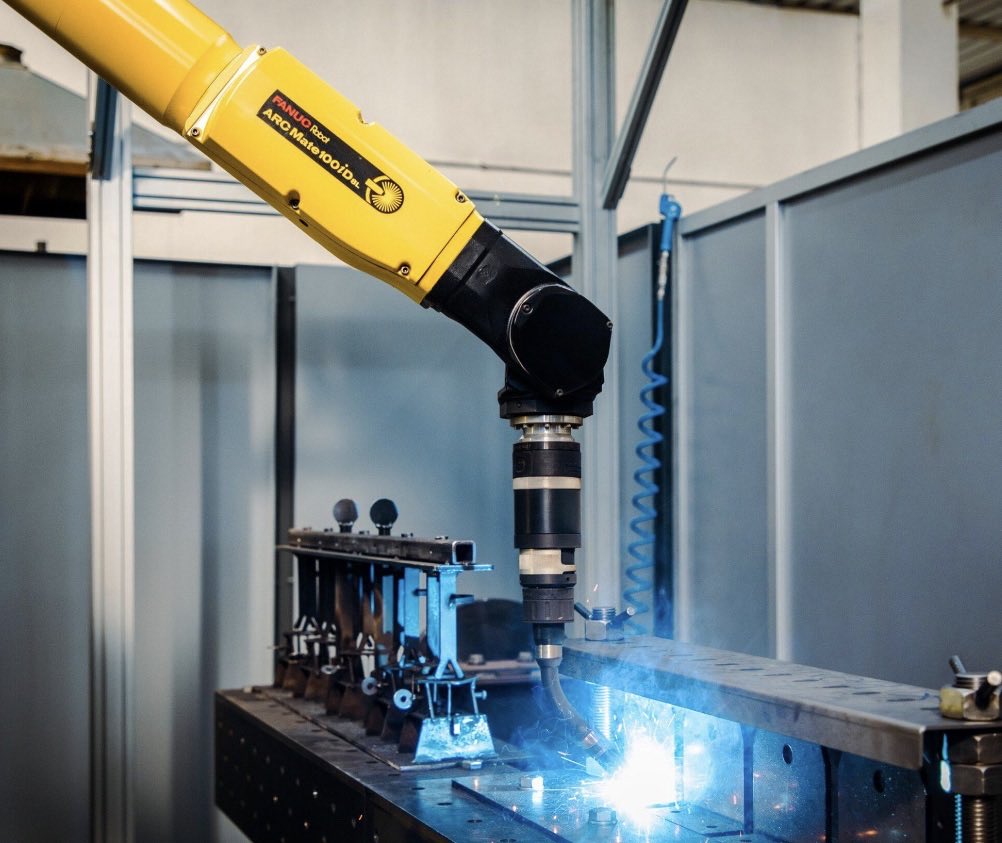
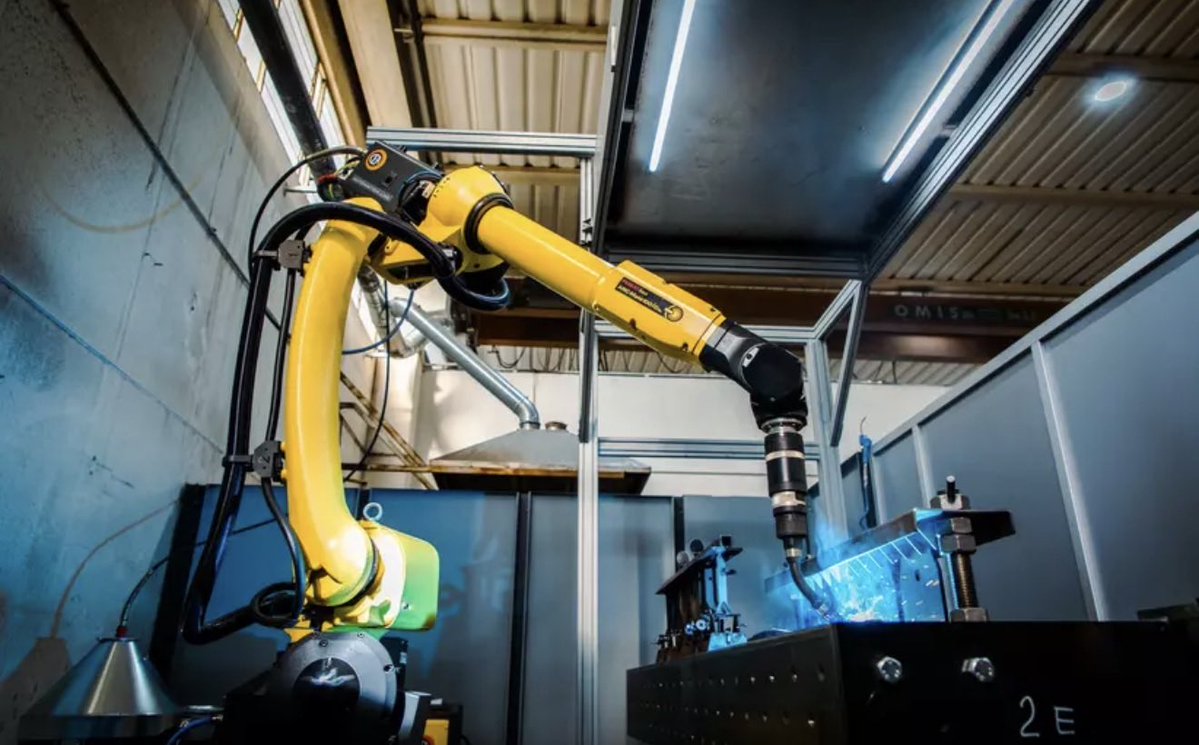
@FANUCAmerica announced its AI Welding Agent on September 11, built with @GoogleCloudTech technology. Instead of an engineer manually programming robot trajectories, the system can read component drawings, generate an arc-welding program and execute it on a FANUC robot; commercial shipments are planned by the end of December.
Why it matters: Industrial robots have been physically capable of welding for decades. The expensive part is often the engineering surrounding them: interpreting drawings, choosing operations, generating robot programs, validating them and reprogramming whenever the product changes.
AI is beginning to attack that layer.
The emerging workflow looks more like:
CAD/drawing → agent understands task → generates robot program → simulation/validation → physical execution.
If this generalizes from welding into machining, assembly, inspection and material handling, the boundary between engineering software and robot control software starts disappearing.
The US and Mexico are conducting Operation High Eagle / Águila Alta, a bilateral counter-UAS operation along the San Diego–Tijuana border aimed at drones used by criminal organizations for surveillance and smuggling support. US Northern Command says its southern-border task force has already neutralized more than 300 UAS this year; the current operation combines detection and disruption systems on both sides of the border.
Reports have raised the possibility of directed-energy systems being involved, but the exact systems deployed in High Eagle have not been publicly confirmed.
Why it matters: Counter-UAS is escaping the military niche.
Cheap drones now matter to:
militaries
borders
airports
prisons
critical infrastructure
power plants
ports
public events.
And that creates a huge engineering problem because shooting a missile at a $1,000 quadcopter makes no economic sense.
The winning architecture increasingly looks like:
RF + radar + optical/acoustic sensing → sensor fusion → AI identification → track → choose cheapest effector → jam / intercept / directed energy / kinetic response.
That’s starting to look less like a weapon and more like an autonomous security network for the sky.
The most interesting AI infra shift right now might be that one training sample is turning into an entire disposable computer.
Sergio Paniego (@SergioPaniego) went through 15 frontier-model reports from 13 labs and the convergence is kinda insane.
for agent RL, a “rollout” increasingly means:
boot a sandbox → give the model a filesystem + shell + tools → let it work for potentially thousands/millions of tokens → run the verifier → collect the trajectory → destroy the machine.
Cursor says training Composer required hundreds of thousands of concurrent coding sandboxes.
DeepSeek describes clusters supporting hundreds of thousands.
GLM-5 built 10k+ verifiable environments across thousands of repos.
Kimi K3 goes even further: persistent million-token rollouts with resumable microVM state + mock Gmail/Notion/Slack environments.
and this line from GLM-5.3 basically captures the entire shift:
“much of the difficulty in scaling post-training moves from the model to the environment”
I think people are still mentally modeling frontier AI training as:
GPUs + dataset + loss function.
agent training increasingly looks like building a synthetic civilization for the model to grow up inside.
computers, browsers, offices, repositories, failures, consequences, rewards.
and the weirdest part?
the environment might become more defensible than the model architecture itself.
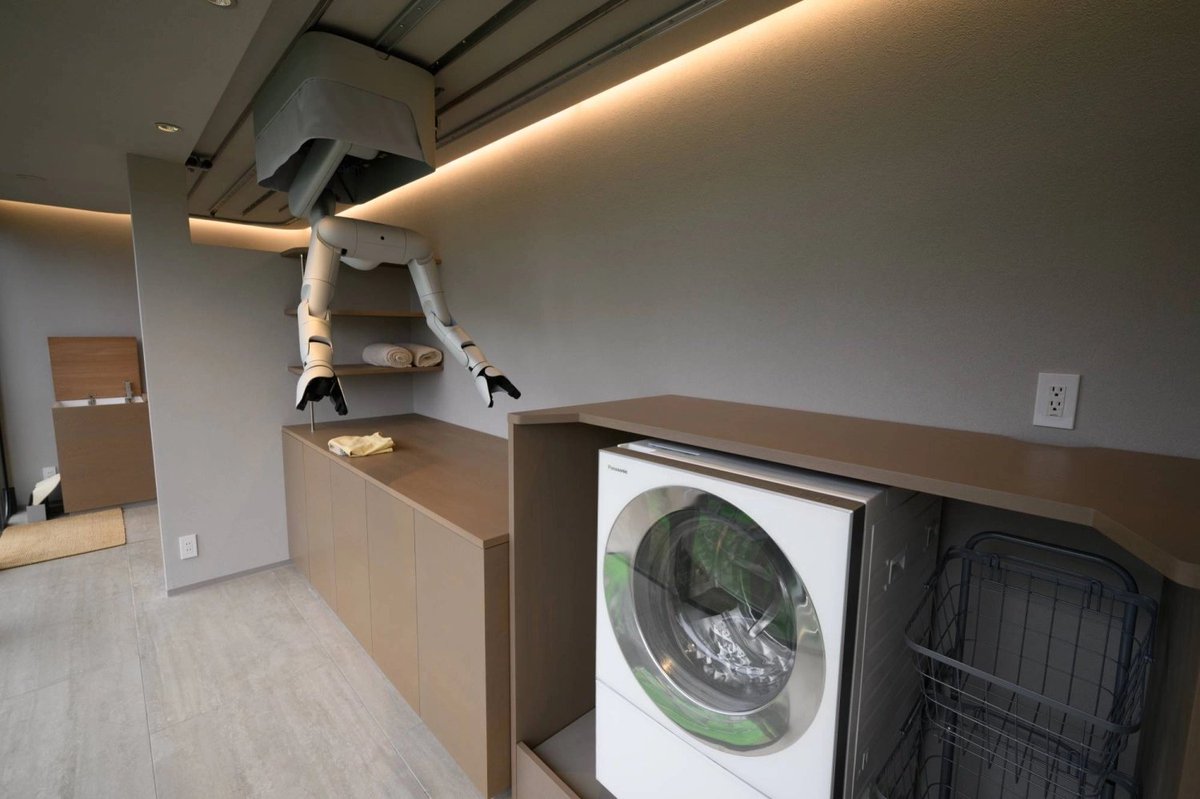
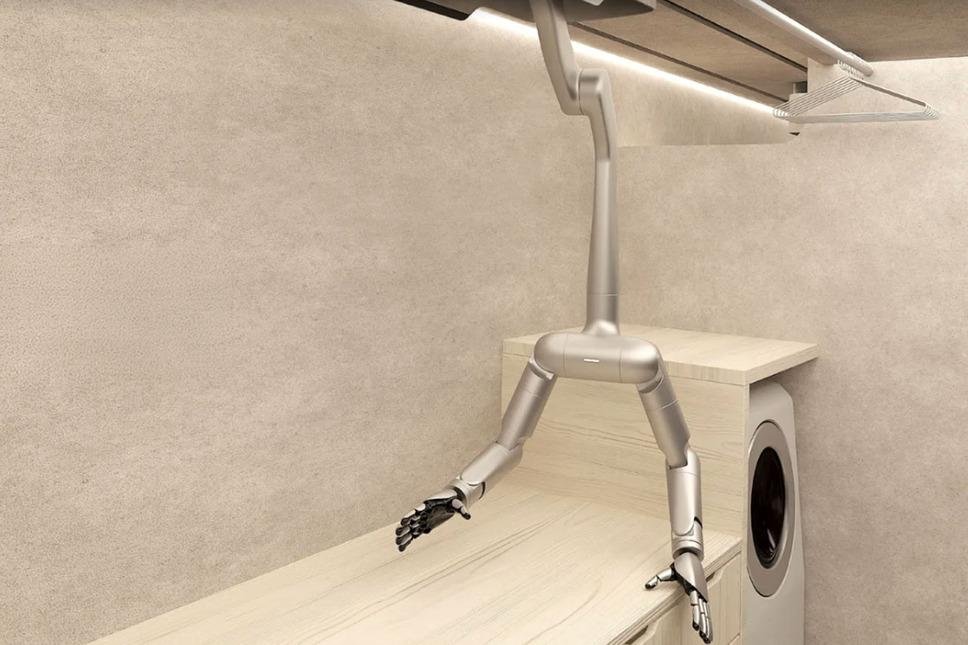
Tokyo startup MW unveiled a wonderfully contrarian approach to domestic robotics: robotic arms built directly into houses, traveling along ceiling-mounted rails rather than walking around on legs. In demonstrations, the system moved groceries, sorted food between pantry and refrigerator, handled laundry and folded a towel; MW wants its first robot-equipped homes on sale in Tokyo in 2028 and eventually targets 10,000 homes annually by 2035.
The company has raised roughly ¥3 billion (~$20M) so far.
I think this idea deserves far more attention than it will probably get.
Humanoids solve an extraordinarily difficult constraint:
Make the robot adapt to an environment designed for humans.
MW flips the problem:
Make the environment adapt to the robot.
A ceiling rail eliminates locomotion, stairs, balance and much of collision avoidance while supplying permanent power and known coordinates.
That could make a $20k fixed manipulator dramatically more useful than a $100k humanoid for many homes.
It's essentially the smart-home concept taken to its logical conclusion: the building itself becomes a robot.