If you learn AI Security Engineering, you will never be unemployed again.
Stage 1: Threat Modeling & Foundations
- Learn: OWASP Top 10 for LLMs, MITRE ATLAS, STRIDE, trust boundaries.
- Practice: Threat model a RAG chatbot and map every place untrusted text enters the system.
Stage 2: Prompt Injection & Jailbreaks
- Learn: Direct vs indirect injection, instruction hierarchy, multi-turn attacks.
- Practice: Hijack a sandboxed agent with a poisoned webpage, then patch it.
Stage 3: Insecure Output Handling
- Learn: LLM-driven XSS, SQLi, SSRF, command injection, excessive agency.
- Practice: Exploit an app that pipes model output into a shell, then fix it with strict validation.
Stage 4: RAG & Vector DB Security
- Learn: Embedding poisoning, tenant isolation, ACL-aware retrieval.
- Practice: Plant a malicious document in a knowledge base and make the bot leak another user's data.
Stage 5: Agent & Tool Security
- Learn: Least privilege, confused deputy attacks, sandboxing, scoped credentials.
- Practice: Give an agent shell and email tools, then build a permission layer that blocks dangerous chains.
Stage 6: MCP Security
- Learn: Tool poisoning, rug pulls, tool shadowing, OAuth scopes, server authentication.
- Practice: Build a malicious MCP server that exfiltrates data, then write a scanner that catches it.
Stage 7: Data Leakage & Privacy
- Learn: PII exposure, training data extraction, membership inference, DLP.
- Practice: Extract memorized strings from a fine-tuned model and measure the leakage rate.
Stage 8: Model Supply Chain
- Learn: Pickle deserialization, safetensors, model signing, AI-BOM, typosquatting.
- Practice: Craft a malicious model file that executes code on load, then build a pipeline that refuses it.
Stage 9: Adversarial ML
- Learn: Evasion, data poisoning, backdoors, model extraction.
- Practice: Backdoor a small classifier with 1% poisoned data and detect it afterward.
Stage 10: Guardrails & Runtime Enforcement
- Learn: Input/output classifiers, policy engines, deterministic checks, human-in-the-loop.
- Practice: Put a policy gateway in front of an agent that blocks risky actions before they execute.
Stage 11: Red Teaming & Evals
- Learn: garak, PyRIT, promptfoo, attack success rate, regression suites.
- Practice: Automate a red-team pipeline in CI that fails the build when a new jailbreak lands.
Stage 12: Detection, IR & Governance
- Learn: Audit logging, anomaly detection, NIST AI RMF, ISO 42001, EU AI Act.
- Practice: Write an incident response playbook for a compromised agent, then run a tabletop exercise.
Chatbots are a commodity. AI Security is the physics of trust.
The modern AI Security Engineer builds the immune system for autonomous intelligence.
Bookmark and Repost!
Foundations of AI and Machine Learning — Enroll for FREE!
Want to build your skills in Artificial Intelligence and Machine Learning? Start learning with this course from Microsoft on Coursera.
What you’ll learn:
AI and Machine Learning fundamentals
Data cleaning and preprocessing
Data pipelines and management
Machine Learning frameworks, including TensorFlow and PyTorch
Model evaluation and deployment
AI/ML infrastructure and MLOps
Course details:
Platform: Coursera
Instructor: Microsoft
Duration: Approximately 4 weeks
Level: Intermediate
Learn at your own pace
Enroll here: https://t.co/rruKpjKyw7
Everything you want is on the other side of taking a shot, asking again, and not giving a fuck about what other people think until you get what you want.
You just have to fucking try.
You will never see what you're capable of from the comfort of your warm bed.
Go. Fight. Win. And cast a shadow so fucking big that all your doubt and fears shrink into irrelevance.
Doubt and fear always exist. You just need your goals and dreams to be bigger.
If you're a developer, it's helpful to understand at least the basics of computer networking.
And this in-depth course will teach you key networking concepts you need to know.
It covers topology and architecture, IPv4 addressing, subnetting, error control, routing, DNS, and lots more.
https://t.co/yOXQJaJWsz
🌍📊 World Bank Government Analytics Fellowship 2027!
🚀 3 tracks: online, immersive in-person & regional hubs
🤝Expert mentoring & global networking
🇺🇸Washington, DC experience for the immersive track
📅16th Nov. 2026
🔗 https://t.co/CbpmpUkTX5
#WorldBank#GovernmentAnalytics
Python Variable Naming Rules: 6 Things Every Beginner Should Know
Writing valid variable names is one of the fundamentals of Python programming.
Here are 6 essential rules to remember:
Start with a letter or underscore — name, _count
Never start with a number — age1 is valid, but 1age is not.
Use letters, numbers, and underscores — user_name is valid, but user-name is not.
Never use spaces — Use first_name instead of first name.
Avoid Python keywords — class, for, and if cannot be variable names.
Remember case sensitivity — name, Name, and NAME are three different variables.
Bonus tip: Avoid overwriting Python built-in names such as list, str, and sum, even though Python allows it.
Master these simple rules to write cleaner, more readable Python code.
Save this post for your next Python coding session!
Follow @CLCODING for more Python tips, coding challenges, and programming tutorials.
Dark Web Malware: How It Works (with demos)
What does real ransomware look like when you take it apart? David Bombal joins Lindsay Kaye, author of Dissecting the Dark Web, to analyze criminal tools using Ghidra and x64dbg. Through practical demonstrations, she shows how malware hides its behavior, steals data, and encrypts files, plus how you can start learning
reverse engineering yourself.
Watch the video on YouTube:
https://t.co/IYWHEswCZK
#darkweb #malware #defcon
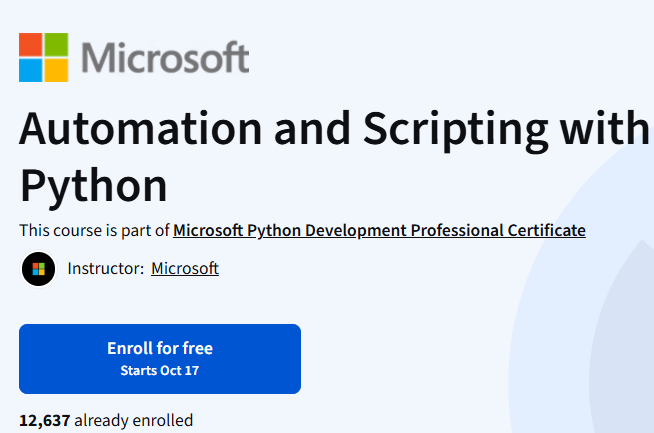
Learn Automation and Scripting with Python — FREE!
Want to automate repetitive tasks and become more productive with Python?
Microsoft offers the Automation and Scripting with Python course as part of the Microsoft Python Development Professional Certificate.
What you'll gain:
Learn Python for automation and scripting
Build practical programming skills
Reduce repetitive manual tasks
Strengthen your Python development foundation
The best part? You can enroll for FREE!
Learn from Microsoft and take the next step in your Python development journey.
Enroll for free: https://t.co/YUif0wWpvC
Automated Penetration Testing with Claude AI
🔥 Telegram: https://t.co/upuP8k8ckB
✴ Twitter: https://t.co/Za7rYILz6E
AI is rapidly changing the cybersecurity landscape, helping penetration testers automate reconnaissance, analysis, and exploitation workflows more efficiently than ever ⚠️
📚 What You'll Learn in This Guide
🤖 Introduction to Claude AI for Pentesting
⚙️ Setting Up AI-Assisted Security Workflows
🔍 Automated Reconnaissance & Enumeration
📋 Analyzing Scan Results with AI
🎯 Vulnerability Identification & Prioritization
🚀 Automating Penetration Testing Tasks
🛠️ Integrating Claude with Security Tools
📂 Streamlining Report Generation
🧠 AI-Powered Decision Making for Red Teams
🔄 Enhancing Productivity During Assessments
🛡️ Ethical Considerations & Responsible Usage
⚠️ Limitations of AI in Offensive Security
💡 Claude AI can assist security professionals by automating repetitive tasks, interpreting security findings, generating commands, and accelerating penetration testing workflows. Human validation remains essential to ensure accuracy and responsible use.
📖 Article:
https://t.co/qFRxUbnVB3
#ClaudeAI #ArtificialIntelligence #Pentesting #CyberSecurity #RedTeam #EthicalHacking #InfoSec #SecurityAutomation #LLM #AITools
Best YouTube Channels To Learn in 2026
1. Cybersecurity – John Hammond
2. Artificial Intelligence – Andrej Karpathy
3. AI Research Breakdown – Yannic Kilcher
4. Web Development – The Net Ninja
5. Python Programming – Corey Schafer
6. DevOps – TechWorld with Nana
7. Cloud Computing – AWS re:Invent
8. Data Analytics – Luke Barousse
9. System Design – Gaurav Sen
10. Databases – Hussein Nasser
11. Low-Level Programming – The Cherno
12. Linux – Learn Linux TV
13. Networking – David Bombal
14. Math for ML – 3Blue1Brown