Great reading list by Prof @avicgoldfarb ! Very relevant for gaining depth for Marketing DS roles as well, for example in Google.
@claudeai nicely made a study plan based on this list.
https://t.co/eAoWdJdtkr
Navy SEALS use box breathing to stay calm & intensely focused during stressful situations.
3 times per day for 5 minutes each will exponentially reduce your cortisol / stress levels.
Come back to this tweet to practice daily
@phokarlsson I am a big fan of @FT Business book shortlisted titles. Never have been disappointed by any of their shortlisted book.
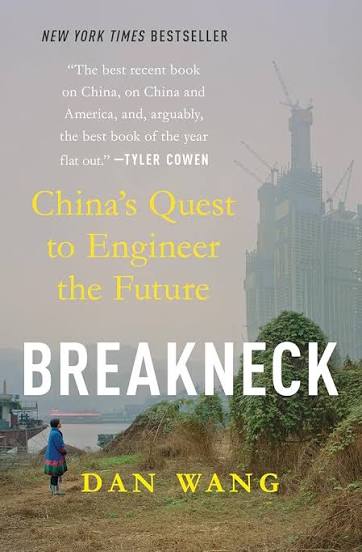
A recent one I read is "Breakneck" on China. Good one. Aim is to finish reading all of their shortlisted titles.
Fun fact: The 1998 paper that introduced Google and PageRank to the world ends with this acknowledgment:
"Supported by the National Science Foundation under Cooperative Agreement IRI-9411306. Funding also provided by DARPA and NASA."
Sergey Brin was on an NSF Graduate Fellowship. Larry Page was a PhD student on the grant.
Google—now worth $2 trillion—exists because American taxpayers funded "the Stanford Integrated Digital Library Project."
Not a startup garage myth. A government grant.
Every time someone says public research funding "picks winners and losers" or "crowds out private innovation," remember: the most dominant technology company of the 21st century was incubated entirely with public money, inside a public university, by researchers on federal fellowships and grants.
The private sector didn't see it coming. VCs passed. The government funded it anyway—not because it would become Google, but because fundamental research into information retrieval seemed worth understanding.
That's the point. You can't predict which grants will change the world. You fund the science and let researchers explore.
The internet (DARPA). GPS (DoD). Touchscreens (CIA/NSF). mRNA vaccines (NIH). Google (NSF/DARPA/NASA).
Public investment in basic research isn't wasteful spending. It's the seed corn of the entire modern economy.
After a certain age, your parents slowly become your children.
They ask simple questions, repeat stories, and depend on your patience the way you once depended on theirs. Very few understand this role reversal. What looks like innocence or inconvenience is really time coming full circle. Don’t correct them harshly. Don’t rush them. Care for them the way they once protected you. This is not a burden. It is repayment, quietly wrapped as love.
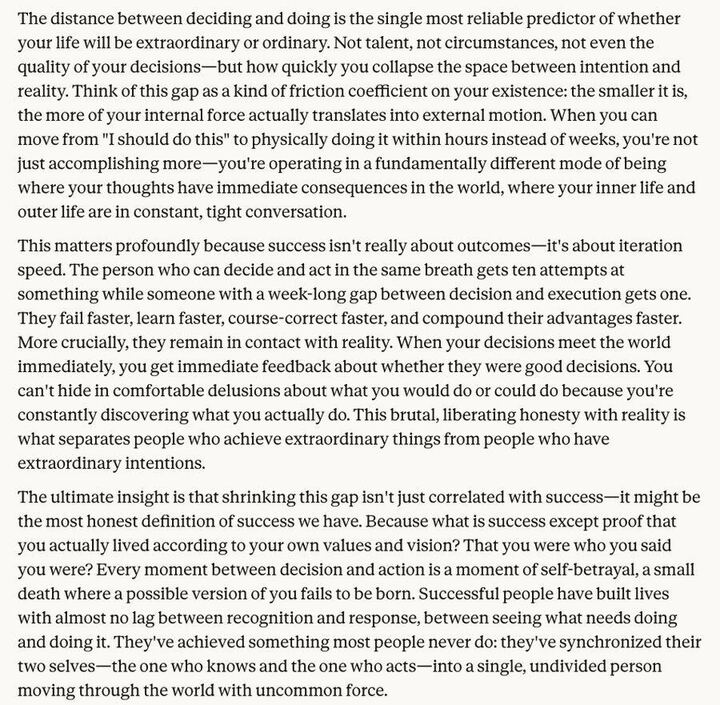
“The distance between deciding and doing is the single most reliable predictor of whether your life will be extraordinary or ordinary.”
These three paragraphs will change your life:
Without saying too much, if you have serious generational wealth goals, it might be smart to read up on some history regarding decaying/dissolving empires, who did best during those times and how. Might give you some valuable ideas that could potentially save you.
Did u know that Vincent Van Gogh's painting were worthless at one time?? Nobody wanted them—not even after his death. They were headed to rot forgotten in storage... Shocking, but check this out, it really brought me to tears and explains everything! 🤯
Yesterday, the world lost an outstanding physicist and a truly remarkable human being.
I first met Nuno a few years ago. He had studied physics at the same university I attended in Lisbon, and we were introduced by a mutual friend.
During a later visit to Boston, I reached out to see if he might be available to meet. Despite his recent promotion to Director of the Plasma Science and Fusion Center at MIT, and an understandably packed schedule, he did not hesitate to say yes.
I expected perhaps 15 minutes of his time in a hallway. Instead, the meeting turned into a 3-hour masterclass. Between cups of coffee and a flurry of back-of-the-envelope calculations, he gave me an unforgettable tour of the MIT fusion lab.
Nuno was one of those rare scientists who mastered his field so deeply that he could distill the most complex ideas into simple, elegant terms. Even as a world-class expert, he never forgot what it feels like not to know something; he could guide you up the "ladder of knowledge" step by step - a gift that reminded me of the greats, like Feynman.
His enthusiasm for the future of fusion was truly infectious. He had a rare blend of entrepreneurial drive and scientific rigor. I was so inspired that I remember ordering 4 books on the subject before I even got back to my hotel.
To the community of young Portuguese physicists, Nuno was a rare "local hero". He was a role model we could truly relate to - someone who once sat in the very same classrooms we did and proved that it was possible to reach the absolute pinnacle of the field.
Thank you, Nuno. You will be deeply missed. Rest in peace.
The bottleneck for deep skill isn't usually intelligence, but boredom tolerance.
Learning has an activation energy: below a certain skill threshold, practice is tedious, but above it, it becomes a self-sustaining flow state. The entire battle is persisting until that transition.
Hello everyone.
A friend told me that I shouldn't post this message because it made me and other PhD students look bad. But I actually think it's important to show how PhD students (especially foreign ones) have to deal not only with research-related difficulties, but also with many other challenges.
I am in the process of resuming my PhD studies at UCL in London after an extended period of medical leave. Unfortunately, I have been informed that I must re-apply for a visa (£524) and pay the health surcharge again (£776 per year). For a two-year application, this amounts to a total of £2,076.
Although it may not seem like a huge amount, I don't have that kind of money, especially since it's on top of other expenses related to my return to London, such as plane tickets, the deposit for the apartment, and my rent (as a foreign student, I'm usually asked to pay the first 3 to 6 months in advance).
I have been told that EPSRC/UKRI (the main funding body in the UK) does not cover any visa or immigration costs, even if you are on health-related leave.
I am therefore asking people for their support. I would be very grateful for any help, especially as I am currently considering whether or not I can actually resume my PhD.
Here is a link to a GoFundMe: https://t.co/yTB2nvnOUB
Please share this post!
A message from a Kindergarten teacher:
After forty years in the classroom, my career ended with one small sentence from a six-year-old:
“My dad says people like you don’t matter anymore.”
No sneer. No malice. Just quiet honesty — the kind that cuts deeper because it’s innocent. He blinked, then added, “You don’t even have a TikTok.”
My name is Mrs. Clara Holt, and for four decades, I taught kindergarten in a small Denver suburb. Today, I stacked the last box on my desk and locked the door behind me.
When I started teaching in the early 1980s, it felt like a promise — a shared belief that what we did mattered. We weren’t rich, but we were valued. Parents brought warm cookies to parent nights. Kids gave you handmade cards with hearts that didn’t quite line up. Watching a child sound out their first sentence felt like magic.
But that world slowly slipped away. The job I once knew has been replaced by exhaustion, red tape, and a kind of loneliness I can’t quite describe.
My evenings used to be filled with construction paper, glitter, and glue sticks. Now they’re spent filling out digital reports to protect myself from angry emails or lawsuits. I’ve been yelled at by parents in front of twenty-five children — one filming me with his phone while I tried to calm another child mid-meltdown.
And the kids… they’ve changed too. Not by choice.
They arrive tired, anxious, overstimulated. Their tiny fingers know how to swipe a screen before they can hold a crayon. Some can’t make eye contact or wait in line. We’re expected to fix all of it — to patch the gaps, heal the trauma, teach the curriculum, and document every move — in six hours a day, with resources that barely fill a drawer.
The little reading corner I once built, full of soft beanbags and paper stars, was replaced by data charts and “learning metrics.” A young principal once told me, “Clara, maybe you’re too nurturing. The district wants measurable results.”
As if kindness were a weakness.
Still, I stayed. Because of the small, holy moments that no spreadsheet could measure —
a whisper of, “You remind me of my grandma.”
a shaky note that read, “I feel safe here.”
a quiet boy finally meeting my eyes and saying, “I read the whole page.”
Those tiny sparks were my reason to keep showing up.
But this last year broke something in me.
The aggression grew sharper. The laughter in the staff room turned to silence. The light went out of so many eyes. I watched brilliant teachers — my friends — vanish under the weight of burnout, their joy replaced by survival.
I felt myself fading too, like chalk on a board that’s been wiped one too many times.
So today, I began my goodbye. I pulled faded art off the walls and tucked thirty years of handmade cards into a single box. In the back of a drawer, I found a letter from a student from 1998:
“Thank you for loving me when I was hard to love.”
I sat on the floor and cried.
No party. No applause. Just a handshake from a young principal who called me “Ma’am” while checking his notifications.
I left my rocking chair behind, and my sticker box too. What I carried with me were the memories — the faces of hundreds of children who once trusted me enough to reach out their hands and learn. That can’t be uploaded. It can’t be measured. It can’t be replaced.
I miss when teachers were partners, not targets. When parents and educators worked side by side, not in opposition. When schools cared more about wonder than numbers.
So if you know a teacher — any teacher — thank them. Not with a mug or a gift card, but with your words. With your respect. With your understanding that behind every test score is a heart that cared enough to try.
Because in a world that often overlooks them, teachers are the ones who never forget our children.
New Video Series: Statistics & Data Analysis!
https://t.co/YfJTxDeiHn
35 videos, 10 hours:
Random sampling, Central limit theorem, Distribution estimation, Method of moments, Maximum likelihood estimation, Hypothesis testing, Monte Carlo sampling, Bayesian statistics, and more!