#BREAKING 🚨🚨🚨🚨🚨🚨
💥I have recorded this episode on my YouTube channel “Politically Very Incorrect” a year ago, explained why & how israel would assassinate Hizbullah’s leaders & launch a war against its allies in Iran! 👇🏽👇🏽👇🏽
#USA #IranIsraelWar #LebanonUnderAttack
https://t.co/sF24UYlRan
@ME_Observer_ Funny this coming from a former ISIS commander; the same ISIS that’s an israeli creation!
Also, why not give the same advice to your masters in Iran?
"Die vorherrschende Meinung ist, dass der Markt eine hohe Rendite abwirft, wenn die Haltedauer nur lang genug ist. Aber der Einstiegszeitpunkt ist das, was wirklich zählt."
(Seth Klarman)
In meinem heutigen Blog zeige ich Dir die 5 fatalsten Anlegerfehler in reifen Bullenmärkten wie jetzt - und wie du dich gegen diese schützen kannst.
https://t.co/bYUWqqCRBU
This woman was recording a vocal performance when her cat interrupted, stepped in front of the camera, and started singing in the exact same tone like, 'Don't forget who's the real star here.'
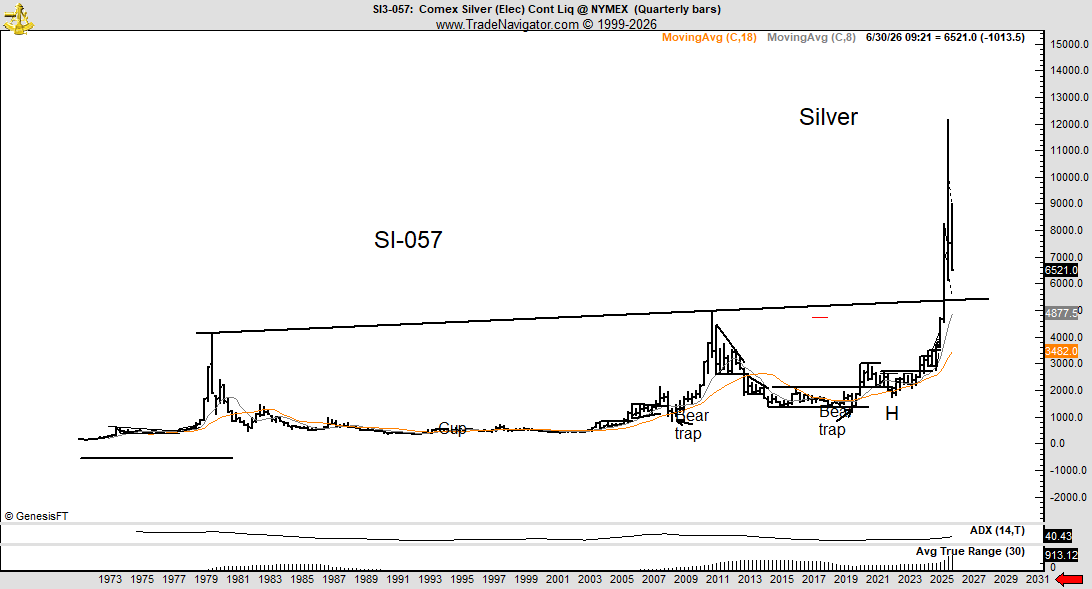
Major support in Silver comes in at $54
Here is how the dynamics of price behavior works:
Late comer bulls who bought >$90 missed the top and have sworn to themselves that they will never sell out
In fact, they have stated their intent to buy more at $65 and more at $60
They will mark the bottom by puking out their positions below $60 swearing to never trade Silver again
This is how bottoms are made every time in every market be it Silver or Bitcoin or Soybeans or Sugar or the S&Ps
$SI_F #silver
As someone who partially grew up among European elite kids like him, this reminds me just how incredibly hollow some of them are.
For a quick background, I went to one of the poshest high schools in France (Janson de Sailly, for those who know) and, afterwards, to what was at the time - and probably still is - the most expensive undergraduate school in Europe (EHL in Lausanne, Switzerland).
Needless to say, many of my classmates were from unbelievably privileged backgrounds. Just in my classroom in Lausanne I had the son of a (very famous) Russian oligarch, the son of Italy's largest real estate developer and the son of Spain's largest real estate developer (funnily, the latter two were flat mates).
Another classmate of mine came from the richest family in Naples, Italy and - while we were at school - his father (known in Naples under the nickname "Il Sultano") got arrested for having bribed half of Naples's city council - which, if you know Naples, ought to tell you something.
These were the kids I was doing group projects on business ethics with (literally) 😅
Anyhow, my story, and probably my luck, was that - before going to high school in Paris - I was raised in very normal public schools in the South of France where my friends were anything but wealthy. Their parents were farmers and everyday workers.
Which means - and I'd come to realize this was very important in life - that it was easy for me to understand how big a mistake it is to see money as identity and meaning - and to confuse someone's net worth with their actual worth.
What really struck me at the time was the contrast with my "poor" classmates of earlier in my life. They couldn't define themselves by what they had - by definition - and this forced them to reach deeper for their identity: their skills, knowledge, humor, etc.
Rich kids can skip that entire process, and the tragedy is that most of them do: they reach for the readymade identity that money provides. I remember being incredibly frustrated by many of my classmates, like "ok, I get it, your dad is rich and you own a lot of nice things but who are YOU, what else is there?" The answer, more often than not, was nothing.
To be fair, there were exceptions. One of my classmates I was most impressed by came from one of Zurich's wealthiest families (which, if you know Zurich, means insanely wealthy) yet he was almost OCD in not showing he had money: driving the shittiest car imaginable, living in a small studio, etc. He was very intellectual, very contrarian, and clearly at war with the idea that his family's wealth ought to define who he was.
I only discovered who he actually was when I started my first company and he approached me to invest: to discuss the investment I went to one of his family homes, which it turned out was a literal palatial castle on the shores of Geneva lake. The guy had decided to live in a small rundown studio when he literally had a castle sitting empty a 5-min drive away.
THAT I was impressed by: it's easy to see that money isn't meaning when you don't have any. To see it when you have more than almost anyone - when everyone around you is organized around the opposite assumption - is much harder. But to actually live it, to choose the studio when you have the castle keys in your pockets - with no audience to applaud you for that - that shows real depth.
At the end of the day, I think, the real distinction isn't between rich and poor but between people who exist from the inside out and people who exist from the outside in.
Wealth just happens to make it incredibly easy to be the latter, to skip the work of becoming someone and settle for a borrowed identity that glitters from the outside but is hollow all the way through. A Potemkin village identity.
This is actually a real societal issue, and magnified by social media (with idiotic posts like this one 👇): the more "outside in" folks out there, the less people with genuine internal anchors, the more fragile everything becomes.
When you think about it, everything that genuinely matters in a society is built by people who think for themselves: they take the world in, pass it through something genuinely their own, and give back something that didn't exist before: an idea, a conviction, a stand.
Every reform, every invention, every act of moral courage in history came from someone with an internal anchor strong enough to resist the current. Remove those people and all you have left is the current.
This isn't new, by the way. Most ancient traditions warn against exactly this, from the Bible (the golden calf story) to Confucius, who built his entire ethics around the distinction between the exemplary person (the Junzi, 君子) - oriented around internal cultivation and righteousness - and the petty person (Xiaoren, 小人), oriented around profit and gain. The junzi builds himself from the inside, the xiaoren chases what's outside.
So please, do not make the mistake of being impressed by wealthy people flaunting their wealth. Don't focus on the glitter, focus on the hollowness it's trying to hide.
“I don’t stake more than 2-3% of my wealth in trading.”
“I never feel stressed after losing money. I may feel for 5 minutes but as Churchill once said - you will loose many battles to win a war.”
- Rakesh Jhunjhunwala. 2006. CNBC
On 8 June 1903, Marguerite Yourcenar was born, a woman who spent her life proving one simple yet uncomfortable truth: that intellect has no gender, and time has very little respect for human prejudices.
She was born in Brussels into a family that from the very beginning resembled a novel more than a biography. Her mother died days after her birth, and thus the dominant figure in her early life became her father, Michel de Crayencour, an aristocrat, aesthete, skeptic, traveller, and a man courageous enough not to turn his daughter into a well-mannered mediocrity.
Instead of school, there were libraries; instead of ready-made truths, there were questions; instead of obedience, there was freedom.
Perhaps that is where the real Yourcenar began.
"I was born when I started reading books."
Few writers have ever said so much in a single sentence.
Because for Yourcenar, reading was never an escape from life.
It was a way of living several lives simultaneously: Antiquity, the Renaissance, Byzantium, France, Rome, and above all, the human soul itself.
All of these meet within her books.
And above all in her masterpiece, "Memoirs of Hadrian", where a Roman emperor reflects upon power, love, old age, death, and the limits of human wisdom with such intimacy that one forgets nearly two millennia stand between the author and her protagonist.
Few books are so intelligent, and even fewer are so profoundly human.
Then came "The Abyss", that immense philosophical novel about the free mind, the price of independence, and the tragedy of a person born too early for their own ideas.
And here Bertrand Russell would probably smile.
Because Yourcenar belongs to that rare category of authors who were never interested in fashionable opinions.
She was interested in civilization, memory, time, and humanity itself.
Her philosophy of life is almost Stoic.
She does not place much faith in heroic gestures, noisy ideologies, or collective hysterias.
She believes in character, intellect, and personal dignity.
"Nothing moves me more than courage."
And when one reads her life, one begins to understand why.
Love also occupies an important place in her world. The deepest relationship of her life was with Grace Frick, the American translator with whom she shared decades of her life, her books, and her intellectual space. It is one of those rare love stories in which passion gradually gives way to something rarer and more enduring: friendship between two powerful minds.
The more I read Yourcenar, the more it seems to me that she never wrote about the past.
She used the past as a mirror through which to see the present and ourselves.
Because great authors understand something important.
History is not a collection of events.
It is a collection of human souls.
And perhaps that is why Marguerite Yourcenar remains so contemporary.
Because the world is constantly changing, while human nature almost never does.
And as she herself wrote:
"One's native land is the place where one first looks upon oneself as an intelligent human being."
When Marguerite Yourcenar entered the French Academy.
Still, what Soros was doing required inner fortitude. "I sat in his office when he made decisions about hundreds of millions of dollars, observed Daniel Doron, a public affairs commentator and director of the Jerusalem-based Israel Center for Social and Economic Progress. "I would shake in my boots. I wouldn't sleep. He was playing with such high stakes. You had to have nerves of steel for that. Maybe he was conditioned for that.”
Soros: The World's Most Influential Investor - Robert Slater
This isn’t even remotely true. $AMZN went public in 1997 at a $450M valuation, or 3x revenues. $GOOGL went public in 2004 at a $23B valuation and at 7x revenues. $META had a $104B valuation in 2012 at 20x revenues(and immediately sold off almost 50%). SpaceX dwarfs these numbers.