the art of keeping in touch:
> please please ALWAYS feel free to reach out to your friends that you've lost touch with. it will be the most welcome surprise
> if you're insecure why you lost touch; it happens and it's a normal part of life. that doesn't make your memories together any less special
> old friends are next level comfort. it’s history, past, and context that doesn’t need to be explained since they lived it right beside you
> there are life seasons - people move, change jobs, start school, start dating, breakup, get sick, grieve - all of these can impact how easy it might be to stay in touch and it's generally never personal
> make it a habit: whenever someone comes to mind, text them immediately. don't overthink it! this helps to maintain a lot of relationships at once
"hey, was just thinking about you! how you been?"
"just remembered the time we <funny memory together> it made me smile"
"saw <thing that reminds me of you> and thought of you"
> getting this type of message will likely make their day and bring back good memories for the both of you
> from there you can: have a back-and-forth texting convo, send voice memos, hop on a call, or figure out when you'll be in the same city again and make plans (woohoo!!)
> just as you're changing over time, your old friends are changing too. they're growing up right alongside you. even if you don't connect in the exact same way you did before, the shared context and memories are wonderful and irreplaceable
don't wait for the 'perfect moment' to reconnect - that perfect moment is now 🤍
The smartest person in any room is usually the one everyone thinks is dull.
They’ve mastered “strategic invisibility.”
Watch them in meetings. While others compete to showcase their knowledge, they ask questions that expose gaps in logic or reveal assumptions nobody else caught.
They frame these inquiries as genuine curiosity instaed of intellectual challenges. The room thinks they’re just trying to understand. They’re actually teaching.
True intelligence recognizes that being perceived as the smartest person creates a target on your back. Colleagues start viewing you as a threat. Bosses worry you’ll make them look incompetent. Friends become defensive in conversations. The social cost of displaying your full cognitive capacity often outweighs the benefits.
So they develop camouflage.
They’ll let someone explain a concept they understood years ago, nodding thoughtfully, asking follow up questions that guide the explainer toward better conclusions. They’re not learning. They’re leading without anyone realizing they’re being led. The explainer walks away feeling brilliant. The hidden genius walks away with social capital and new information about how that person thinks.
Pay attention to their word choice.
Genuinely intelligent people who are hiding it will use simpler language than their vocabulary actually contains…
They’ll say “that’s interesting” instead of “that’s a fascinating manifestation of bounded rationality in decision making under uncertainty.” Same insight, zero intimidation.
They remember everything but pretend to remember selectively. They’ll “forget” minor details that would make them look like they were paying too much attention, but somehow always recall the exact piece of information needed to solve a problem three weeks later. Convenient memory gaps coupled with perfectly timed recall.
The tell is in how they handle being wrong.
Average people get defensive when corrected. Actually smart people get curious about their error. People pretending to be less intelligent will get visibly excited when someone teaches them something, even if they already knew it. They treat every correction as a gift because they understand that people love feeling helpful and knowledgeable.
But the real giveaway is what they do with information asymmetry.
Most people hoard knowledge to maintain advantage. Hidden intellectuals do the opposite. They’ll casually share insights that solve other people’s problems without taking credit. They’ll send articles, make introductions, offer perspectives that save someone hours of work. They position themselves as connectors and facilitators, never as the source of wisdom.
Everyone remembers who helped them. Nobody feels threatened by someone who makes them look good.
Smart people pretending to be average understand that influence flows to those who make others feel intelligent, not to those who prove their own intelligence. They’ve realized that being underestimated is a superpower. People speak more freely around them. Share sensitive information. Include them in discussions where the “obvious genius” would be excluded.
They’re collecting data while everyone else is performing.
The deepest irony is that this strategy actually makes them more intelligent over time.
Long story short, the person who appears to know everything usually knows less than the person who appears to know just enough.
I've found a good way to spot outlier people is to look for 'script-breaking' when you have a conversation with them.
Because so many people are parroting things they've read or heard, most conversations fall into a handful of predictable scripts. You're mostly trading soundbites.
Every once in a while you meet someone where you can't really predict what they'll say or how they'll think about something in a conversation. If they consistently surprise you, I've found that's a pretty good indicator that they're special on some dimension.
I know someone who is extremely good at disagreeing with someone in a way that makes you feel safe and excited to discuss. It’s somehow completely clear just how wrong he thinks you are & simultaneously how welcome and respected you are. Pretty aspirational
watch a lion hunt. pure murder wrapped in perfect grace. no shame in its violence, no pride in its mercy. when it kills, it kills. when it rests, it rests. doesn't waste time judging its nature or apologizing for its hunger. grace isn't pretty - it's honest.
Nostalgia is memory telling you that you were once exactly where you needed to be. What a privilege it is to have lived days worth missing, to carry time within you as proof that you’ve felt deeply, that there were days so full they glow in hindsight and refuse to fade
Everyone deserves a parents home. A home, where the doors are always open, where you can lay wherever you want to, wearing whatever you want to. A home, where you can always be a bit of a brat, a home that spoils you. You can keep your feet on the Living room table, drag a blanket to the drawing room to watch television.
You know that the refrigerator always has some food that was made for you, just in case you come home hungry from a dinner. A kitchen that you know well and a kitchen where you can make any noise at any hour of the night and no one will mind. Even if they wake up, they will not be annoyed but will ask you if you need anything to be made.
You can decide to do nothing for a couple of days and no one minds. Everyone deserves a parents home at every age...
1/
Get a cup of coffee.
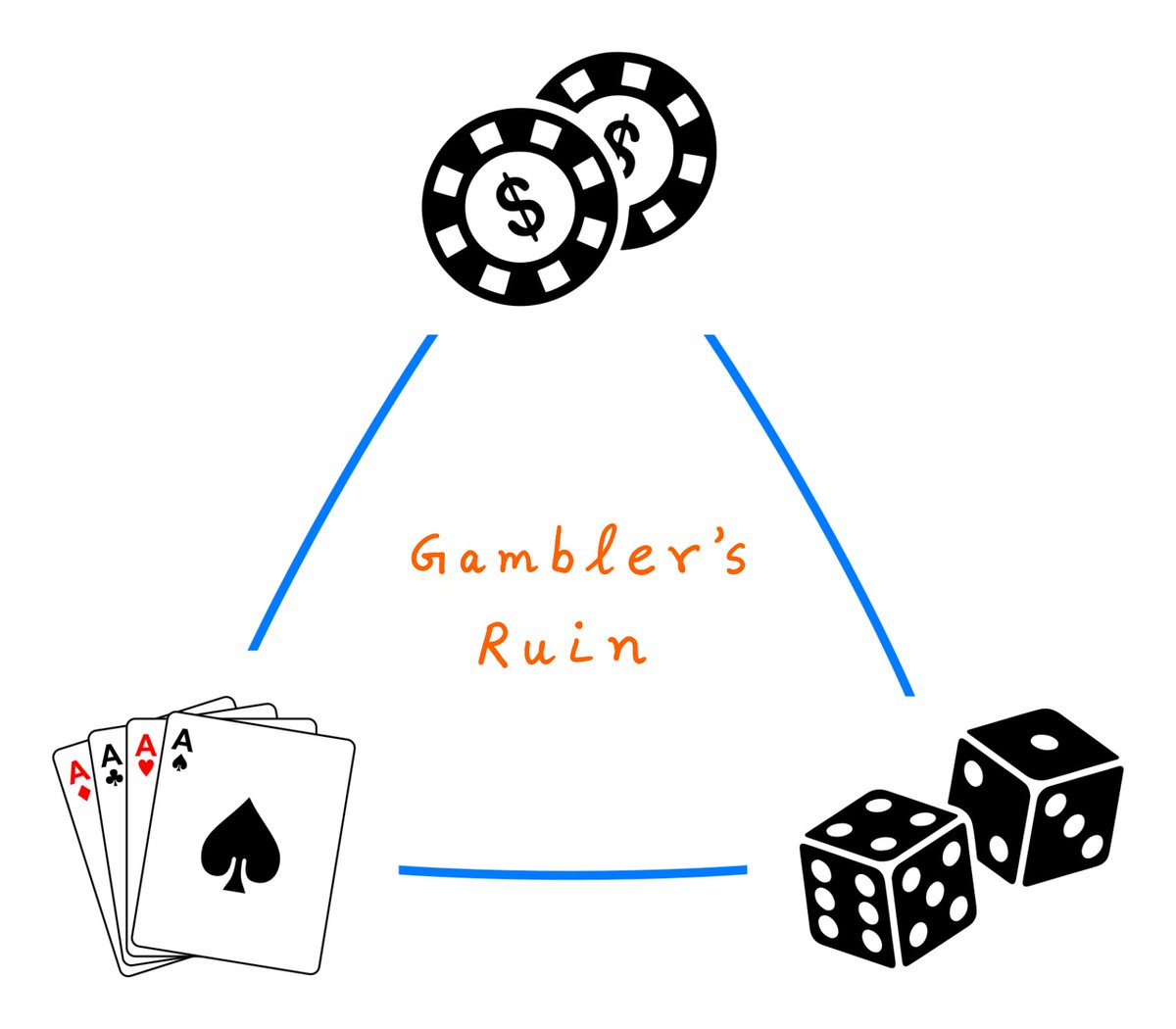
In this thread, I'll walk you through "Gambler's Ruin".
This is a classic exercise in probability theory.
But going beyond the math, this exercise can teach us a lot about life, business, and investing.