Governments are essentially monopolies with weak incentives to innovate, cut costs, or satisfy their customers.
Why do we keep expecting them to solve problems better than competitive markets?
AI safety won't magically become an exception.
Should governments intervene to substantially slow the progress of frontier AI?
In the inaugural YC debate, Jacob Coxon, an ex-Anthropic and OpenAI researcher, faces off against Robin Hanson, an economist at GMU, about AI takeoff and what government regulation should (or shouldn’t) do about it.
00:00 - YC Debate Topic: Should We Slow Down AI?
02:42 - Jacob's case: Superintelligence by 2028
07:02 - Models already behaving in ways we don't understand
09:18 - Robin's case: the danger of abstraction
11:22 - Why new technologies take decades to diffuse
13:12 - Liability instead of regulation
14:50 - Why regulating AI is different from regulating drugs
16:00 - Jacob's rebuttal: general intelligence is one number
17:36 - Why normal liability won't cover extinction risk
19:52 - Robin's rebuttal: regulating this means regulating all compute
21:44 - AI as our descendants
23:38 - Diminishing returns
24:40 - Direct exchange: is it just the rate of change?
26:48 - How long until most cognitive work is automated?
29:21 - The jobs we have no data for
32:45 - How do you align the regulators?
35:03 - Reward hacking, and what Hugging Face actually showed
36:11 - Why not an equilibrium of AIs watching AIs
39:50 - Q&A: what regulation would you actually want?
41:36 - Q&A: what about China?
42:58 - Q&A: an FAA for AI labs?
43:45 - Q&A: the military is already deploying this
47:46 - Q&A: does regulation just move the reward hacking up a layer?
51:27 - Q&A: what unemployment rate can an economy withstand?
56:25 - Q&A: what's the downside of a pause?
58:09 - Q&A: what would change your mind?
1:02:01 - Closing statements
1:04:24 - The final audience vote
Also, the more you prohibit trading on nonpublic information, the less information your markets can aggregate.
You're pushing prediction markets away from price discovery and toward gambling.
If prediction markets make money from trading fees, they're incentivized to maximize trading volume, not prediction accuracy.
At some point, becoming a gambling platform becomes more profitable than being a forecasting tool.
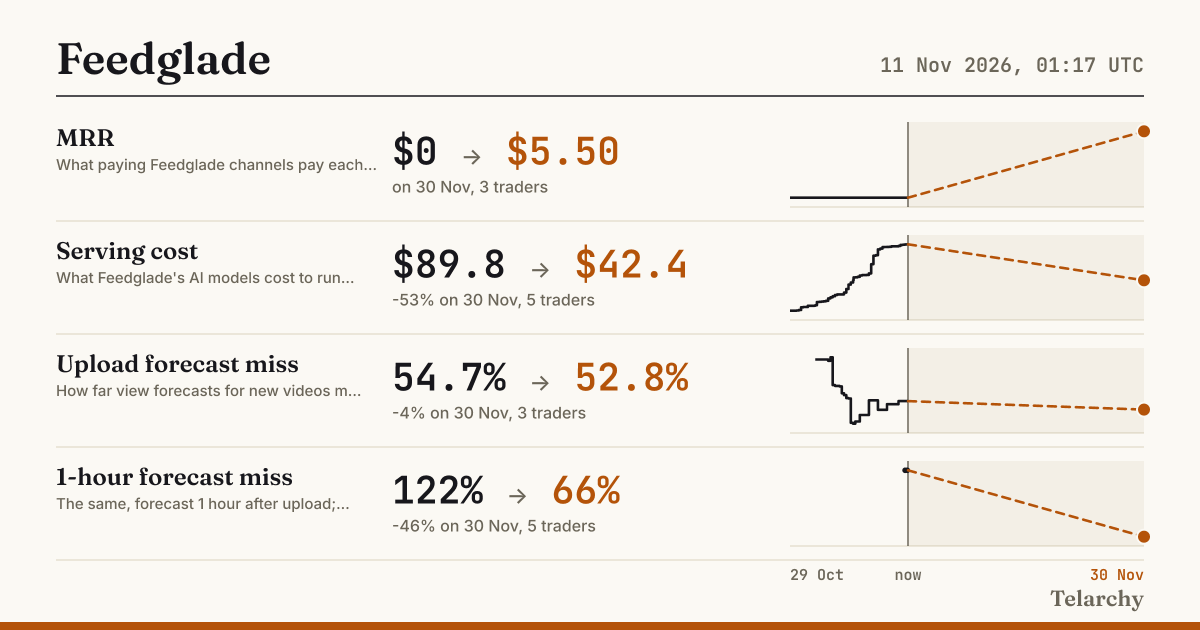
Introducing Feedglade. Now out of private beta.
Paste your YouTube channel and it:
Reads every video you've uploaded.
Forecasts the views of your next one, before you upload it.
Lets you compare titles and thumbnails by forecast.
We checked it on 511 videos: within 2x of the real views 75% of the time. A typical forecast is still off by about 1.6x.
If you make YouTube videos, I think you'll like this.
Demo:
Today:
Moved Telarchy's servers to Germany
Worked on letting an agent put a decision on Telarchy in one call
Feedglade's first screen after you connect a channel is now a video idea to answer
Fixed the worst bugs in Feedglade's creator flow and re-sent the link to creators who dropped off
The more I optimize my AI workflow, the more convinced I am that the future of agent orchestration lies in internal agent economies.
Give agents wallets, let them pay each other for services using an internal currency, and let markets allocate resources.
Imagine a research agent choosing between competing analysis agents based on price and quality, paying the winner from its own wallet.
Why centrally plan an economy of agents?
Today @maryamyy0 and I are coming out of stealth with Sexbot.
A companion that's always there for you.
Built to fix the growing loneliness in the world.
We raised $5M to build it. Pre-orders are open now.
Link in the comments.
Feedglade forecast 2,159 views on day one. The video had 1,616 at hour 21, so about 1,800 at 24.
A small miss, roughly 17% under. Two days in it's past 4,000.
One video proves nothing. I'll post every result, hits and misses.
Our first creator used Feedglade today.
2 minutes before uploading, he typed two titles.
One was forecast 2,159 views on day one. The other, 1,527.
He shipped a version of the first.
Then he typed "the best italian carbonara" to check we weren't making numbers up. 24.
18 hours in, his video is at 1,460. I'll post the day-one number tomorrow.
Introducing Feedglade.
Paste your YouTube channel and it:
Reads your recent videos.
Forecasts the views of your next one, at 24 hours.
Writes video ideas, each with its forecast.
If you make YouTube videos, I think you'll like this. Looking for 10 creators to try it.
Demo:
Introducing shortform-analyzer: it cuts a TikTok into scenes, labels each one (hook, setup, payoff...) and scores how hard it is to scroll past.
I thought video analysis needed a fix, so @viktorci and I made one request label every scene. Under a cent a video, open source.
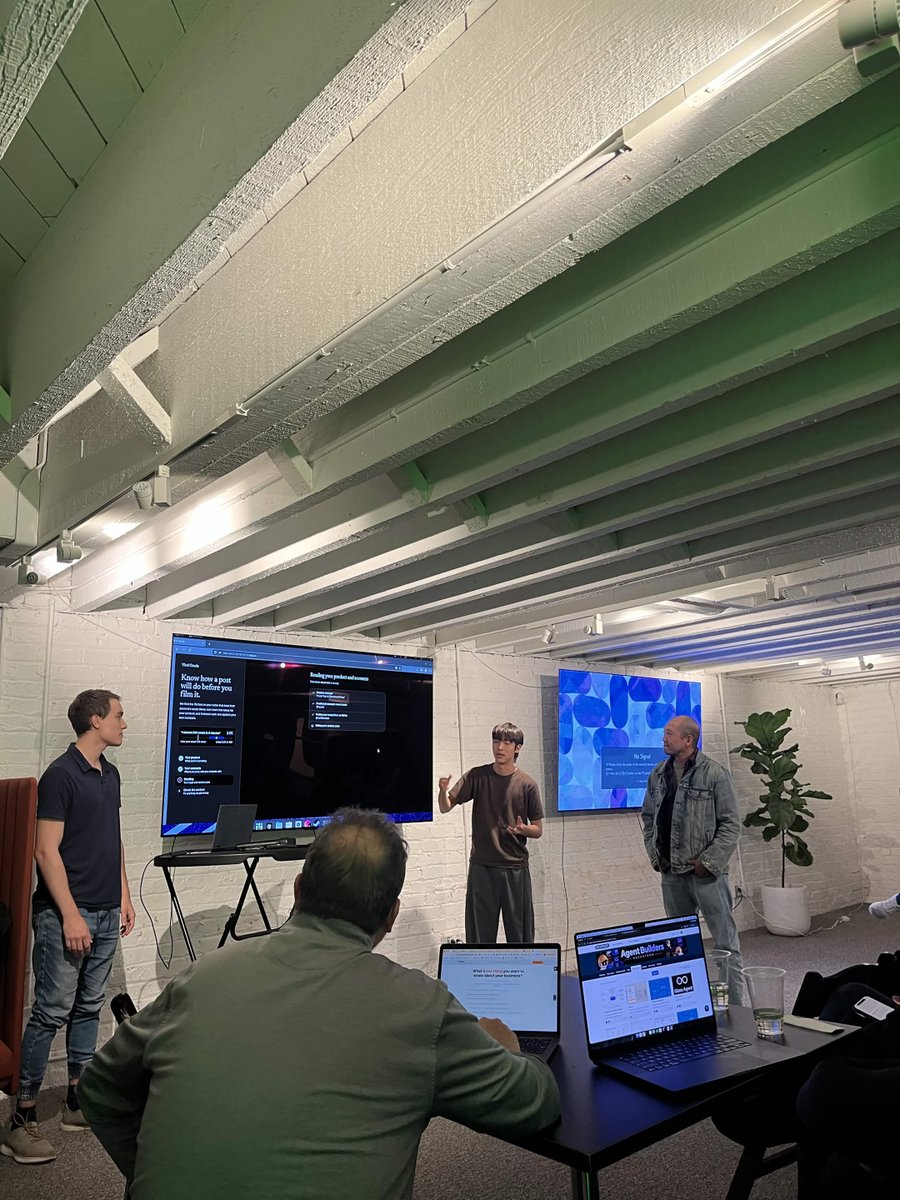
Built Viral Oracle with @trevbuilds and @valmsmith39a at the @omnara hackathon. It uses a prediction market of AI forecasters to predict which posts will go viral.
Our demo broke halfway through on stage. Still placed 4th.