The National Library of Medicine has stopped indexing articles from @SciReports in MEDLINE because the journal’s inclusion in the world’s largest biomedical library is under review, Retraction Watch has learned.
https://t.co/8NKSeo6LPs
"The Case of the Should-Be-Missing Proteins": On Sholto David's search for papers with "erroneous claims of protein expression."
https://t.co/jvoQ65Hsqz
https://t.co/2Gn4kqriU8
I am ringing the alarm.
We have now found >400 papers that all share a very similar title layout, graph layout, and (most importantly) the same Western blot layout.
This is a massive #PaperMill of (what we assume) fabricated data.
Retracted papers will be easier to spot with a new deal between @RetractionWatch & @CrossrefOrg. #iSchoolUI Assoc. Prof. @jodischneider, whose research focuses on reducing inadvertent citing of “zombie papers,” is featured in this @ScienceMagazine report: https://t.co/YrwGKWoMd9
This is a single case report with no biomarker-confirmed Alzheimer’s diagnosis and no standardized cognitive testing. The report’s authors explicitly say causality cannot be established.
Non-medically-trained charlatans shouldn’t promote anecdotes as evidence. *That* is insane.
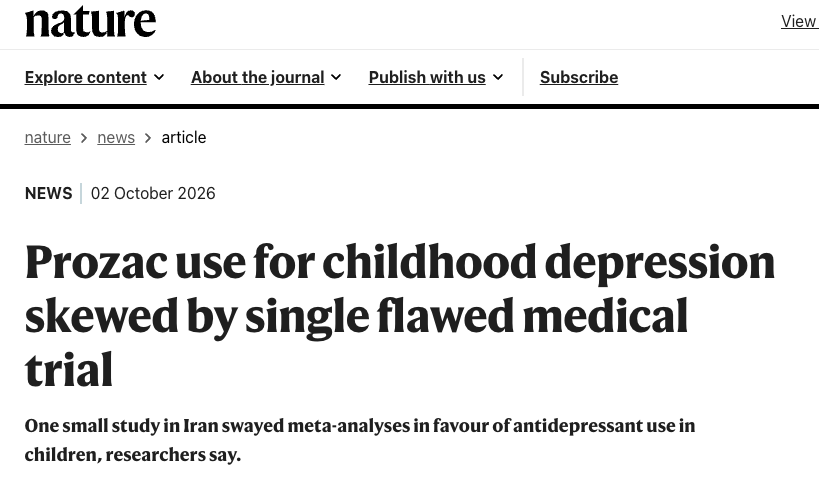
This is certainly the most consequential paper published in child and adolescent psychiatry for the last few years. It shows that the meta-analyses that current child psychiatry guidelines rely on to recommend fluoxetine for depression were skewed by an unbelievable trial (n=40) in Iran which found an effect 15 times larger than the average.
When this trial is removed all meta-analyses find the same as a recent Cochrane analysis which found 'small and unimportant differences.'
The flawed meta-analyses by Zhou and @cipriani in the @TheLancet and Lancet Psychiatry need to be corrected.
And guideline committees need to update their guidance in the context of the harms of these drugs including withdrawal effects, sexual effects and agitation/akathisia and suicidality in a minority of youths exposed to them.
Link below
Today I'm posting a new video to my YouTube channel! A recent case report published by Frontiers in Medicine includes AI generated images with SynthID watermarks. https://t.co/vLjmQsIDlc
Scientific fraud is a growing problem. “You can’t just read an abstract and have any faith in it. I kind of assume everything’s wrong,” a scientist and journal editor told me. Read our deep dive for @ConversationUS https://t.co/i4N8acywDa