🪨 A Tiny Hole in a Giant Stone… But Its Purpose Still Mystifies Experts
At first glance, it looks like nothing more than a small hole carved into a massive stone wall. But when you realize where it is—and who built it—it suddenly becomes far more fascinating.
This mysterious feature can be seen inside the massive stone walls of Sacsayhuamán, an ancient fortress located high above the historic city of Cusco in Peru. The structure was built in the 15th century by the powerful Inca civilization, a society famous for its incredible engineering skills.
Sacsayhuamán itself is legendary. Its enormous stones—some weighing more than 100 tons—fit together so perfectly that even a thin blade cannot slide between them. No cement. No mortar. Just pure precision. Even modern engineers are still amazed by how these stones were cut and assembled with such perfection.
But hidden within one of these gigantic blocks is something unusual: a small carved opening that leads into a narrow, smooth channel cut directly into the stone. The channel looks carefully shaped, almost as if it was drilled or polished with surprising accuracy.
So what was it used for?
Archaeologists have several theories. Some believe the channel may have been designed for drainage, allowing rainwater to flow away from the walls during heavy storms in the Andes. Others think it may have played a role in ritual offerings, possibly guiding sacred liquids during ceremonies performed by Inca priests. A third idea suggests it could have been part of a precise architectural alignment, connected to the advanced planning behind the fortress.
Whatever its true purpose was, one thing is certain: it shows the extraordinary stoneworking skills of Inca craftsmen. These builders shaped incredibly hard stone using simple tools made of stone, bronze, and patience—yet the results still stand strong centuries later, even in a region famous for earthquakes.
Standing in front of this small carved feature today raises a powerful question.
How did a civilization without modern machines manage to carve, move, and fit stones with such astonishing precision?
Sometimes, the biggest mysteries of the ancient world are hidden in the smallest details.
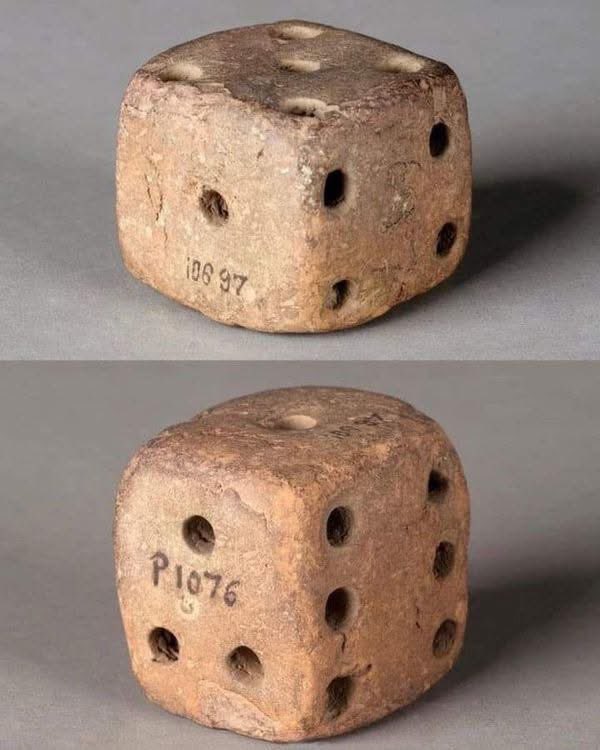
The 5,000-Year-Old Dice That Proves Ancient Humans Loved Gambling Too 🎲
Buried beneath the dust of ancient ruins in Mohenjo-daro, archaeologists uncovered a small object that feels strangely familiar… a tiny terracotta dice from the mysterious Indus Valley Civilization, dating back nearly 5,000 years.
At first glance, it looks almost modern. Tiny carved dots mark each side, just like the dice people still roll today during board games, bets, and moments of pure luck. But there is something eerie about it. The arrangement of the numbers is slightly different from modern dice, hinting that the forgotten people of this ancient civilization may have played games with rules now lost to history.
Imagine the scene for a moment…
A crowded street in one of the world’s earliest cities. Oil lamps flickering in the night. Merchants, travelers, and wealthy citizens gathered around a game board. A hand reaches forward… the clay dice rolls across the floor… and everyone holds their breath waiting for fate to decide the outcome.
That exact feeling — the suspense, the hope, the fear of losing — existed thousands of years before modern civilization was born.
The dice itself is worn smooth around the edges, showing it was handled again and again by real people who once laughed, argued, celebrated victories, and cursed bad luck. It is more than an artifact. It is proof that human emotions have barely changed across 50 centuries.
What makes this discovery even more fascinating is that the people of the Indus Valley left behind no fully understood written language. Their secrets remain locked away in silence. So this tiny cube becomes one of the few surviving clues to their daily lives — a silent witness to entertainment, competition, and perhaps even ancient gambling.
And somewhere in the distant past, someone may have made a life-changing decision based on the roll of this very dice.
On December 20, 1522 CE, the gates of Rhodes opened up. After six months of siege, shattered walls, and streets choked with rubble and corpses, the surviving Knights Hospitaller marched out beneath their black banners, Crosses still stitched to their cloaks. Sultan Suleiman the Magnificent, conqueror of Belgrade and future master of much of the Mediterranean, watched them go. He had broken their fortress, but not their order. Impressed by their resistance, he granted terms rare for the age: safe passage, protection for civilians, and freedom to depart with their arms and relics. It was a moment of exhausted respect between enemies who understood war.
Knights were not a kingdom, and now they had no home. Founded centuries earlier in Jerusalem as a brotherhood sworn to care for sick pilgrims, they had long since become warrior-monks—the Knights of St. John—defending Christendom’s eastern frontier. Driven from the Holy Land, they had turned Rhodes into a stone fist clenched against Ottoman expansion, harassing Muslim shipping and sheltering Christian refugees. But that defiance had finally drawn Suleiman’s full attention. Rhodes fell—but the Order survived.
For years the Knights wandered, unwanted guests of Europe’s quarrelsome princes, until in 1530 CE, they were granted a barren rock by Charles V: Malta. From that fortress-island they remade themselves yet again, now known to history as the Knights of Malta. They became the corsairs of Christendom, launching daring sea raids against Ottoman vessels, ransoming captives, and turning the central Mediterranean into a lethal chessboard. Their galleys struck fast and vanished. Their fortresses bristled with cannon. They were small in number, but relentless.
Their defining hour came in 1565 CE, when Suleiman—old now, but still formidable—returned to finish what he had begun. At the Great Siege of Malta, tens of thousands of Ottoman troops descended on the island. The Knights, vastly outnumbered, fought with ferocity bordering on madness. At Fort St. Elmo, defenders died almost to the last man. Grand Master Jean de Valette, wounded and in his seventies, refused surrender. When relief finally arrived, the Ottoman army withdrew in ruins. Europe rang bells. Malta had held. It was a grand day for Christendom.
But time is the enemy no fortress can defeat. The age of crusading orders faded, and the Knights’ power ebbed with the sail and the cannon. In 1798 CE, Napoleon seized Malta without a fight, and the Order was scattered once more. They never recovered their sovereignty. Yet they never disappeared. Today, the Sovereign Military Order of Malta survives as a humanitarian and medical organization, still tracing its lineage to those men who marched out of Rhodes with heads held high.
📷 : a 15th Century CE, French manuscript illumination, invading Ottoman ships fill the harbor at Rhodes as the defiant Knights Hospitallers man the ramparts in defense.
#archaeohistories
On this day in 362 BC, the greatest general nobody talks about won the biggest battle of his life and died the same afternoon.
His name was Epaminondas, a Theban. Ten years earlier he'd done the impossible at Leuctra, smashing the Spartan army everyone thought couldn't be beaten. He basically invented a new way of fighting, loading up one wing of his phalanx into a massive hammer and crushing the enemy's best troops before the rest of the line even engaged. Sparta never really recovered.
At Mantinea he did it again. He stacked his left, feinted like he was making camp so the enemy relaxed, then swung his whole army forward like a warship ramming home. The Spartan side buckled. The Thebans and their allies were pouring through the gap. It was happening.
And then a spear found his chest.
They carried him off the field still breathing. The story goes he asked if his shield was safe, was told yes, asked if Thebes had won, was told yes, then told them to pull the spearhead out. He knew that was the end. He had no son and no clear successor, and the two men he trusted most were already dead on that field.
So Thebes won the battle and lost everything that mattered. Without him there was nobody to hold the supremacy he'd built. Xenophon, who lived through that whole era, basically threw up his hands and said Greece was more confused and uncertain after this "victory" than before it.
A generation later a kid named Philip of Macedon, who'd spent time in Thebes as a hostage, took those tactics and conquered everyone.
2388 years ago today.
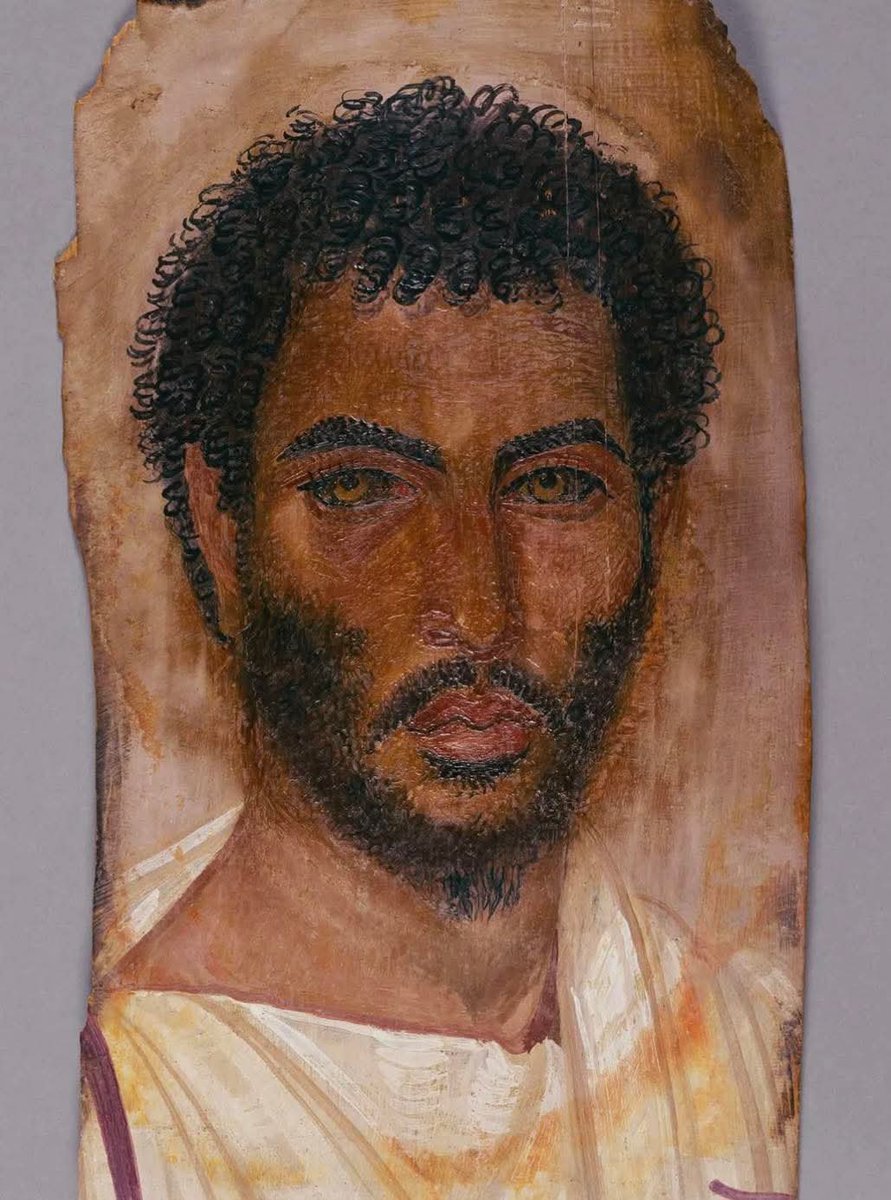
Portrait of an unidentified man that was placed over the face and upper torso of his mummy. Dated to 150–170 AD, it is painted in encaustic on a panel of linden wood, and it was originated in Roman Egypt.
This remarkable portrait belongs to a group of artworks known as the Fayum mummy portraits, a tradition that flourished in Roman Egypt between the 1st and 3rd centuries AD. Unlike the stylized depictions of faces seen in earlier Egyptian funerary art, these portraits were painted in a strikingly naturalistic style, giving us lifelike glimpses of people who lived nearly 2,000 years ago.
Painted in encaustic, a technique using hot wax mixed with pigment, the colors remain vivid even after centuries. The medium gave artists the ability to capture depth, texture, and warmth, preserving the humanity of their subjects with astonishing realism. In this particular piece, the curly hair, sharp eyebrows, and direct gaze make the man seem almost alive, as though he could step out of history and into the present.
The portrait was originally placed over the face and chest of the deceased’s mummified body, merging Egyptian burial practices with Roman artistic sensibilities. These works represent more than individual likenesses—they reflect the cultural blending of Greek, Roman, and Egyptian traditions in a society at the crossroads of the ancient Mediterranean world.
What makes the Fayum portraits so moving is the intimacy they provide. Unlike statues of emperors or gods, these images show ordinary people: merchants, soldiers, mothers, and children. Each one is a reminder that behind the ruins and relics of antiquity were lives full of stories, emotions, and identities. This man’s name may be lost to time, but his face survives as one of history’s most hauntingly personal echoes.
#archaeohistories
Archaeologists find 2000 year-old 'Gemstones' in drain beneath a Roman Bathhouse, Carlisle, England 🏴🇬🇧
Down a drain beneath the murky waters of an ancient Roman bathhouse in Carlisle, England, near Hadrian’s Wall, archaeologists have discovered a trove of gemstones lost by bathers 2000 years ago. More than 30 gems, including amethyst, jasper and carnelian have been found so far during excavations at the site. Wealthy bathers likely dropped them back in opulent bathhouse’s heyday in 2nd-3rd Century CE.
“It’s incredible,” says archaeologist Frank Giecco, who led the excavation, to Observer’s Dalya Alberge. “It’s caught everyone’s imagination. They were just falling out of people’s rings who were using the baths. They were set with a vegetable glue and, in the hot and sweaty bathhouse, they fell out of the ring settings.”
The pieces feature deities dedicated to war, sun, commerce, luck and fertility. The largest were around 0.6 inches and smallest were just under 0.2 inches. Their small size would have made the carvings particularly difficult, requiring the expertise of an advanced craftsman.
“You don’t find such gems on low-status Roman sites,” Giecco tells Observer. “So they’re not something that would have been worn by the poor.” Still, Carlisle site isn’t entirely unique: In the past, similar gemstones have been found in the drains of other bathhouses during archaeological excavations.
The small, semiprecious engraved gems are known as intaglios, which were first produced some 5000 years ago in Mesopotamia. Owners would press their intaglios into clay or wax to create a seal, which they used to authenticate documents (similar to a modern-day signature). “Their material, size and color would reflect the wealth and taste of the patron,” writes G. Max Bernheimer, Christie’s international head of antiquities, on auction house’s website. At one point, he adds, it was in fashion for Romans to wear intaglios featuring the likenesses of their favorite philosophers.
“The intaglios can be seen on many levels,” Giecco tells Artnet’s Min Chen, “from pieces of art to connections to the individuals who owned them.”
In addition to the gemstones, the team at the Carlisle bathhouse found over 40 women’s hairpins and 35 glass beads in drain. Hundreds of other artifacts, including pottery, weapons and coins have also been uncovered at the site. Eventually, discoveries will most likely go on view at Tullie House Museum and Art Gallery.
“Carlisle was very much at the center of the Roman frontier,” Giecco tells BBC News, “and we are very excited to go back … for more amazing finds, as it is the site that just keeps giving.”
#archaeohistories
Before many modern nations existed, Africa had thriving kingdoms, universities, and trade networks that connected continents.
History is much bigger than most textbooks tell us.
Africa isn't just the cradle of humanity.
It's also home to some of the world's greatest unsolved mysteries.
The problem isn't a lack of history—it's a lack of attention.