Lagrange points ✍️
When two large objects orbit each other in space, like the Sun and Earth, their combined gravity creates five special points called Lagrange points. At these points, a smaller object like a spacecraft can remain perfectly still relative to both bodies without drifting away, because all the forces acting on it balance out. Three of these points, L1, L2, and L3, lie along the straight line connecting the two bodies. L1 is located between them, L2 is just behind the smaller body, and L3 is directly on the opposite side of the larger body. These three points are unstable; if you nudge something there, it will slowly drift away, much like a ball balanced on top of a hill. Still, they are very useful; the James Webb Space Telescope is positioned at L2, where it remains cool and has a clear view of deep space. The other two points, L4 and L5, are the truly special ones. They are positioned 60 degrees ahead of and behind the smaller body in its orbit, forming a triangle with the two large masses. These points are naturally stable, like a ball resting in a bowl; if something is nudged, it will gently drift back. Thousands of asteroids have been resting at Jupiter's L4 and L5 for billions of years because of this stability. The red figure-8 shape shown in the diagram is called the Roche lobe, which marks the boundary of the smaller body's gravitational zone. If a star in a binary system expands beyond this boundary, its gas spills over to the companion star through L1, similar to water overflowing between two connected bowls. In simple terms, Lagrange points are nature's free parking spots in space, and we are just beginning to explore their use.
@luigifoschini@AstroDanziger@albertovecchia3 🤗🤩👍 grazie @luigifoschini e tutti i partecipanti. Non solo docenti ma anche impegnati dietro alle quinte per organizzazione e produzione attestati, controllo presenze che spesso entrano in conflitto con chi inserisce nickname o altro, ma pur sempre una bella impresa 🤩👍🍾🥂👏
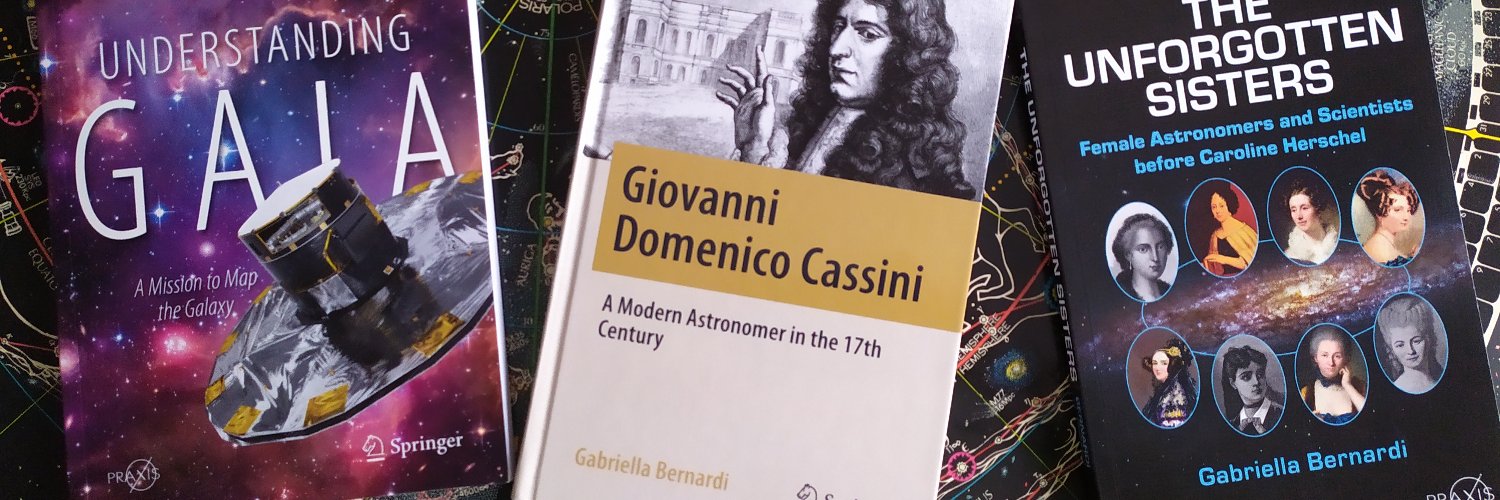
👉https://t.co/28p5SDlrhK Yesterday we celebrated 401 years of Giovanni Domenico Cassini! 🔭From the meridian line in San Petronio to the discovery of Saturn's moons and ring divisions, he defined 17th-century astronomy. A legacy that still inspires us today. 📷 👇
Why do meteors seem to come from one point in the sky? 🌠
During a meteor shower, Earth passes through a stream of tiny particles left behind by a comet or asteroid. These particles enter our atmosphere on nearly parallel paths.
But from our point of view on the ground, those paths appear to spread out from a single point in the sky. This point is called the radiant.
It’s the same perspective effect you see with railroad tracks: the tracks are parallel, but they seem to meet in the distance.
So meteors don’t actually fly out of one spot — they only appear that way from Earth. ✨
That’s why meteor showers are named after the constellation where their radiant appears: the Perseids from Perseus, the Geminids from Gemini, and so on.
#meteorshower #astronomy #didyouknow #meteors #starwalk
Tomorrow we celebrate 401 years of Giovanni Domenico Cassini! 🔭From the meridian line in San Petronio to the discovery of Saturn's moons and ring divisions, he defined 17th-century astronomy. A legacy that still inspires us today. 🪐✨ 👇https://t.co/hbKov2lXvn
A Hamiltonian system is a way of describing motion where position and momentum evolve together as one coupled system.
The plot shows an energy landscape in phase space, with the motion of the system traced directly on top of it and projected onto the underlying phase portrait.
#HamiltonianSystems #PhaseSpace #PhysicsSimulation #DynamicalSystems #MathematicalPhysics
Use of Sun and Stick for direction. ✍️
1. Place a stick upright in the ground.
2. Mark the tip of the shadow cast by the Sun.
3. Wait 15-30 minutes, then mark the new shadow tip.
4. Draw a line between the two points — this line runs East-West.
5. The first mark is West; the second mark is East.
🌌 Our cosmic home is alive & in constant motion! 💫The other night at #FutureWeekTorino, I moderated a talk with Dr. Alberto Vecchiato (@INAF_OATo ) on the mind-boggling results of @ESA_Gaia. Thanks for the invite! 🚀
#SpaceScience#GaiaMission#Torino