How far do you live from a constitutional court?
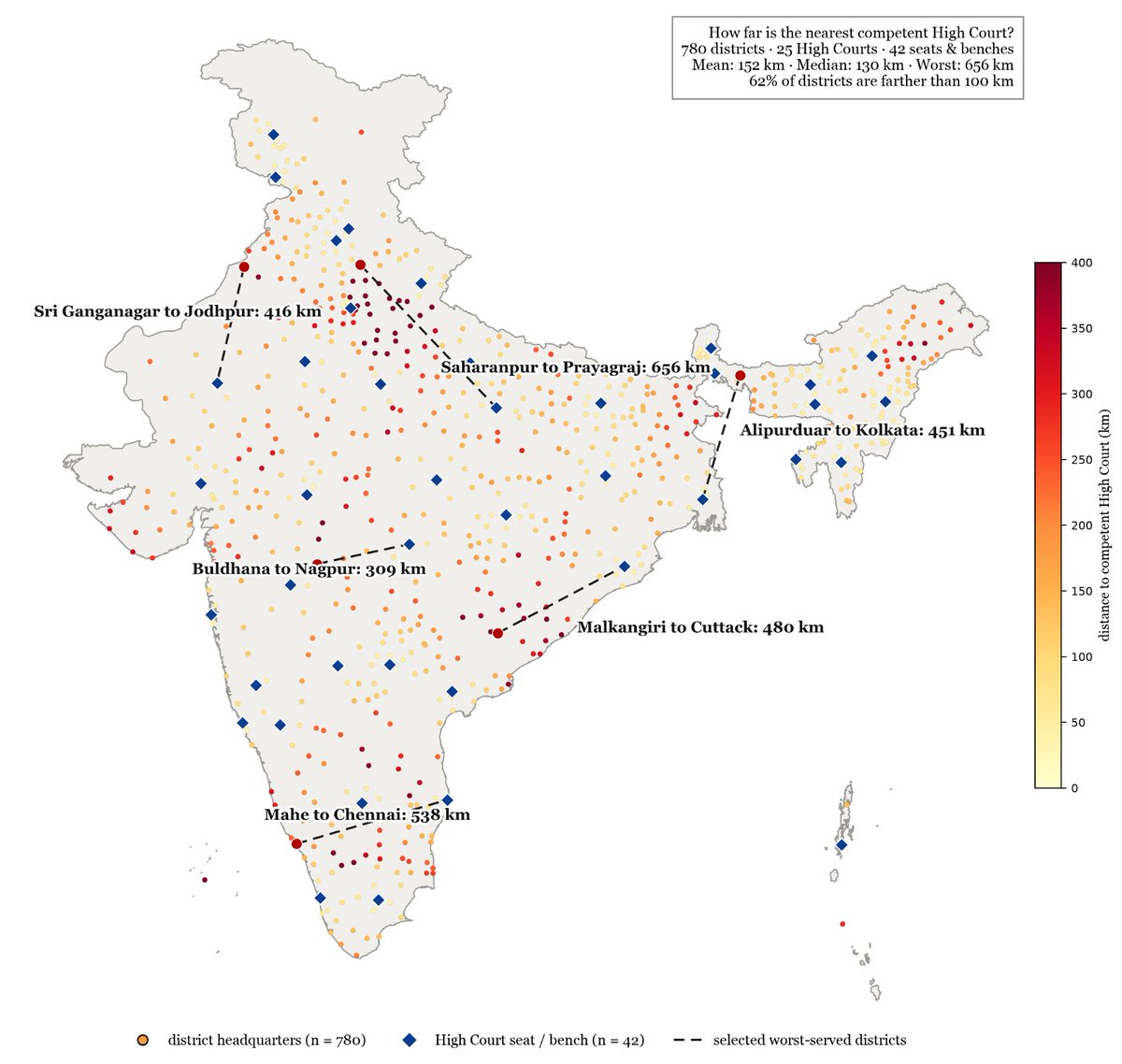
In our latest #CountingOnLaw, @GokulSunoj maps the distance from 780 Indian district headquarters to the High Court with jurisdiction over them.
The numbers are striking:
The average distance is 152 km.
62% of districts are more than 100 km away.
And for some districts, the nearest competent High Court is 500+ km away.
The map shows just how uneven access to constitutional courts can be across India. But geography need not determine access to justice. Some of the solutions to bridge this distance already exist — they just need to be used better.
Gokul explains 👇
https://t.co/aeCwLGBeZx
Written column in the thread.
I resigned from Anthropic today. I spent the last three years doing pretraining research at both OpenAI and Anthropic. Neither company is acting responsibly. They are racing straight to self-improving superintelligence and gambling with our lives. More thoughts below.
Completely neutral and strictly educational thread 🧵
Non-exhaustive list of all private vendors who provided surveillance tech and other tools of oppression & control to the Delhi Police during the Jantar Mantar youth protests 1/n
Chalo. Even if we couldn’t hold the government, led by a 75 yo, accountable in 12 years, they at least managed to dox a 15 yo, hold her accountable and make her apologise within 12 days.
Bravo! Take a bow old, wise folks, take a bow!
What a win!
Beg to differ. SC since 1950s has read the constitution by deferring to view of “boots on ground” when it comes to interactions between police and public in protests. What protects people in those settings is not the constitution, but numbers and politics. Law comes much later.
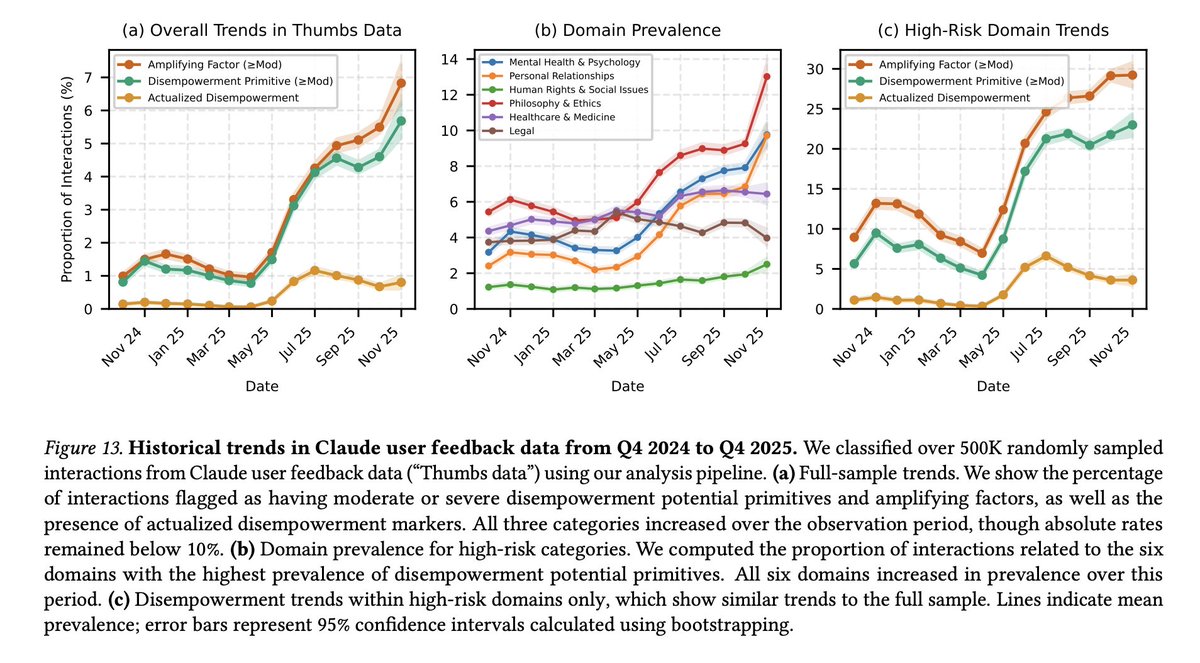
An analysis of 1.5 million Claude conversations found that “disempowerment patterns” — instances when AI interactions risk leading users to form distorted perceptions of reality or act in ways misaligned with their values — have increased over time.
New: The amicus curiae in SC's suo moto case on digital arrests wants to know how the DoT plans to act on Bluetooth-enabled messaging apps such as BitChat.
Not clear why such services need to be regulated to deal with digital arrests.
Link to full story: https://t.co/tfO9i95LiJ
Statement : The blocking of BitChat's code on GitHub is unconstitutional and authoritarian.
New Delhi, 24 July 2026
The Internet Freedom Foundation (IFF) condemns the order issued by the Indian Cyber Crime Coordination Centre (I4C), Ministry of Home Affairs, directing GitHub to remove the code repositories of BitChat.
The order, Notice No. 11072601011432, was issued at 11:16 pm on 23 July 2026 under Section 79(3)(b) of the Information Technology Act, 2000 read with Rule 3(1)(d) of the IT Rules, 2021. The order directs GitHub to disable access to three repositories, including the Android application and its release files, within three hours. It threatens the platform with loss of safe harbour and criminal prosecution. No copy was published by the Government of India. The public learnt of it from a post by @jack, whose team develops BitChat. Censorship in India now comes to light through disclosure by the censored.
Since 17 July 2026, the Ministry of Home Affairs has suspended mobile internet around Jantar Mantar as per public reports about five times, most recently within a 1.5 kilometre radius from 4 pm until midnight on 23 July. That radius takes in Janpath and parts of Connaught Place. Reports describe signal jammers at the protest site and people walking two kilometres before their phones work. Inside that zone a student separated from her group during a detention drive cannot send a message to say where she is. Thousands of students and young people have camped at Jantar Mantar since June, seeking accountability for examination irregularities. Permission for their march to Parliament was refused. Metro stations were shut and also internet connectivity has been blocked.
BitChat is an open source application built for exactly this situation. It passes messages from phone to phone over Bluetooth, without mobile networks or a central server. It is striking that the order does not identify a single unlawful message. It objects to what BitChat is. In its own words, the application is dangerous because it enables communication "even during network restrictions" and can "circumvent lawful restrictions" during "internet shutdowns". Hence, the government's objection is that citizens can speak to one another while it has switched the internet off.
The order is illegal on at least four grounds.
1. Section 79(3)(b) is not a blocking power. In Shreya Singhal v. Union of India (2015) 5 SCC 1, the Supreme Court read down the provision. Intermediaries may be required to act only on a court order, or a government notification confined to the grounds under Article 19(2) of the Constitution. Blocking is governed exclusively by Section 69A and the Blocking Rules, 2009, which require a hearing and reasons recorded in writing, subject to review. Directions issued under Section 79(3)(b), Rule 3(1)(d) and the Sahyog Portal evade these safeguards, and constitutional challenges to this parallel regime are pending before High Courts.
2. The reasons in the order are circular. The order asserts that the repositories contain "information which is prohibited under any law" without naming any such information, and rests on what the application is "capable of" enabling. Anticipated misuse of a communications tool is not a lawful basis to prohibit the tool. By this logic a telephone exchange could be sealed.
3. The order cites Section 43 of the IT Act, a civil compensation provision, alongside conspiracy and abetment offences under the Bharatiya Nyaya Sanhita, 2023, against a platform that hosts code.
4. A three hour deadline issued close to midnight forecloses legal assessment and recourse, and fails the proportionality standard in Anuradha Bhasin v. Union of India (2020) 3 SCC 637.
The order also fails on its own terms as deleting a repository does not delete the application from any phone that carries it, and the mesh keeps functioning without servers. What the takedown actually prevents is scrutiny of the underlying code.
IFF demands that the Government of India:
1. Withdraw Notice No. 11072601011432 dated 23 July 2026 issued to GitHub.
2. Publish every takedown direction issued under Section 79(3)(b), Rule 3(1)(d) and the Sahyog Portal, with the reasons recorded for each.
3. Restore full connectivity around Jantar Mantar, publish all suspension orders, and disclose the legal authority for the deployment of jammers.
We stand with the developers and the young protesters whose speech this order seeks to silence.
Has the time to trawl social media to find “cockroaches” who criticise the judiciary and influencers who make questionable content. But is too busy to deal with allegations of police brutality.
Good to see SCBA and DHCBA Presidents, Sr Advs. Vikas Singh and Hariharan lead from the front in the petitions on police violence on protestors before the Delhi High Court.
DHCBA however has issued no statement of condemnation on the brutal and unprovoked police lathi charge on 20th July, despite requests by members.
DHCBA I know you have been rather busy reading CPC and pecuniary jurisdiction.
Please waste a little time reading Chapter 3 of Indian Constitution.
This is unfortunate and unconstitutional in my opinion for the following reasons/tweets (in 7 parts):
Part 1. The blanket ban problem (Article 19(1)(a) and (b)). The order prohibits all assemblies of five or more persons across an entire district, save one designated site. In Mazdoor Kisan Shakti Sangathan v. Union of India (2018), the Supreme Court held precisely this practice — Delhi Police’s repetitive Section 144 orders converting the entire New Delhi District into a perpetual no-protest zone — to be an abuse of power. Section 144 (now 163 BNSS) is an emergency provision for specific, imminent threats; it cannot function as a standing regulatory regime. The Court directed the police to frame proper guidelines regulating protest rather than banning it wholesale. This advisory reproduces exactly the practice the Court condemned.
It's not OK to wear smart glasses around other people. It's not cool. It's creepy, disrespectful. It pollutes the public sphere with the oppression of surveillance. It puts the onus on non-Glassholes; that's not asking for consent.
https://t.co/Wwj1HYiPtr
All this shows is how prevalent state surveillance is and how easily it can be used to stalk you to find out when you left your residence despite there being no official proceeding against you.
Not the flex the police thinks it is.
A fresh law graduate who is randomly asked to take a passover in a matter he has no idea about and the judge starts turning pages trying to understand the matter:
One of the worst things that can happen to a young lawyer is getting a front-row seat to everyone else's success.
You open Twitter and someone is arguing in the Supreme Court.
You open LinkedIn and someone has become Partner.
You open Instagram and someone is posting about their brand new Car.
And suddenly, sitting in a small chamber, reading files, drafting applications and waiting for a potential client to call back, you start feeling left behind.
But litigation doesn't work that way.
You are comparing your first few years to someone's 10th, to someone's outcome of first successful matter after failed 5.
You are seeing their results, not the years they spent carrying files, waiting outside courtrooms, losing clients, losing matters and wondering whether any of this would ever work out.
Most lawyers you admire today spent years being where they are.
The difference is that nobody posted those years.
Nobody uploaded a picture of the rented room, the matters they lost, or the month when earnings barely covered expenses.
They only posted the spoils of years of hardwork.
Litigation rewards people who can stay focused while watching others move ahead.
Every lawyer's journey runs on a different timeline.
Stop looking sideways.
Read the file.
Prepare for the hearing.
Show up again tomorrow.
One day you'll realise that the years you spent struggling were the years that built everything.