Big thanks to @GabbyLogan and her superb team for having me on the MidPoint. It’s vital we keep having such conversations to keep #menshealth moving onwards and upwards! 🚀
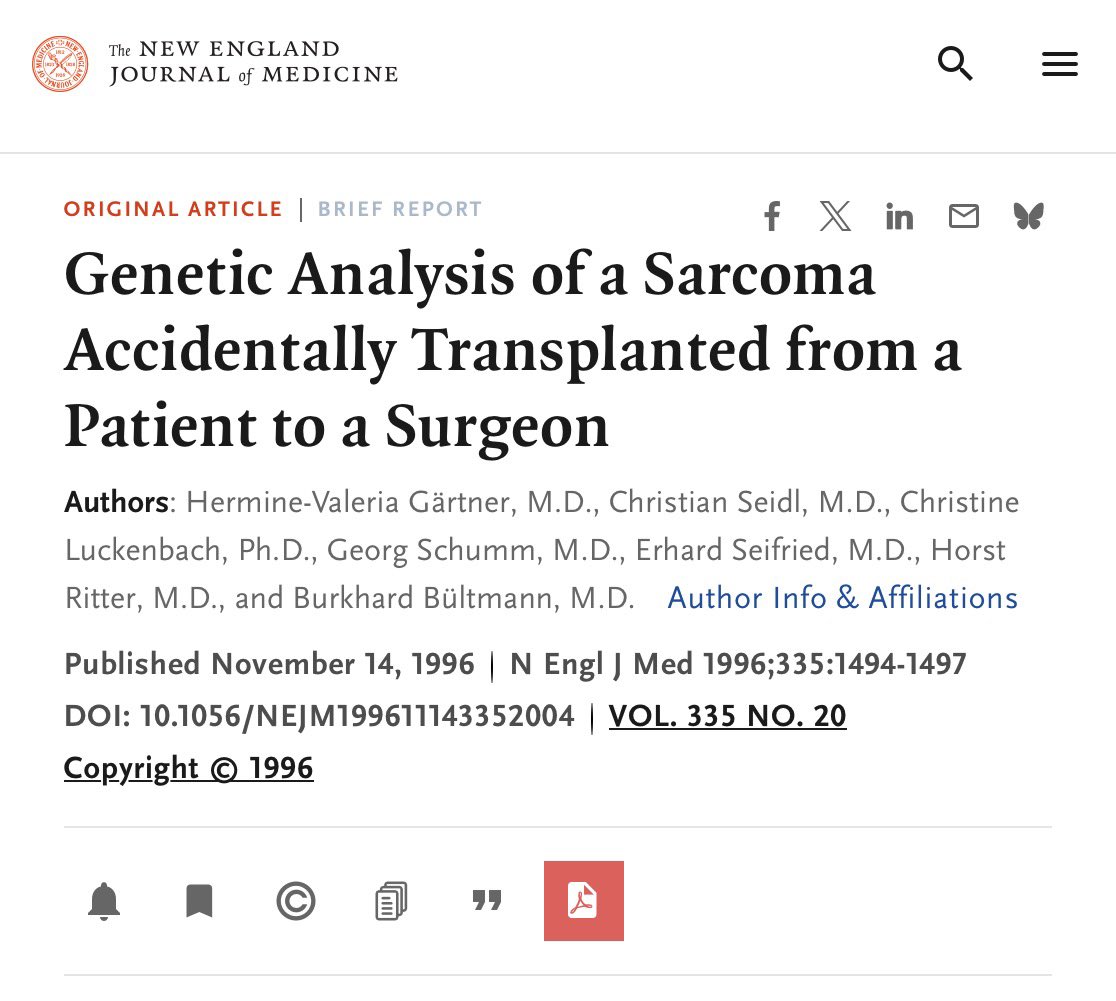
A rare case where a surgeon accidentally developed his patient’s cancer
Cancer is not considered contagious. If cancer cells from another person enter your body, your immune system is supposed to destroy them.
But in very rare situations, biology doesn’t follow the rules.
A 32-year-old man underwent emergency surgery for an aggressive soft-tissue cancer called malignant fibrous histiocytoma. Sadly, he died shortly after the operation due to complications.
During the surgery, the 53-year-old surgeon accidentally injured the palm of his left hand while placing a drain. The wound was small, immediately cleaned, and properly dressed. No one thought much of it.
Five months later, the surgeon noticed a hard lump growing at the exact spot where his hand had been injured. It slowly enlarged to about 3 cm, roughly the size of a large coin.
The lump was surgically removed.
The diagnosis was shocking.
It was malignant fibrous histiocytoma, the same rare cancer the patient had.
The surgeon was otherwise healthy. Tests showed no immune deficiency. So how could this happen?
The DNA answered the question
Pathologists compared both tumors under the microscope and found them to be identical in appearance. But the real proof came from DNA testing.
Using genetic markers and HLA typing (a way of identifying tissue origin), doctors showed that the tumor in the surgeon’s hand carried genetic material from the patient.
This meant only one thing:
👉 The cancer had been accidentally transplanted from patient to surgeon during surgery.
Cancer cells likely entered through the small hand injury and managed to survive long enough to form a tumor.
Fortunately, the tumor was completely removed.
At two-year follow-up, the surgeon was healthy, with no recurrence and no spread.
Why this case is so remarkable:
This case does not mean cancer spreads through touch or casual contact. It shows that direct implantation of living cancer cells, under very specific conditions, can rarely lead to tumor growth, even in a healthy person.
It’s a rare exception that reminds us:
- Cancer isn’t contagious, but biology has loopholes
- The immune system is powerful, not perfect
- Medicine still encounters situations that challenge long-held beliefs
@harrogate_urol Amazing piece of work!
Immediately obvious the potential clinical utility of this! Is there a strategy for adding new treatments as they become accepted options?
@benchallacombe@JafferUrol@GuysUrology I’ve been using it as standard for all comers for some time now. As long as you stick to principles, even with large intravesical median lobe, UOs are protected as long as you keep bladder neck integrity.