*An advice from a senior citizen currently visiting the US*
Dear friends,
We have been staying in Seattle, Washington, for the past two months. My wife was suffering from a severe respiratory issue when we left India. After using those medicines from India,here in the US, she had almost recovered.
However, as our supply ran out, So, I asked my daughter to schedule an appointment with a pulmonologist (respiratory specialist) in Seattle.
we had to consult a general physician first. We were given an appointment for a week later—and that too, only via a video call.
We spoke to the doctor on the phone for about 10 minutes.He said he understood the issue and prescribed appropriate medicines, stating that we could pick them up from a pharmacy.we were told the medicines were not immediately available and would take 4–5 days to arrive.
We finally received the medicines on the fifth day. Surprisingly, the medicines were manufactured by 'Cipla' and bore the label 'Made in India'. Even after a 50% discount through US medical insurance, we still had to pay an equivalent of ₹21,000. This means medicines costing just ₹2,500 in India cost a staggering ₹42,000 in the US.
It took us 12 days to obtain medicines here that are readily available at any pharmacy in India. A week later, we received a bill of $283 (approximately ₹23,000) for the doctor's consultation fee.
Consider yourselves to be fortunate to be living in India during your retirement years.
We often look abroad in search of a "good life." But if we pause to think... certain everyday conveniences—unavailable even to billionaires in London or New York—are easily accessible to the middle class in India.
Here are *7 examples* showing that even the life of a common person in our country is a **VIP lifestyle**:
*1 Data Democratization:*
While countries around the world spend over $50 (approx. ₹4,000) a month for basic internet, we enjoy high-speed 5G data for just ₹300. We have the cheapest data in the world! This is what has digitally transformed our economy.
*2 The "10-Minute" doorstep delivery:*
Run out of ginger for your tea or out of milk? Place an order on Blinkit, Zepto, or Swiggy Instamart, and the item is in your hands before the water even boils. In Europe, by contrast, you’d have to put on a coat and walk 15 minutes in the cold to a store—and you wouldn't be surprised to find it already closed.
*3 Instant Healthcare:*
Need to see a specialist? You can go straight to the hospital. Need a blood test? A lab technician comes to your home as early as 6 AM to collect the sample, and the report arrives on your WhatsApp by afternoon. We don't face the three-month waiting lists or the nightmare of "insurance approvals" common elsewhere even for trivial ailments.
*4 Human Support System:*
Having people to help with house cleaning, cooking, and driving isn't a luxury reserved only for the wealthy here; it is the backbone of middle-class life. It offers something incredibly valuable: it saves **TIME**.
*5 The UPI Revolution:*
From a ₹5 roadside tea to a ₹50,000 laptop—everything is just a scan away! No need for wallets, no excuses like "the card machine isn't working," and absolutely no transaction fees. In this regard, the rest of the world lags far behind us.
*6 *"Free" Little Joys:*
No matter which restaurant you visit, you get a glass of drinking water for free (whereas elsewhere, they’d charge you $5). There’s an ironing man / chai wallah right at the end of the street to take care of our instant needs. It is these little things that make life run so smoothly.
*7 Social Bonds (Social Safety Net):*
We don't live in a culture of legal notices and courts; we live in a culture of relationships. If we face a problem, a neighbor won't send a court notice—they’ll lovingly cook and send over some *khichdi*.
*The Bottom Line:*
India is not merely a country; it is a wonderful world filled with conveniences at every turn.
@sanjeevsanyal Give a tab+free Internet connection to all economically stressed and create an independent testing &degree awarding platform and watch the miracle unfold. Present College template is unproductive.
@ActForVijay@irfhabib I wish she had allowed economy 2grow in a liberalised economic environment rather than shackle it &promote infamous Licence Permit Raj that wasted enterprenurial spirit of a whole generation of Indians &encouraged a rentier economy exploited by politicians keeping the ppl poor
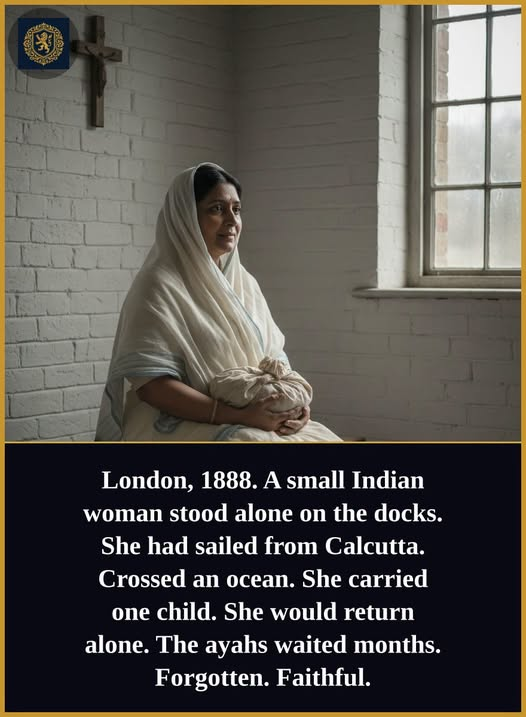
She sailed 4,000 miles with a British child in her arms. When she arrived in London, the family took the child and left her on the docks. No passage home. No pay. Sometimes no shelter for months.
The ayahs — Indian nursemaids — crossed the Bay of Bengal and the Arabian Sea with infants whose parents were returning from service in the Raj. The voyage took weeks. The children cried, fell ill, needed constant care through storms and tropical heat. The ayahs rocked them, fed them, kept them alive. When the ship docked at Tilbury or the Thames, the families collected their children, thanked the women politely, and walked away.
What happened next was left to chance.
Some families paid for return passage. Most did not. The ayahs waited on the docks or in cheap lodgings near the river, hoping to find another family sailing back to Calcutta who needed a nursemaid for the eastbound voyage. If they were lucky, they found one within a few weeks. If they were not, they waited through an English winter in a cotton sari, spending what little money they had on food, sleeping in boarding houses that charged by the night, watching their savings disappear.
No one kept records of how many were stranded at any given time. No official agency tracked them. They were private servants, hired by individual families, invisible to the bureaucracy of empire. They did not speak English. They knew no one in London. They had no legal protection, no contracts, no recourse.
A few people noticed.
In the 1890s, a small home for stranded ayahs opened near the London docks. It was a modest house, funded by donations, where the women could wait in safety until they found passage home. The woman who ran it — her name is not recorded in the surviving accounts — kept a register. She noted arrival dates, departure dates, how long each ayah had been stranded. Some waited two months. Some waited four. One woman had been in London for nearly six months, still hoping for a family to take her back to Calcutta.
The home provided beds, food, and a place to gather. The ayahs cooked together, mended their saris, wrote letters home when they could find someone to pen the words for them. They were uniformly grateful. They were also uniformly poor. The families who employed them paid a flat rate for the voyage — rarely more than a few pounds — and rarely paid it in full before the ship docked. If the family decided not to pay for return passage, the ayah had no means to compel them. She simply waited.
The register from the ayahs' home recorded women from Calcutta, Madras, Bombay. Hindus and Muslims. Young women and older women who had raised British children for decades. They all shared the same story: they had been hired, they had made the crossing, they had been left.
It was not cruelty, exactly. It was something closer to indifference. The families did not set out to abandon the women. They simply did not think of them after the voyage ended. The ayah had served her purpose. The child was home. The household staff in England would take over. Arranging return passage required effort, cost money, involved paperwork. It was easier not to bother.
The home for stranded ayahs operated for decades. By the early twentieth century, a few missionary societies and charitable organisations had begun to take notice, coordinating return passages and negotiating with shipping lines for reduced fares. The problem never disappeared entirely. As long as British families sailed back from India with children, there were ayahs making the crossing, and some of them would be left behind.
The woman who opened the first home never published her accounts widely. The register was kept for practical purposes, not historical record. What survives is fragmentary: a few mentions in parish records, a line or two in missionary society reports, the faint outline of a system that saved dozens of women from destitution on the Thames.
They were faithful. They crossed oceans to care for children who were not their own. And when the voyage ended, they waited — patient, invisible, hoping for passage home.
More forgotten chapters of empire over at Empire Untold. Follow for the stories they didn't put in the textbooks.
Image is AI-assisted illustrations created to depict historical events.
« Dans le passé,
le monde était dur,
parce qu’il était gouverné par les intelligents.
Les intelligents forçaient les stupides à apprendre,
et cela était difficile pour les stupides.
Mais aujourd’hui, ce sont les stupides qui gouvernent le monde.
Et c’est quelque chose de juste,
car les stupides sont bien plus nombreux.
Maintenant, les intelligents apprennent à parler de façon à être compris par les stupides.
Si le stupide ne comprend rien, c’est le problème de l’intelligent !
Autrefois, les stupides souffraient.
Aujourd’hui, ce sont les intelligents qui souffrent.
Mais le nombre de ceux qui souffrent diminue chaque jour,
car le nombre d’intelligents diminue jour après jour. »Mikhaïl Jvanetski
Remembering Rajinder Kumar Tikoo: A Kashmiri Pandit who Hizb Terrorists killed.
On 22 June 1990, Rajinder Kumar Tikoo, the son of Prithvi Lal Tikoo, a resident of Batapora, Shopian, in south Kashmir, lost his life in a terror incident at Jamia Masjid, Shopian.
His death was not just the loss of an individual; it was the loss of a son, a family member, and a cherished part of his Kashmiri Pandit community. The tragedy left behind a family forced to live with a grief that time could never erase.
More than three decades later, the memory of Rajinder Kumar Tikoo continues to live on in the hearts of those who knew him. Today, we remember him with respect and honour, paying tribute to a life cut short and a family forever changed by loss.
#jammukashmir #shopian #kashmir #martyrs
This is also for those who still claim that Kashmiri Pandits left on their own and that nobody drove them out.
Perhaps the reason I shared this video is to show the depth of the pain they continue to carry. No one who watches an elderly woman return to her home after 36 years, touch the soil, embrace a tree she grew up with, and break down in tears can truly believe that exile was a choice.
A lost home is not just a house left behind—it is a lifetime of memories, belonging, and identity torn away. The anguish of displacement does not end with time; it lives on in every return, every tear, and every unanswered longing for the place once called home.
A heartbreaking reminder of a pain that still echoes through Kashmir
After 36 long years, an elderly Kashmiri Pandit woman returned to her ancestral home in Danew, Bogund, Kulgam.
She touched the soil she was forced to leave behind, kissed the old walnut tree standing silently in her courtyard, knelt before it in prayer, and broke down in tears. For a moment, time stood still. The tree had waited for her; the home had remembered her.
Some wounds never heal. Some separations never end.
And one cannot help but ask: where will those find peace who turned these innocent people into refugees in their own land, who tore them away from their homes, their memories, and their roots?
Tout le monde pense que le monde libre a gagné en 1989, à la chute du mur de Berlin.
C'est faux.
Et c'est exactement pour ça que le monde est aujourd'hui en feu.
Ce qui est tombé le 9 novembre 1989, c'est un appareil.
Une économie planifiée, un empire militaire, un mur de béton. Ce qui n'est pas tombé, c'est l'idée. L'idée que le monde se divise en oppresseurs et en opprimés. L'idée qu'il existe une égalité finale à atteindre, par tous les moyens. L'idée que tout ce qui existe (la famille, la nation, le mérite, l'héritage) est une structure de domination à abattre.
Cette idée-là n'était plus dans le bâtiment quand le bâtiment s'est effondré.
Il faut reprendre la chronologie, parce que tout est dans la chronologie :
Le communisme économique avait un défaut fatal : il était réfutable. Il promettait l'abondance, il produisait des famines. Il promettait l'émancipation, il produisait des barbelés. Budapest 1956, Prague 1968, L'Archipel du Goulag publié à Paris en 1973, les boat people de 1979 : à chaque décennie, le réel envoyait sa réfutation. Les boat people étaient une réfutation flottante, visible depuis les plages.
Alors l'idéologie a fait ce que fait tout organisme menacé : elle a muté.
La mutation a un nom, et j'en ai raconté la généalogie ici : la French Theory.
Foucault a déplacé la guerre du terrain des faits, où le communisme perdait à chaque fois, vers le terrain du savoir lui-même.
S'il n'y a pas de vérité, s'il n'y a que des rapports de pouvoir déguisés en savoir, alors plus aucune famine, plus aucun mur, plus aucun goulag ne peut réfuter quoi que ce soit.
La French Theory n'a pas enterré le marxisme.
Elle l'a rendu irréfutable.
Et la mutation a des dates. Toutes antérieures à 1989.
1934 : l'École de Francfort, chassée d'Allemagne, s'installe à Columbia. La critique de l'économie devient critique de la culture.
1964-1965 : Marcuse, exilé allemand devenu professeur américain, remplace le prolétariat défaillant par un nouveau sujet révolutionnaire (les minorités, les étudiants, les marginaux) et écrit noir sur blanc que la tolérance doit être accordée aux mouvements de gauche et refusée à ceux de droite.
Octobre 1966 : le débarquement a une date précise. Université Johns Hopkins, Baltimore. Derrida, Barthes, Lacan présentent la pensée française aux campus américains.
1967 : Rudi Dutschke lance le mot d'ordre, la longue marche à travers les institutions.
1968 : les révolutions de rue échouent partout.
Qu'importe. La révolution ne passera plus par la rue, elle passera par la salle de classe.
1975-1985 : Yale, Berkeley, Columbia absorbent la théorie, qui devient le système d'exploitation des humanités.
1987 : Allan Bloom publie The Closing of the American Mind pour donner l'alerte. Un million d'exemplaires vendus.
L'université le traite de réactionnaire et passe à autre chose.
L'Amérique avait son Aron, elle en a fait la même chose que nous du nôtre.
Puis arrive le 9 novembre 1989.
Le Mur tombe. L'Occident célèbre. Fukuyama avait déclaré la fin de l'Histoire dès l'été, avant même la chute. On démantèle les missiles, on encaisse les dividendes de la paix, on déclare le match terminé.
Nous avons célébré notre victoire sur une adresse vide. L'idéologie avait déménagé vingt ans plus tôt. Nous avons gagné contre les chars et perdu contre les chaires.
Pendant ce temps, l'autre empire communiste faisait la lecture inverse. Pékin avait écrasé Tian'anmen dans le sang cinq mois avant Berlin. Sinistre, mais lucide sur un point : la Chine savait que la guerre était idéologique.
Elle a choisi : abandonner l'économie marxiste, garder le contrôle du récit. L'Occident a fait l'exact opposé : il a gardé le marché et absorbé l'idéologie. Trente-cinq ans plus tard, regardez qui construit des centrales et qui déboulonne ses statues.
Vous voulez la preuve que c'est le même logiciel ? Faites la table de correspondance.
La lutte des classes est devenue la lutte des identités.
Les koulaks sont devenus les privilégiés.
L'autocritique maoïste est devenue le privilege checking. Les commissaires politiques sont devenus les DEI officers.
Le samizdat est devenu le compte shadowbanné.
La nomenklatura a quitté Moscou pour Davos et Bruxelles.
Et le paradis ne s'appelle plus la société sans classes : il s'appelle l'équité, l'égalité des résultats.
Exactement ce que je décrivais ici il y a quelques semaines.
On me dira : il n'y a pas de Goulag.
C'est vrai. C'est même tout le génie de la version 2.0.
Le communisme dur devait briser les corps parce qu'il ne tenait pas les esprits.
Le communisme mou tient les esprits : il lui suffit de briser les carrières.
Pas de camps, des services RH.
Pas de procès de Moscou, des excuses publiques.
Pas de Sibérie, la mort sociale.
Demandez aux émigrés du bloc de l'Est installés en Occident ce qu'ils ressentent en traversant une université américaine en 2026.
Ils reconnaissent l'odeur.
Et voilà pourquoi le monde est en feu.
Une civilisation a passé trente-cinq ans à enseigner à ses propres enfants qu'elle était le problème. Résultat : elle ne sait plus défendre ses frontières, transmettre son héritage, ni même nommer ses ennemis.
Quand la présidente de Harvard, devant le Congrès, répond que condamner un appel au génocide « dépend du contexte », vous voyez le logiciel tourner en production.
Et les prédateurs du dehors lisent cette faiblesse comme un livre ouvert : Moscou teste, Pékin patiente, l'islamisme avance dans les rues de nos capitales.
Le feu extérieur n'est que la conséquence du désarmement intérieur. On ne brûle bien que les maisons qui se sont vidées de leurs défenseurs.
Le Mur n'est pas tombé. Il s'est déplacé. Il ne sépare plus l'Est de l'Ouest : il passe désormais à l'intérieur de chaque institution occidentale, entre ceux qui construisent et ceux qui déconstruisent.
La première guerre froide s'est gagnée avec des missiles et du PIB. La seconde se gagnera avec des écoles, des médias libres et des modèles d'IA. Celui qui écrit les valeurs dans les machines écrira le prochain 1989.
Cette fois, ne nous trompons pas de victoire. Au travail.
Remember when Rakesh Jhunjhunwala bashed Prabhu Chawla for his remarks : ‘Poor have become poorer in India’ 😂
“Which poor person has become poor? My servant has a bank account now, he has a passport. He sends his money to his family in village.”
“10 years ago, he used to spend Rs. 200 to transfer Rs. 10,000 and it took 7 days, now he transfers money in half hour. He has got mobile phone, he can speak on video call with his children.”
“Earlier we used to beg from USA for wheat, today we are producing wheat in surplus.”
- Rakesh Jhunjhunwala. 2021