Liang already picked the companies worth investing in China for you, as Deepseek's investors: $tcehy, $300750, $NTES, $JD ...these were the companies have the kind of good company culture and vision from Liang's perspective.
DeepSeek Completes First External Funding Round, Raising $7.4 Billion
- DeepSeek has completed its first external fundraising round, raising more than RMB 50 billion (approximately $7.4 billion). The company was reportedly valued at over $50 billion.
- Investors are investing through a limited partnership (LP) managed by CEO Liang Wenfeng, rather than directly into DeepSeek itself. This structure allows Liang to maintain absolute control over the company.
- The China National AI Industry Investment Fund is the sole exception, investing directly in DeepSeek and receiving voting rights. The fund has committed RMB 1 billion.
- Ordinary investors receive no voting rights, but gain access to financial information and priority rights in future financing rounds. All investor stakes are subject to a five-year lock-up period, designed to discourage short-term profit-taking.
- Major investors include Liang Wenfeng (RMB 20 billion), Tencent (RMB 10 billion), CATL (RMB 5 billion), https://t.co/aenZOhkOz3, NetEase, and IDG Capital (RMB 3 billion each).
- DeepSeek’s management reportedly conducts due diligence on the identities of LPs backing investment funds, aiming to prevent the entry of unwanted investors.
- DeepSeek had previously operated without external funding, but rising compute costs and intensifying competition for AI talent have increased the need for capital.
WATCH: @edzitron absolutely destroy the SpaceX, Anthropic and OpenAI IPOs in 5 minutes
He explains why they're all trying to cash out because the entire AI narrative is a lie.
Jeff Bezos reveals why compromise is one of the worst ways to resolve a disagreement
"An example of a really bad way of coming to agreement is compromise. If I say the ceiling is 11 feet and you say 12 feet, we say let's call it 11 and a half. That's compromise"
"The advantage of compromise is it's low energy. But it doesn't lead to truth"
"Another really bad resolution mechanism is who's more stubborn. Two executives disagree, they have a war of attrition, and whichever one gets exhausted first capitulates. You haven't arrived at truth, and this is very demoralizing"
"Escalation is better than a war of attrition. Escalate to your boss and say, we can't agree, we like each other, we're respectful, but we strongly disagree, we need you to make a decision"
"Exhausting the other person is not truth seeking. Compromise is not truth seeking"
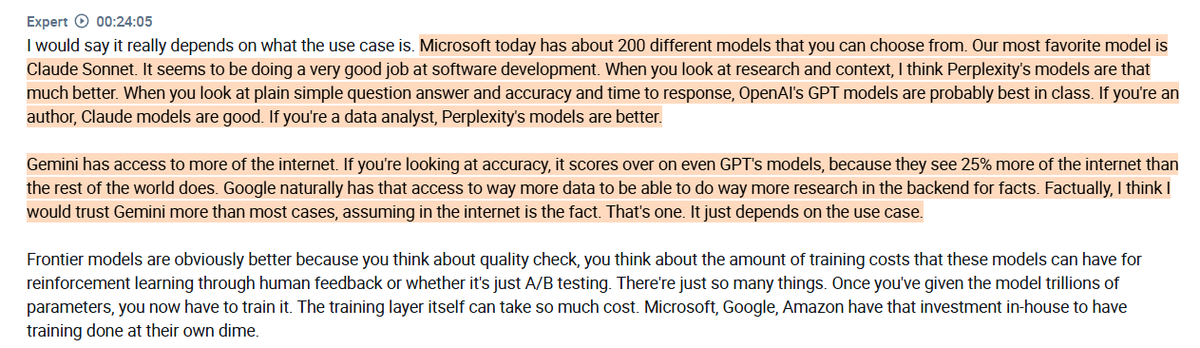
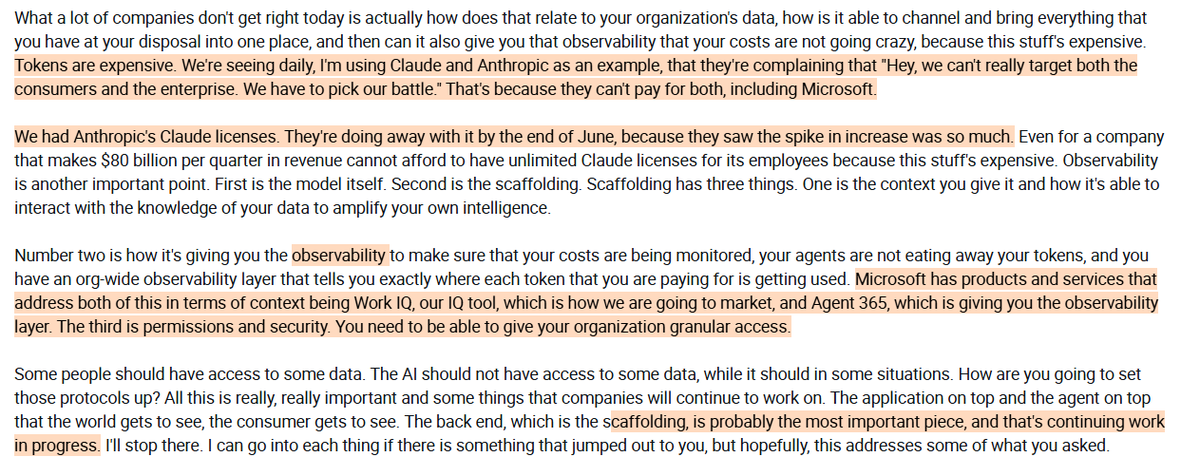
Interview with a $MSFT employee on why the real value in AI is in what gets built on top of the model:
1. He sees the real value sitting not in the models themselves but in what gets built on top of them, what $MSFT internally calls scaffolding, meaning how AI connects to an organization's data, what context it is given, and how well it amplifies the intelligence already inside a business. The expert's view is that as models continue to improve and commoditize, the differentiation will shift entirely to that layer above the model.
2. The expert believes that token costs are a real and often underestimated problem, noting that even $MSFT is pulling back on unlimited Claude licenses because the cost spike became unsustainable. He also mentions that most companies are not getting the data integration piece right, failing to bring everything they have into one place in a way the AI can actually use.
3. Observability is flagged as equally important, with organizations needing a clear view of exactly where every token is being spent before costs spiral out of control. $MSFT is addressing both through Work IQ for context and data integration and Agent 365 for the observability layer, with permissions and security rounding out the three pillars of what the expert sees as the scaffolding that will ultimately determine which organizations get real value from AI and which do not. The expert believes model selection as highly use-case dependent, with $MSFT running 200 models internally.
4. According to the expert, AI is actively decoupling workflows from the SaaS application layer, which historically locked users into platforms like $CRM or $NOW to execute any process. With agentic AI, workflows can now sit above the application stack entirely, with the agent pulling data from a CRM, triggering actions in an ERP, and updating tickets in $NOW system without the user ever touching those systems directly. $MSFT is positioned as exactly this kind of orchestration layer.
found on @AlphaSenseInc
"Those full lines are 3x less efficient for producing HBM than DRAM, so if and when HBM demand steadies and hoarding drops, forcing margins down, any spare capacity in HBM is 3x more than needed for DDR5 DRAM.
For now, the Big 3 take commodity DRAM front-end die and space and allocate it to HBM. Normal DDR5 then goes into massive shortage. DDR5 is what goes into phones, computers, and other consumer-level electronics. So margins go up all around, boosting euphoric extrapolation.
DDR5 is actually what is carrying margins now - not the AI buildout directly, but the shortage of regular DRAM elsewhere."