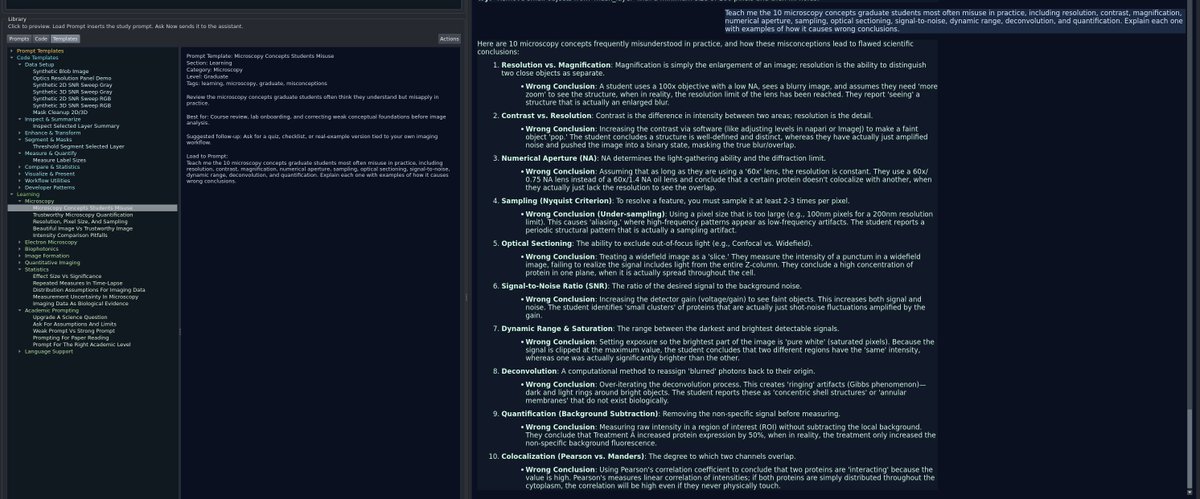
Built a local napari assistant using qwen3.5 + Ollama.
Session-aware
Runs image tools
Generates napari code
No API keys
Repo:
https://t.co/zYjdWDBeav
#BioimageAnalysis#LocalAI
💯
Jensen Huang: “AI is not likely to replace you, but someone using AI better than you might.”
That is exactly why AI fluency is becoming a real skill — not just for tech people, but for everyone.
ref:
https://t.co/YQYnmm6p7B
As a neuroscience researcher building computational tools for multimodal microscopy, Eric Schmidt’s point feels real: coding is shifting from writing every line manually to guiding AI agents that reason, debate, test, and refine code.
https://t.co/epSHDHVRMW
Tested a microscopy reasoning prompt in napari-chat-assistant (local gemma4:31).
Using structured prompt templates inside the viewer.
Interesting direction for local AI + imaging workflows.
https://t.co/zYjdWDBeav
Interesting result 👇
I typed one prompt in napari-chat-assistant and it generated synthetic images, compared histograms, and computed simple SNR live inside napari — not outside the viewer.
A new way to teach image properties interactively.
Try it:
https://t.co/zYjdWDBeav
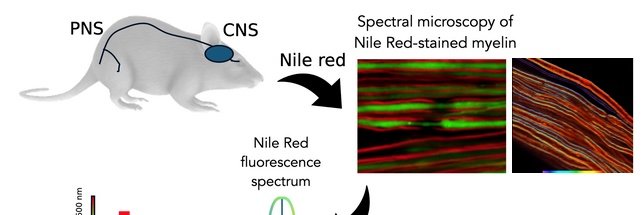
Quantitation of the physicochemical properties of myelin using Nile Red fluorescence spectroscopy - Teo - Journal of Neurochemistry - Wiley Online Library https://t.co/9nDUJWToYU
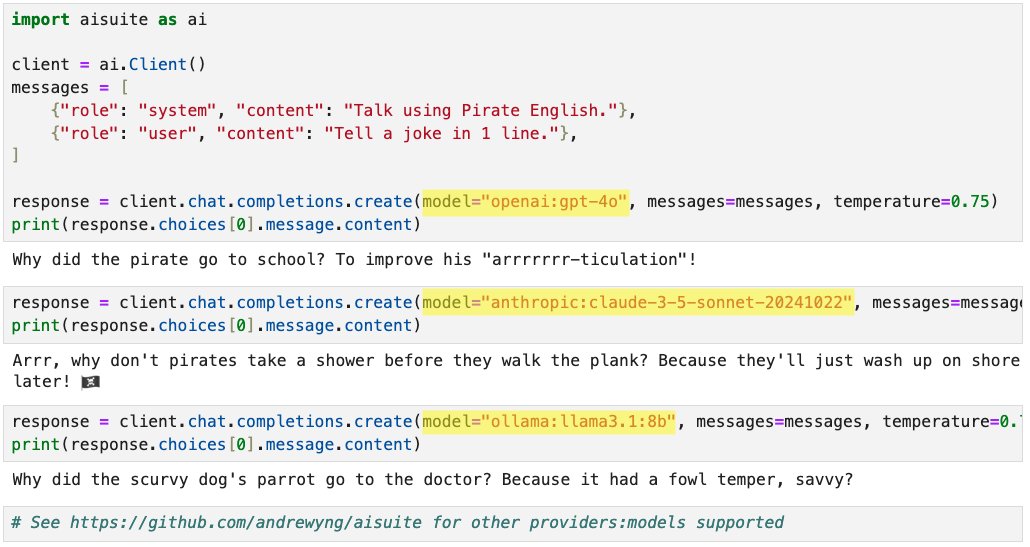
Announcing new open-source Python package: aisuite!
This makes it easy for developers to use large language models from multiple providers. When building applications I found it a hassle to integrate with multiple providers. Aisuite lets you pick a "provider:model" just by changing one string, like openai:gpt-4o, anthropic:claude-3-5-sonnet-20241022, ollama:llama3.1:8b, etc.
pip install aisuite
Open-source code with instructions: https://t.co/gwz9oKTCFx
Thanks to Rohit Prsad, Kevin Solorio, @standsleeping, Jeff Tang and @Johnsanterre for helping build this!
Important tips:
➡️Avoid using solvents like xylene, alcohol, or acetone for fixation—they can alter lipid composition.
➡️No detergents or slide mounting media should be used on NR-stained tissue.
#ProtocolSharing#ResearchTips
ref:
https://t.co/rvLDR6hLKw
Performing myelin imaging with Nile Red?
Here’s a quick protocol I used:
➡️Prepare 5 mM Nile Red stock solution in DMSO, store at −20°C.
➡️Working concentration: 10-25 μM in 1X PBS.
➡️Stain fixed frozen tissue sections for at least 10 min.
➡️Wash with 1X PBS for 5 min.
1/3
After staining, immerse tissue in PBS on a glass slide. For imaging:
➡️Thin tissue sections: no coverslip needed.
➡️Thick tissues: use a coverslip and secure with a small magnet.
Water-immersion objective lens recommended for optimal imaging.
2/3
Augmentation, which introduces variation in training data, and early stopping are key to maintaining accuracy, especially when brightness across the tissue varies.
3/4
Despite non-homogeneous intensity (see red arrow), U-Net achieved 95% accuracy by epoch 10 with augmentation. However, performance dropped by epoch 20 due to overfitting.
2/4
This study demonstrates that the vibrational spectrum of C-H bonds in lipid molecule's tails, within the myelin sheath encasement, can generate quantum entangled photon pairs through cascade radiation from the second excited state to the ground state. 10/13
The myelin sheath, a lipid membrane encasing the outer side of a neuron's axon, provides energy to the axon, enhances action potential conduction, and acts as an insulator in the nervous system. 8/13
Photons released during tricarboxylic acid cycle in neurons resonantly couple to C-H bond vibrons in lipid molecules, altering possibly the dielectric constant of the membrane to enhance action potential conduction. 7/13
@NTFabiano Thank you for sharing these intriguing findings on the relationship between photons, lipid vibrational modes, and neural activity.
You can measure myelin's dielectric constant using Nile Red, which provides insights into its chemical polarity.
ref:
https://t.co/rvLDR6hLKw
here is GPT-4, our most capable and aligned model yet. it is available today in our API (with a waitlist) and in ChatGPT+.
https://t.co/2ZFC36xqAJ
it is still flawed, still limited, and it still seems more impressive on first use than it does after you spend more time with it.
@AndrewYang I disagree: Military aid can escalate conflict & lead to more violence. A study by the Stockholm International Peace Research Institute (SIPRI) found that in the majority of cases, the provision of arms to a country engaged in a conflict had the effect of prolonging the fighting.