THE WORLD'S 4TH RICHEST COUNTRY JUST BOUGHT BITCOIN. 🇱🇺
Luxembourg allocated 1% of its entire sovereign wealth fund into BTC.
This isn't a retail investor.
This isn't a hedge fund.
This is a government.
Putting national wealth into Bitcoin.
Norway is watching. Singapore is watching.
Every sovereign wealth fund on the planet is watching.
When the 4th richest country in the world chooses Bitcoin the other 190 countries just took notes.
Bitcoin’s quantum defenses are progressing fast.
In the last 2 days, two major quantum-related updates came out for Bitcoin.
One prototype lets users recover their funds if quantum computers break current signatures.
Another proposal shows Bitcoin transactions can be made quantum-safe without changing the protocol.
Iran demanding $BTC for Hormuz tolls proves it: censorship-resistance IS the intrinsic value.
- USD? Frozen by SWIFT.
- Yuan? Beijing's control.
- Stables? Issuer blacklists.
- Gold? Try emailing it.
Bitcoin is the only truly unstoppable, neutral money on earth.
While quantum may pose a threat to Bitcoin signatures sometime in the future, new research finds quantum computers are no threat to Bitcoin mining.
Even a best-case quantum miner would need 100 million qubits and 10,000 MW of power, roughly the electricity use of a large country.
At today’s Bitcoin difficulty, the requirement explodes to near star-level energy.
Quantum cracking mining is more than hard, it’s physically unrealistic.
You can now send Bitcoin transactions without internet
A live $BTC transaction was broadcast using mesh radio at the BOSS Summit, completely off-grid
This is what censorship resistant money actually looks like.
🎥: @bala_1116
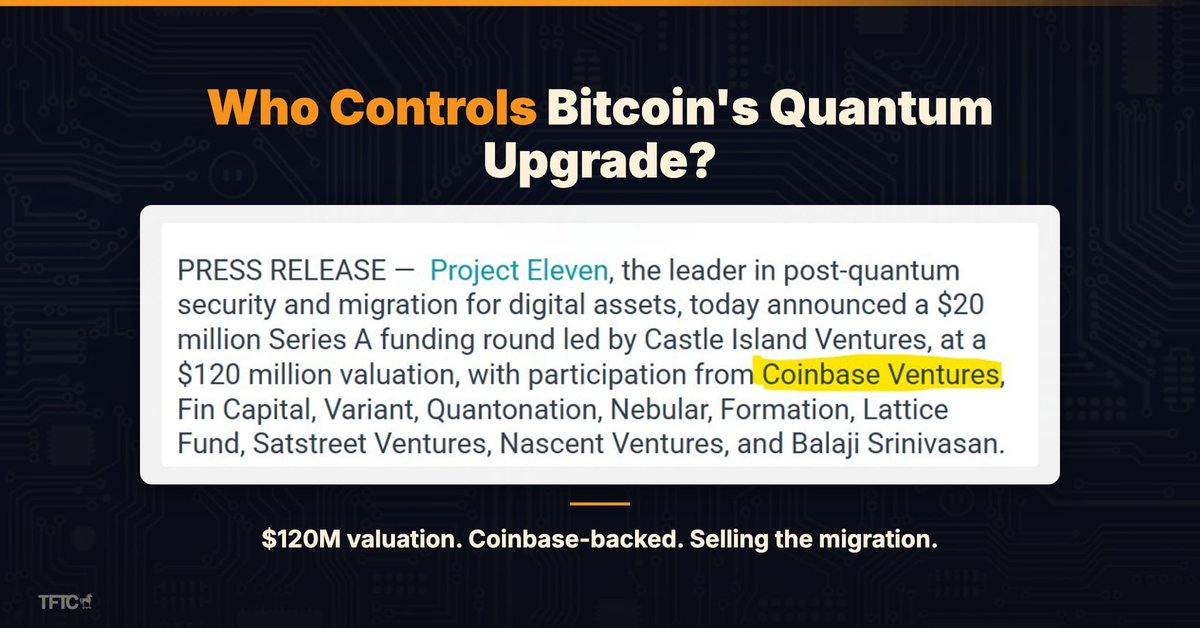
There's a company raising venture capital to "save" Bitcoin from quantum computing.
It's called Project Eleven, backed by Coinbase Ventures and Castle Island Ventures with over $26 million in total funding. They sell post-quantum migration services, which means the scarier the quantum timeline sounds, the more their product is worth.
Their research is technically sound. They published a prototype wallet demonstrating that BIP32 non-hardened key derivation, the mechanism every major exchange uses to generate deposit addresses, breaks under NIST's finalized post-quantum signature standard. The technical problem is real and eventually needs to be addressed.
The quantum timeline is narrowing. Google Quantum AI cut the theoretical ECDSA attack down to 1,200 logical qubits in a paper published last month, a significant reduction from prior estimates. Google set an internal 2029 deadline for post-quantum readiness. These are real developments and we covered them when they dropped.
But "the timeline is narrowing" and "this is an emergency" are two very different statements. The best entangled logical qubit count today is 96. Coherence time is measured in seconds. The attack requires days. The engineering gap between a theoretical paper and a working cryptographic attack remains enormous. Nobody has solved it. Nobody has announced a clear path to solving it.
Bitcoin developers have known about this for years, and the response has been exactly what you'd expect from a community that doesn't rush.
Jonas Nick and Mikhail Kudinov at Blockstream Research published SHRIMPS, a post-quantum signature scheme producing 2.5KB signatures, three times smaller than NIST standards, built specifically for Bitcoin's block space constraints. BIP-360, a quantum-resistant output type, is already live on a Bitcoin testnet with real transactions running through it. The estimated upgrade timeline is seven years, and the work is well underway.
The question is not whether Bitcoin needs to prepare. It does, and it is. The question is who controls that preparation.
When your lead investor is Coinbase, the company running one of the largest deposit address generation systems in the world, and your revenue model is selling the quantum migration itself, the incentive is to make the timeline feel shorter than it is. Urgency sells migration contracts. Methodical, open-source development does not.
If this dynamic sounds familiar, it should. In 2017, a group of companies including Coinbase tried to force through SegWit2x via the New York Agreement, an institutional push that tried to bypass Bitcoin's governance process. The community rejected it.
The risk here is not quantum computing breaking Bitcoin tomorrow. It's that manufactured urgency around quantum becomes the next lever institutions use to capture Bitcoin's upgrade path. If the migration ever does become genuinely time-sensitive, the pitch writes itself: "We don't have time for the community process. These tools already exist. Just use them."
Bitcoin's open-source developers are building the defense on their own timeline, with no product to sell and no investors to return capital to. That's the upgrade path worth trusting.
QUANTUM RACE HEATS UP: BLOCKSTREAM UNVEILS NEW POST-QUANTUM SIGNATURE SCHEME FOR BITCOIN JUST DAYS BEFORE GOOGLE ANNOUNCEMENT
Just days before Google teased a major quantum computing breakthrough, Blockstream Research dropped a new post-quantum signature scheme: SHRIMPS by @n1ckler.
SHRIMPS introduces ~2.5KB hash-based signatures that work across multiple devices, solving a key limitation in earlier designs.
For context:
Prior scheme SHRINCS achieved ultra-small ~324-byte signatures but only on a single device
SHRIMPS enables multi-device usage from the same seed, with signatures ~3x smaller than standard SLH-DSA
Combined setup: primary device signs at ~324 bytes, backups under 3KB
The design assumes a bounded number of devices per key, allowing smaller signatures while maintaining 128-bit security.
Why it matters:
Bitcoin keys are typically used only a handful of times. That makes stateful, compact post-quantum signatures viablewithout massive overhead.
As quantum concerns accelerate, the Bitcoin ecosystem is actively developing realistic, scalable defenses that don’t sacrifice usability.
A federal court struck down the ATF's pistol brace rule. The DOJ dropped its appeal.
And now the ATF admits it's STILL enforcing that same interpretation against law-abiding gun owners.
Up to 10 years in prison for a rule the courts already killed. This is exactly why I introduced the Abolish the ATF Act. This agency is out of control.
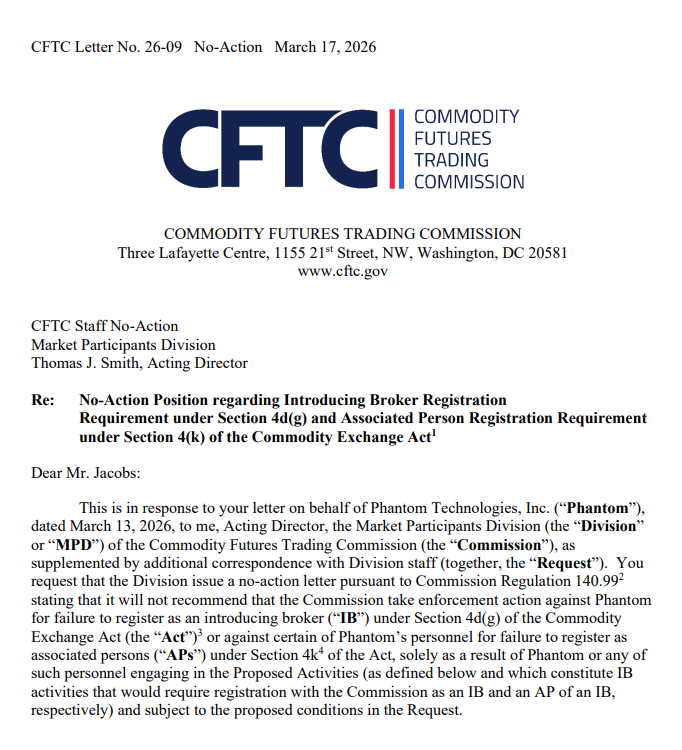
The CFTC just told self-custodial wallet developers they don't need to register as brokers.
Phantom Wallet received a no-action letter stating the CFTC will not pursue enforcement against self-custodial wallet developers who connect users to regulated trading venues, as long as they don't custody user funds. First time the agency has formally drawn that line.
Here's why this is massive:
Under existing U.S. law, any entity that solicits or facilitates derivatives trading typically must register as an introducing broker with the CFTC. That rule was written for traditional finance intermediaries. But as self-custodial wallets started integrating access to derivatives markets, developers faced a legal gray area that could have classified them as unregistered brokers simply for writing software.
The CFTC's position was, if your wallet software connects users to properly registered futures commission merchants, introducing brokers, or designated contract markets, and you don't custody user funds, you are not a broker. You're a software provider.
The timing is not coincidental. One week ago, CFTC Chairman Mike Selig said at FIA's Boca Raton conference, "For too long, there has been an open question as to whether software providers trigger the CFTC's registration requirements. We intend to address this question head-on."
Seven days later, they did.
This matters far beyond Phantom. Every self-custodial wallet developer and every open-source protocol interface that connects users to regulated markets now has a reference point. Write software, don't custody funds, route through registered intermediaries, and the CFTC will not come after you.
For context, the previous administration used ambiguous intermediary rules as a weapon against developers. Tornado Cash developers were prosecuted. Frontends shut down preemptively. The chilling effect pushed builders offshore.
This no-action letter, combined with Selig ending "the days of CFTC-SEC infighting" through Project Crypto, signals a complete reversal. The U.S. is actively trying to bring developers back.
NEW: Tether just unveiled a major breakthrough in local AI.
Its new QVAC Fabric lets powerful AI models run directly on your smartphone or laptop, no data centers or expensive hardware required.
Key points:
• Runs on iPhone, Android, and desktop
• Up to 90% less memory needed
• Faster performance than traditional setups
• No reliance on NVIDIA GPUs or the cloud
AI is moving from big servers to your pocket, opening the door to faster, cheaper, and more private intelligence.
Coinbase is quietly lobbying to kill Bitcoin's de minimis tax exemption.
The company reportedly told legislators that "no one is using Bitcoin as money" and that a Bitcoin de minimis exemption would be "DOA." Meanwhile, they're pushing for the exemption to apply only to stablecoins, specifically regulated, dollar-pegged stablecoins like USDC.
Coinbase made $1.35 billion in stablecoin revenue in 2025, up 48% year over year, almost entirely from interest earned on U.S. Treasuries held in USDC reserves. Bloomberg estimates that number could surge 7x under the GENIUS Act. Every person who uses USDC for payments instead of Bitcoin is a person whose dollars are sitting in Coinbase's reserve pool generating risk-free yield for Coinbase.
A de minimis exemption for Bitcoin would let people spend it freely for everyday purchases without triggering a taxable event. That makes Bitcoin a direct competitor to USDC as a payment method. Coinbase doesn't want that competition. They want you locked into their centralized stablecoin ecosystem where they clip yield on every dollar you park there.
The irony is that a de minimis exemption doesn't even make sense for stablecoins. They're pegged to the dollar. They don't fluctuate in value. There's no capital gain to exempt. The exemption matters for Bitcoin precisely because it does fluctuate, and without it, every coffee purchase becomes a taxable event.
Senator Lummis proposed a $300 de minimis exemption that would cover Bitcoin. The House framework only covers stablecoins under $200. The Bitcoin Policy Institute has already warned that Bitcoin is being deliberately excluded from these talks.
A de minimis exemption that covers stablecoins but not Bitcoin isn't a tax framework. It's a subsidy for Coinbase's treasury management business disguised as consumer protection.
Many tried to warn about $ZEC
Although it had some interesting technology there’s was no doubt it was a VC led project with the main goal of extracting money from the ecosystem.
Marketed as “encrypted bitcoin” it was actually nothing more than a fancy grift.
JUST IN: 🇺🇸 US Treasury reports to Congress that using Bitcoin and crypto privacy mixers are NOT unlawful:
"Lawful users of digital assets may leverage mixers to enable financial privacy when transacting through public blockchains."
Big win for privacy! 👏
Today, we're introducing Spectre I, the first smart device to stop unwanted audio recordings.
We live in a world of always-on listening devices.
Smart devices and AI dominate our world in business and private conversations.
With Deveillance, you will @be_inaudible.