A Dutch computer scientist gave one lecture in 1988 arguing that programming is unlike anything humans have ever tried to do before, and the reason most software on earth is broken is that we are still teaching it as if it were a hobby.
His name was Edsger Dijkstra. He won the Turing Award in 1972. He invented the shortest path algorithm that every GPS on earth still runs on.
He wrote the paper that killed the goto statement in modern programming languages.
He spent 50 years quietly being one of the most consequential thinkers in the entire history of computer science, and he was in a very bad mood by the time he stood up at the ACM Computer Science Conference in 1988 to deliver the lecture that almost nobody at the conference wanted to hear.
The lecture was called On the Cruelty of Really Teaching Computer Science.
It is now one of the most cited papers in the entire history of computing education. It was filed in his archive as EWD1036, handwritten in his careful fountain-pen calligraphy because he refused to use a typewriter and famously refused to use email for the rest of his life.
The argument was simple and uncomfortable.
Programming, Dijkstra said, is a radical novelty. Not a new tool. Not a new skill. Not a faster version of something humans already knew how to do. A genuinely new category of intellectual activity that has no real precedent in the entire history of the human species, and our brains have not been built to handle it.
Here is what he meant by that.
When a programmer writes a line of high-level code and presses run, that single line might trigger a billion operations at the level of the silicon.
The ratio between the abstraction you are working in and the physical events you are actually causing is roughly one billion to one. No engineer in history before computing ever had to reason about a system spanning that kind of ratio inside their own head.
A bridge builder reasons about steel beams and the physics of weight. A surgeon reasons about organs and the physics of tissue. A chemist reasons about molecules and the physics of bonds.
All of them are working inside ratios of physical scale where the largest and smallest things they need to think about are within a few orders of magnitude of each other.
A programmer routinely writes one line that orchestrates a billion physical events on a chip, and is expected to predict the behavior of all of them in advance.
Dijkstra argued that the human brain was simply not built for this. Every intuition we have evolved over hundreds of thousands of years comes from a world of medium-sized objects behaving in continuous ways. Computing is the opposite. It is discrete, not continuous.
A program that runs perfectly a billion times can crash on the billion-and-first iteration because of a single bit. A single character missing from a line of code can take down a power grid. There is no margin. There is no graceful degradation. The system either works or does not, and the only way to know is to actually run it.
This was the part of the lecture where Dijkstra made everyone in the room uncomfortable.
He said the way computer science was being taught in universities was a quiet disaster. Professors were teaching programming the way carpenters teach woodworking. With examples. With metaphors. With analogies to things students already understood. Files are like folders. Memory is like a desk. A function is like a recipe.
Dijkstra said this was actively making it harder for students to think clearly. The whole point of a radical novelty is that there is nothing in your past experience to compare it to.
The moment you start reaching for metaphors, you are smuggling in old intuitions that do not apply, and those intuitions will betray you the first time you try to reason about a system the metaphor was not built to describe.
His exact line was this: the usual way in which we plan today for tomorrow is in yesterday's vocabulary. And yesterday's vocabulary, he argued, was killing the field.
The reason most software is broken is downstream of this single misunderstanding. Programmers are taught to think of code as a craft. Something you get a feel for.
Something you pick up through practice. Something where intuition gets sharper with experience.
Dijkstra said this is exactly backwards. Programming is not a craft. It is closer to mathematics than to carpentry, and the moment you treat it as a craft, you guarantee that the software you produce will be full of the kind of bugs that craftsmanship cannot catch.
The fix, in his view, was to teach programming the way mathematics is taught. You should be able to prove your program correct before you run it.
You should reason about your code formally, the way a mathematician reasons about a theorem, not the way a carpenter feels their way through a joint. The students who learned this way, he said, would walk out of their classes with a kind of confidence that no amount of typing practice could produce.
The lecture was published in Communications of the ACM in 1989. The field did not listen. Universities kept teaching programming the same way.
Software kept getting bigger. Bugs kept compounding. By 2026, almost every piece of software on earth has known security vulnerabilities, undefined behaviors, and edge cases that nobody has ever proven safe. The doom that Dijkstra warned about in 1988 is now the default condition of the digital world we have built.
The deeper lesson is the one most readers miss the first time through.
Dijkstra was not just talking about software. He was making a much bigger point about how humans learn anything that is genuinely new. The instinct to translate the unfamiliar into the familiar is the most natural thing in the world.
It is also the single biggest obstacle to actually understanding something that has no precedent. If you keep reaching for analogies, you will never see the new thing clearly. You will only see your old framework projected onto it.
This is happening right now with AI. The same instinct that made people learn programming through metaphors of files and folders is making people understand large language models through metaphors of brains and people.
Almost every framework being used to describe AI in 2026 is borrowed from a previous domain. None of them quite fit. The few people who are actually building useful intuitions about how these systems work are the ones who have done what Dijkstra recommended forty years ago.
They have set down the old vocabulary. They have looked at the new thing on its own terms. They have accepted that the radical novelty is radical for a reason.
You are not slow. You were taught a discipline as if it were a hobby. The cruelty is real.
The fix is still available.
A British biologist looked at 200,000 years of human history and found that the entire reason humans broke out of poverty was not intelligence, not language, not even agriculture, but one mechanism so simple a 6-year-old could explain it.
His name is Matt Ridley.
He is a zoologist by training, an evolutionary biologist by career, and in 2010 he wrote a book called The Rational Optimist that quietly argued the most important fact about human progress had been hiding in plain sight for the entire history of economics.
Naval Ravikant has been telling people to read everything Ridley has ever written for the last 15 years. The reason is the argument inside this one book.
For 200,000 years, anatomically modern humans walked around with the same brain you have right now. Same skull size. Same neural architecture. Same raw capacity for language, planning, and abstract thought.
For roughly 190,000 of those years, almost nothing happened. Generation after generation lived and died inside the same Stone Age toolkit their great-great-grandparents had used. Then somewhere around 50,000 years ago, the line on the chart of human progress started to tick upward. Then it bent. Then it exploded.
The question Ridley spent years on was the only question that mattered. What changed.
It was not the brain. The brain had been the same for 190,000 years. It was not language, which had existed long before the takeoff. It was not even agriculture, which arrived only 10,000 years ago and was actually preceded by the upward bend, not the cause of it.
What changed was that humans started trading with strangers.
This sounds too small to be the answer. Ridley argues that it is the answer to almost everything. The moment one human exchanged a useful object with another human from a different group, something happened that no other species on earth had ever done.
Two ideas that had developed in isolation came into contact. The flint knapper learned what the spear maker had figured out. The fisherman from the coast learned what the hunter from the forest had figured out. The two pieces of knowledge fused into something neither side could have produced alone.
Ridley calls this ideas having sex. The phrase sounds frivolous and it is meant to. The point is that ideas, like genes, get better when they combine with other ideas from different lineages.
An idea sitting inside one head, no matter how brilliant the head, eventually hits a ceiling. The same idea exposed to ten thousand other ideas does something genes do under sexual reproduction. It mixes. It recombines. It produces offspring nobody planned.
The cleanest proof of this argument is the most uncomfortable case study in the book. Tasmania.
Around 10,000 years ago, rising sea levels cut Tasmania off from mainland Australia. A population of roughly 4,000 humans was now isolated on an island, with no possibility of contact with the rest of humanity. They had the same brains. The same language. The same starting toolkit as their cousins 150 kilometers north. The natural experiment was now running.
What happened next is something no economist or geneticist had ever predicted.
The mainland Australians kept inventing. Boomerangs. Spear-throwers. Fishing nets. Bone needles for sewing fitted clothes. Watercraft with paddles. Their technology compounded slowly across the centuries.
The Tasmanians went the other way. They did not just fail to invent the new tools their cousins were developing. They started losing the tools they already had. Fishing was abandoned within a few thousand years. Bone tools disappeared. Fitted clothing disappeared. They forgot how to make fire from scratch and started carrying lit firebrands from camp to camp instead, relighting their fires from a neighbor's whenever their own went out.
By the time European explorers arrived in the 17th century, the Tasmanians had the simplest toolkit of any human society ever recorded. Their material culture had gone backward for 8,000 years.
The archaeologist Rhys Jones called it a slow strangulation of the mind.
Joseph Henrich at Harvard later proved with formal mathematical models that there was nothing wrong with Tasmanian brains. There was something wrong with their network. A toolkit requires a critical mass of people exchanging skills to maintain itself.
The act of teaching a skill is imperfect. Every generation loses a small percentage of what the last generation knew. If your population is large enough and trading widely enough, those losses get caught and corrected by someone else who still remembers.
If your population shrinks below a certain threshold and stops mixing with outsiders, the small losses compound until entire technologies disappear.
This is the part that should haunt anyone reading this in 2026.
Intelligence is not a property of the individual brain. Intelligence is a property of the network the brain is connected to. A genius in isolation will produce less than a mediocre thinker inside a dense exchange of other mediocre thinkers.
The thing your ancestors needed in order to break out of 190,000 years of stagnation was not better brains. It was better connections between brains they already had.
The implication for any individual is direct and uncomfortable. If you are smart and isolated, you will be outproduced by people half as smart who are connected.
The most successful people in any field are almost never the smartest people in it. They are the ones positioned at the intersection of the most idea flows. They are reading more authors than their competitors. They are talking to more people from more disciplines. They are in the rooms where ideas from different lineages bump into each other.
Ridley ends the book on the line that sounds optimistic but is actually a warning its this "The future will be invented by people who connect ideas, not by people who guard them."
“𝘠𝘰𝘶 𝘢𝘳𝘦 𝘢 𝘩𝘦𝘢𝘳𝘵𝘣𝘦𝘢𝘵 𝘪𝘯 𝘵𝘩𝘪𝘴 𝘥𝘳𝘦𝘴𝘴𝘪𝘯𝘨 𝘳𝘰𝘰𝘮”: Andy Flower to Virat Kohli ❤️
Coach Andy uncut. From highlighting top performances, to wishing the young guns. Here’s a special from Andy’s dressing room talk. 🎥😇🤩
Thank you, Coach! 🫡
To be continued…. ✌️
@AMP86793444 But he was always a loud and noisy commentator…
Also the Trace of Bullet is not his - but Richie Benaud’s but for some reason all the social media helped to give him that credit!
Beautiful article by @manojkjhadu
Nehru dreamed of building a modern India.
Guru Dutt gave that India a soul through cinema.
One shaped the nation’s future, the other captured its emotions.
Together, they represent an era where India believed in both progress and art.
https://t.co/JDqnl3lIXM
When Nehru became PM, India had nothing. We were struggling for food, our budget was only ₹500 Cr
Still he built ISRO, IITs, IIMs, AIIMS & the entire India from scratch
There can never be second Nehru
— Major Gen. CS Dhawan 🫡🔥
Jawaharlal Nehru had at least survived 4 major documented assassination attempts. The threats were so serious that Deputy Prime Minister Sardar Patel famously confessed that the fear of what happened to Mahatma Gandhi happening to Nehru kept him awake at night.
> The close Range -Knife Attack (1955) : When he was greeting crowds from an open car, a Rikshaw puller named Baburao Laxman Kochle suddenly leaped onto the car's footboard wielding a six-inch knife.
> The Partition Violent Clashes 1947 : when he toured the highly volatile North-West frontier Province (now in Pakistan), his convoy was targeted and attacked by mobs opposed to his vision of a United India.
> The Amritsar Express Train Plot 1953 : when Saboteurs placed explosives on the track on which Nehru would pass.
> The Bombing Attempt 1961 : a terrorists- planted bomb attack on the track Nehru was visiting Maharashtra by train. The device exploded prematurely.
Nehru notoriously hated heavy security and constantly tried to break through police cordons to interact directly with everyday people. He believed a leader of a democratic nation should not be cut off from the public by a wall of armed guards. 🗿🗿
>First Prime Minister of India
>Donated 98% of his wealth
>Brought the first 5 Year Plan
>Built IIT, IIM, AIIMS, ISRO etc
>The architect of Modern India
>Never did Hindu Muslim in his life
>Promoted Scientific temperament
Remembering Pandit Nehru on his death anniversary.🙏🇮🇳
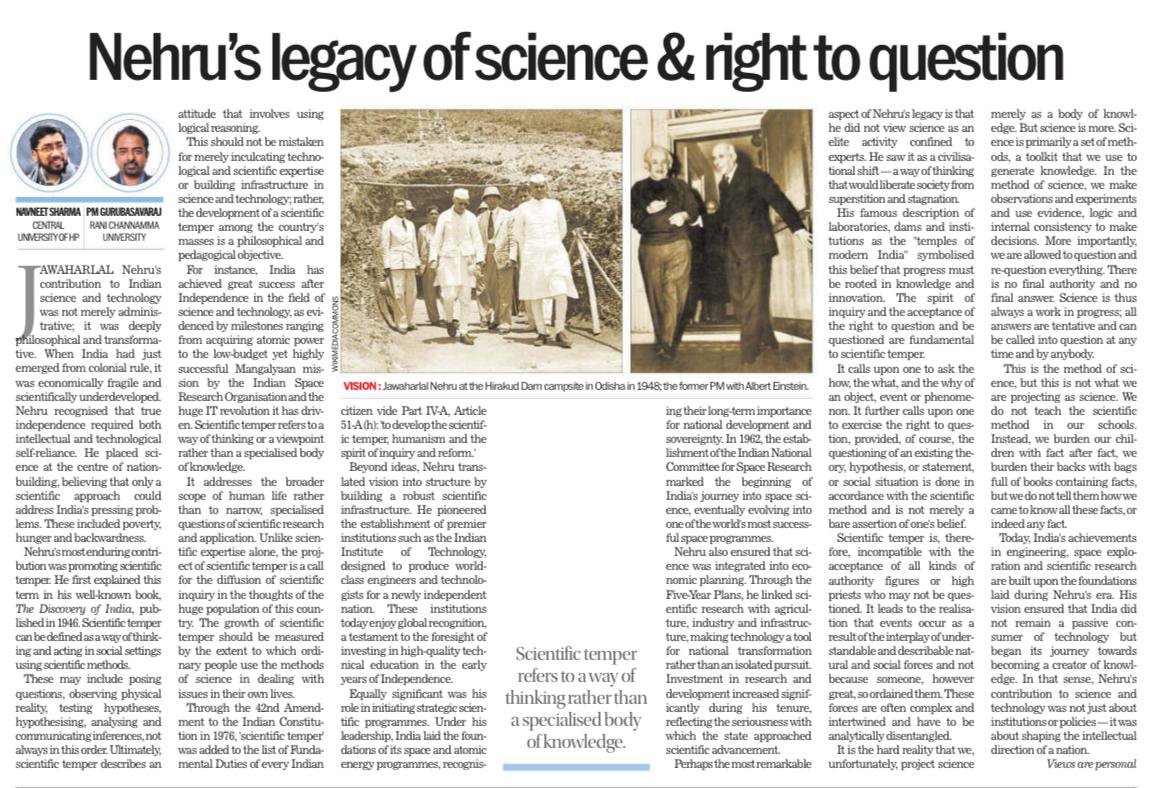
'India's achievements in engineering, space exploration and scientific research are built upon the foundations laid during Nehru's era. In that sense, Nehru's contribution was not just about institutions or policies — it was about shaping the intellectual direction of a nation.'
Nehru was imprisoned 9 times during the freedom struggle, spending a total of 3,259 days—almost 10 years of his life—behind bars.
Between 1921 and 1945, the British colonial government arrested him nine separate times for leading non-violent protests, civil disobedience movements, and anti-colonial campaigns.
He was held in various locations including Almora, Bareilly and Ahmednagar Fort jail.
His longest single confinement lasted over 1,000 days during the Quit India Movement.
JACK DORSEY, CO-FOUNDER OF TWITTER (NOW X) AND BLOCK, ON WHY TREATING AI AS A “COPILOT” IS A LOSING STRATEGY:
JACK SAID THAT MOST COMPANIES ARE APPROACHING AI IN A WAY THAT WILL MAKE IT NEARLY IMPOSSIBLE FOR THEM TO SURVIVE.
“I THINK MOST OF THE INDUSTRY IS THINKING ABOUT AI AS LIKE A CO-PILOT, AS SOMETHING THAT IS AUGMENTED ONTO, RATHER THAN LIKE HOW DO YOU JUST REBUILD OUR WHOLE COMPANY WITH THIS AS THE CORE.”