PRIM-1, open-source. A harness for harnesses.
We have great coding tools like Claude Code, Codex, Grok and many more. What if you could manage them in one place and let them talk to each other?
The concept is simple. One day I found myself copy-pasting output from Claude Code to Codex and vice versa, and I wondered if I could eliminate this. Turns out I can, and now you can too.
PRIM-1 has rooms in which you place your harnesses. You and your agents can post to a shared room feed and send a prompt to a specific member or the whole room. The feed is shared, including addressed messages.
This lets the harnesses review each other's work and bring different strengths to the same task.
It has been my daily driver for managing harnesses and their sessions for a few weeks now.
A few important things:
1. It's my first open-source repo (any feedback is welcome).
2. The current version is an alpha. It has bugs and things to fix! I will be updating it.
3. Windows-only for now, built from source. Linux is next on my list.
Code + first-room quickstart: https://t.co/NyUcbvExiT
Just released Parakeet Redux!
A ternary speech-to-text model, built by compressing NVIDIA's Parakeet model from 1.2GB to 178MB.
Runs at 113x realtime on CPU, and beats the base model on the 25-language FLEURS benchmark while staying within 0.3 WER on English.
PRIM-1, open-source. A harness for harnesses.
We have great coding tools like Claude Code, Codex, Grok and many more. What if you could manage them in one place and let them talk to each other?
The concept is simple. One day I found myself copy-pasting output from Claude Code to Codex and vice versa, and I wondered if I could eliminate this. Turns out I can, and now you can too.
PRIM-1 has rooms in which you place your harnesses. You and your agents can post to a shared room feed and send a prompt to a specific member or the whole room. The feed is shared, including addressed messages.
This lets the harnesses review each other's work and bring different strengths to the same task.
It has been my daily driver for managing harnesses and their sessions for a few weeks now.
A few important things:
1. It's my first open-source repo (any feedback is welcome).
2. The current version is an alpha. It has bugs and things to fix! I will be updating it.
3. Windows-only for now, built from source. Linux is next on my list.
Code + first-room quickstart: https://t.co/NyUcbvExiT
It's been my daily driver for a few weeks.
This is my first open-source repo and an alpha: there are bugs, and I'll keep updating it.
Linux is next on my list. Feedback is welcome, especially if something gets in the way of your first room.
Add Claude Code, Codex or Grok to a room. You and your agents can post to its shared feed, or send a prompt to one member or everyone.
Addressed messages stay visible to the room. Agents can review each other's work without me relaying every message.
I believe we’re at a new inflection point.
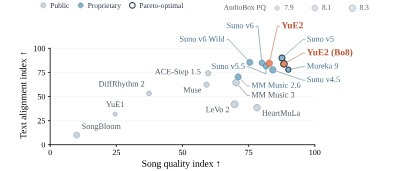
Open-source music models like yue 2.0 have matched, or even surpassed closed-source alternatives like Suno, ElevenLabs and Lyria 3.5 in certain capabilities (abc notation planning).
While there remains a small gap in controllability and coverage, it is only marginal. Most of these limitations can be addressed via local fine-tuning. Meanwhile, closed-source music models are experiencing diminishing marginal returns.
https://t.co/QUZnNIUihn
I gave the fly brain $100 to trade bitcoin.
Dopamine neurons are stimulated when the fly makes profit. Neuron activity controls buy/sell decisions and makes trades on coinbase.
Will the fly get rich?
We’re sharing a solution to the Navier-Stokes Millennium Prize Problem, one of the deepest problems at the frontier of mathematics.
The proof was produced by a group of agents, using an OpenAI next-generation model significantly more capable than GPT-6 Astra.
The problem concerns whether the description of smooth three-dimensional fluid motion modeled by the Navier-Stokes equations can break down. It has remained unresolved for roughly 90 years.
@MaMoMVPY Well, Lars, I INVENTED THE TERM and I say we have achieved AGI. Current models perform at roughly high-human level in command of language and general knowledge, but work thousands of times faster than us. Still some major deficiencies remain but they're falling fast.
Minimax H3 running locally.
~65GB of models.
12GB VRAM. RTX 4070 Ti.
100% Text-to-Video.
100% ComfyUI.
Pass 1 → 960×544
Pass 2 → 1920×1088
One continuous loop built from multiple context-connected generations.
No cloud. No API.
CONTROL IS THE KEY.
LOCAL IS THE WAY.