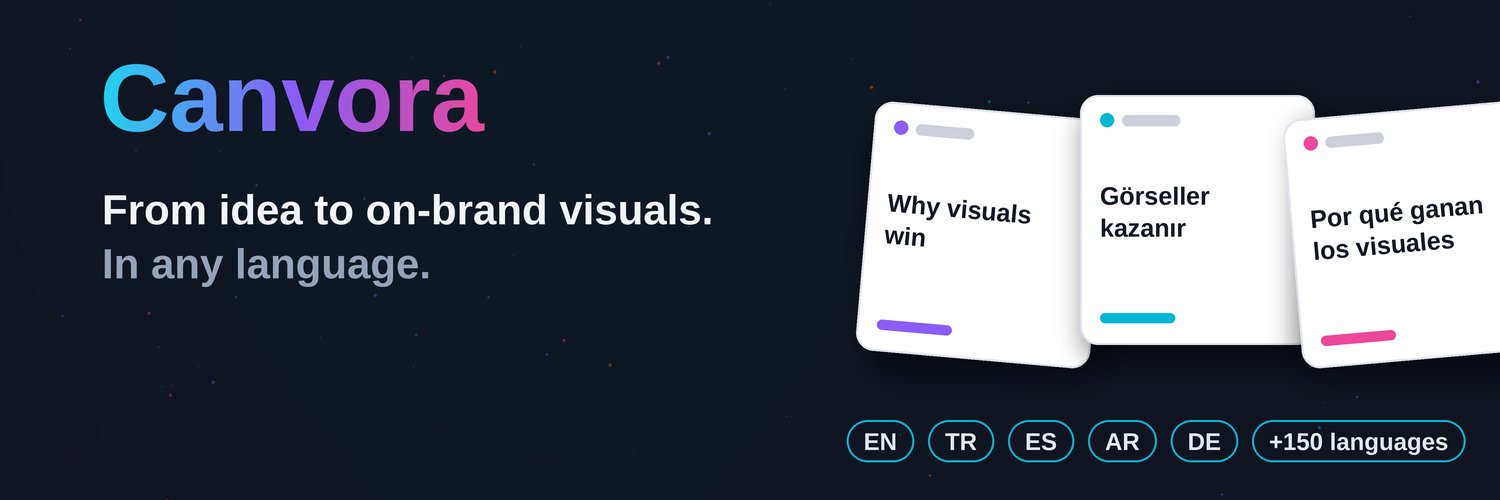
Design tools gave you better templates.
We skipped templates entirely.
This is Canvora - describe what you want, get what you need. Every feature in one video 👇
I am waiting for the time now when ppl will get out of https://t.co/Q9L3I6gxkk. While full respect to @jonathan_wilke and what he has achieved . But All my feed is full of it. Come on , need to see some other interesting stuff now..been 2 days now and nothing new on timeline.
@tibo_maker Prioritise it. You seem to keep it at low hence this. Set a target of 1 hr to devote to it everyday else you will give me $100 per lapse, it wound work 😀
@aporia9n yes though he's rarely desperate. usually it's the newest entrant, no old margin to mourn, so the low price is just his normal. incumbents call it betrayal, for him it's tuesday
@robj3d3 the base building comparison is real. last week i had fable recreate our app screens inside remotion so our demo videos are rendered code instead of screen recordings. the describe, render, check the frame, redo loop is exactly that game feeling
@wickedguro crowded means the dominator owns the generic use case. every specific one is underserved by definition. we're in design tools which is worse than scheduling, and the wedge that works is never "better canva", it's the job canva structurally won't do
@kuberdenis the annoying part is both halves are kind of true now. building got easy, getting seen got brutal. so the play is boring software plus your own distribution stitched together. the mediocre youtube channel IS the moat lol.
@twoclipping did the same thing for meta ads recently.. pulled every long running ad in my niche through an mcp and had claude break down the hook patterns. ended up rewriting our whole video plan off that one session. tools reading tools is the real unlock, the model was never the bottleneck
Beginning July 20, Claude Fable 5 will be included in all Max and Team Premium plans, at 50% of limits.
Pro and Team Standard users will continue to have access to Fable via usage credits, and will receive a one-time $100 credit.
Demand for Fable has been challenging to predict, which is why we rolled it out to subscription plans in stages, extending access several times as we secured additional capacity.
Postiz is on $145k MRR!
Right now, we are growing by $1k MRR per day (some days are better) and will probably hit $2m ARR this week.
But how can Postiz be growing that fast?
What about the competitors?
Why do some of them even struggle to pass the $1k MRR?
This is my point of view on the subject.
But it relates to everyone.
Try to listen. It might help you with your startup.
GLM-5.2 is the open-source Claude moment.
The demand we’re seeing at Databricks is astonishing. The world is going to see massive adoption of oss LLMs.
Also, more companies will shift toward post-training their own models on top of oss models and owning the weights.
This is the moment Chinese AI beat American AI.
One of the largest public crypto companies in the world just DUMPED OpenAI and Anthropic.
Coinbase switched to open-weight Chinese models from Zhipu and DeepSeek, and shaved nearly 50% off the company's internal AI spending.
The numbers are absolutely ridiculous:
Running the same enterprise workload through Anthropic's Claude costs $4,811. Running it through Zhipu's GLM 5.2 costs $544. That's a 9x price difference for equivalent output.
OpenAI's GPT-5.5 sits in the middle at $3,357. DeepSeek's V4 lands at $1,071. Moonshot's Kimi at $948.
On the actual benchmarks: Zhipu's GLM 5.2 scored 62.1 on SWE-bench Pro, the gold standard for coding. OpenAI's GPT-5.5 scored 58.6.
One AI researcher called GLM 5.2 "at least as good as Opus 4.8 and GPT 5.5." Another called it "the first open model that can really compete with closed-source systems."
The Chinese models are not just cheaper but they are now also beating American models on the benchmarks American companies pay $4,811 per workload for.
Coinbase did the math first and reacted - more companies will certainly follow.
Now watch what happens to the IPO timeline:
Anthropic confidentially filed for an IPO targeting October at a $965 billion valuation. OpenAI followed days later with its own confidential filing.
Both companies built their financial models on the assumption that they could keep charging enterprise prices that are 9 to 33x what Chinese competitors charge for the same task.
Brian Armstrong publicly proved customers WILL leave.
45% of companies are now spending over $100,000 per month on AI, up from 20% last year. Every one of those customers is one quarterly budget review away from dumping American AI.
OpenAI has reportedly already started preparing major token price cuts.
Anthropic is expected to follow.
And here's the thing...
The export controls were supposed to CRUSH Chinese AI.
The US government banned American AI chips, restricted model weights, blacklisted Alibaba and Baidu as Chinese military companies, and just banned Anthropic's flagship model from every foreign national on the planet. The entire premise of the American AI valuation bubble is that Washington can keep China two generations behind.
But Chinese labs responded by building cheaper, more efficient models on inferior hardware and pricing them at one ninth the cost of the American alternative.
And now American companies are voting with their checkbooks.
The dominant American labs are valued at nearly $2 trillion combined on the assumption that their pricing power is durable. Coinbase proved it is not, and every customer doing a year-end budget review will be looking at the same math.
For investors, the question here is what happens to the Anthropic IPO at $965 billion when the company is being forced to cut prices to defend share against open-weight Chinese models that score higher on the benchmarks.
For everyone else, the bigger question is what happens when Washington spent four years and billions of dollars trying to contain Chinese AI, and the only thing that actually shifted in the end was American customers.