Zerodha turned 16 this month. Sweet 16.
Every year, I write a letter to all our customers about what’s happening in the business and how we are thinking about the future.
The last couple of years have been mixed for brokers. We had to take revenue hits because of regulatory changes, and then the Indian market peaked in September 2024. Volumes steadily declined after that, and growth has been muted, to say the least.
So while the bull run may not have ended, it has definitely taken a pause. Internally, though, there’s a bull market in our enthusiasm.
Despite all the growth over the last 10 years, our team has remained more or less the same. Our core team across tech, product, business, and operations is still very small. This has helped us move faster, and AI has now given us another boost in our ability to iterate quickly on products and ideas.
There is serious work happening across Kite, @CoinbyZerodha, Console, and pretty much all our products and services.
Our NRI experience has gotten significantly better, and the latest SEBI consultation paper, if it goes through, will make investing for NRIs easier than ever. There is also significant work going into US investing.
Our content initiatives across @ZerodhaVarsity, @zerodhamarkets, and @Zerodha continue to get a lot of love from investors.
Through @Rainmatterin and the @RainmatterOrg, we continue to support startups, individuals, and organisations trying to solve significant problems for India and some of the most pressing problems facing humanity.
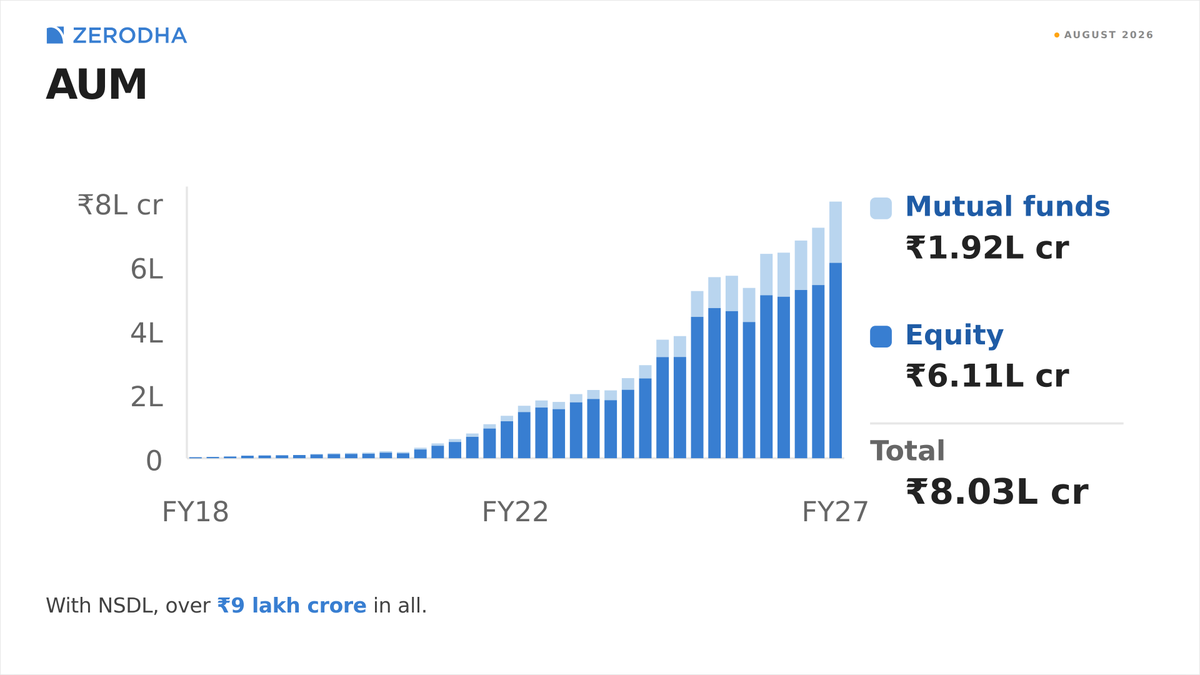
The fall in market activity has also meant fewer new people coming into the markets. But our customers’ AUM continues to grow. We are now the largest broker in India by AUM, and ultimately, that is the number that matters to us. It is also a sign of the trust customers place in us.
That being said, one area of the business continues to worry me: MTF, or margin trading funding. Our MTF book has now grown to about ₹9,000 crores.
The problem with leverage is that it gives you a boost when things are good. But when things go bad, they can get bad really, really quickly.
Indian markets are still shallow, and liquidity can evaporate quickly if markets fall. We are already heavily dependent on F&O activity. Add the leverage through MTF, and a sharp downturn can become a double whammy.
This is why we have spent years trying to make Zerodha resilient to whatever may come. A lot of work has gone into diversifying the business through @zerodhacapital, the @ZerodhaAMC, and the investments we are making through Rainmatter.
But ultimately, what matters most is the promise we made when we started Zerodha.
The philosophy has remained the same from day one: don’t do unto others what you don’t want done unto you.
For us, that means not pushing or peddling unsuitable products. No triggering customers to trade or do things that may be bad for them. It means not annoying customers and not doing anything that could lead to a loss of trust, even if doing the right thing means taking a revenue hit.
Pretty much everything about Zerodha has changed over the last 16 years.
The philosophy, and the promise we made to you, haven’t.
Thank you for all the love over the years.
Here’s the full update: https://t.co/8G5kgU3Zs5
There has been a lot of discussion about the sharp closing moves since the new Closing Auction Session went live.
CAS itself is not a bad idea. Most large global markets have some form of closing auction. A large amount of institutional activity, especially from passive funds and other benchmark-tracking investors, happens near the close. Instead of the closing price being determined based on the average traded price during the final 30 minutes, CAS brings these orders together in an auction to discover one closing price.
The goal of CAS is to enable better price discovery and make it easier to execute large orders without moving prices abruptly. But the price dislocations we have seen over the last few days highlight some of the structural problems that are specific to the Indian markets.
Closing auctions work well when there is deep liquidity and a large and diverse ecosystem of market participants, including market makers and arbitrageurs. Whenever prices diverge between the cash market, futures, ETFs, or different exchanges, participants step in and arbitrage the differences away.
This ability to arbitrage is much more limited in India.
For one, it is impossible to express a short view in the cash market. We have a securities lending and borrowing mechanism, but it isn’t deep or easy enough to use. Unless borrowing stocks and shorting them becomes easy, there is bound to be structural upward pressure in the markets.
Then there is the difference in the cost of trading an option versus a futures contract. In April 2026, STT on futures was increased to 0.05% of the entire contract value, while STT on options is charged on the premium. So even though the STT rate on options is higher, trading futures is more expensive.
Once you add STT, exchange charges, spreads, and impact costs, the trading opportunity has to be quite attractive before a futures arbitrage trade is worth doing. The same directional view can often be expressed more cheaply through options. This leads to traders preferring options over futures.
India has over 13 crore registered investors, but only about 20–30 lakh traders trade actively on any given day. That’s it. We don’t have a large enough committed ecosystem providing two-sided liquidity across the cash market, futures, ETFs, and closing auctions.
CAS is not the reason for these structural limitations, but it makes them more apparent. The timing of its rollout is also unfortunate, because the RBI’s new norms on capital-market exposure, which limit banks’ exposure to capital-market activities, are going live at the same time.
When one instrument is more attractive than another, or when participants cannot express both bullish and bearish views easily, distortions are inevitable.
There might be tweaks required in how CAS itself works. But the larger issue of our markets being shallow is a complicated problem to solve. It requires building an ecosystem that encourages all kinds of traders and investors, with different time horizons, to participate easily.
Making shorting and securities lending easier, reducing distortions between instruments, and encouraging genuine market-making would be a good place to start.
Before making Zerodha videos, I used Quora as “Byomkesh Bakshy” to answer questions retail investors were already asking.
The account went on to reach nearly 2 million views.
The lesson: customers rarely begin by looking for a product. They begin by looking for help.
आदरणीय मुख्यमंत्री जी, संपर्क करते ही आपने तुरन्त समय दिया,और जिस प्रकार से भरत तिवारी के माताजी सहित परिवार को मुख्यमंत्री आवास बुलाकर सुना, और फिर न्याय का भरोसा दिया, वो आपकी न्यायप्रियता और संवेदनशीलता का उदाहरण है।परिवार सहित सभी को आपके न्याय पर विश्वास है
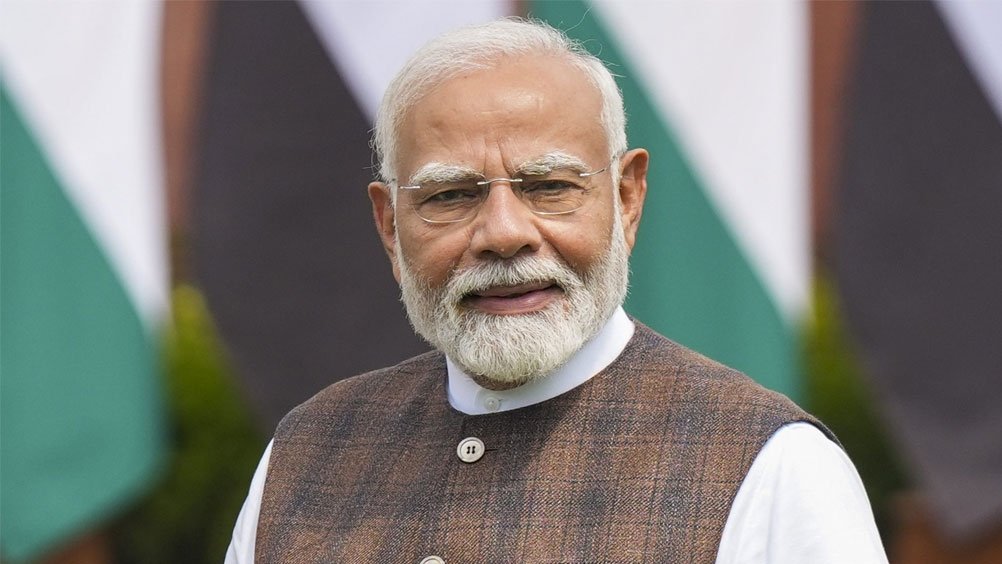
ये है भारत के ऐतिहासिक प्रधानमंत्री नरेंद्र मोदी जी का काफिला.. मात्र दो गाड़ी.. यही है नरेंद्र मोदी जी का असली परिचय.. जब भी वे दूसरों से अपील करते हैं तो खुद भी उसका पालन करते हैं.. इसे कहते हैं लीडर..
अपनी सुरक्षा को भी ताक पे रखकर..!
When it comes to personal finance, people somehow keep making the same mistakes over and over again. There’s very little creativity in the mistakes people make.
Take investing. Pretty much every influencer, every serious finance writer, and the financial media have been screaming for years: don’t mix insurance with investments. ULIPs are usually a bad idea. Endowment policies are usually a bad idea.
And yet, ULIP sales continue to grow and endowment plans continue to be sold. People continue to fall for the same pitches, despite all the articles, videos, and excel sheets explaining why these products are bad.
The same applies to health insurance, though I have a little more sympathy there. Health insurance is genuinely complicated. There are tiny clauses, room rent caps, waiting periods, exclusions, and conditions that most people don’t fully understand and then they find out the hard way, when they still have to pay out of pocket despite having a policy.
But with products like ULIPs and endowment plans, there’s no excuse. These are not impossibly complicated products. Even a cursory Google search will tell you the problem. And today, in 2026, you can just ask ChatGPT or Claude whether a product is a good idea, and they’ll usually show you the math, explain the catches, and give you pointers on what to do.
And yet, people still keep falling for the same thing.
@PrateekLearnapp from @Zero1ByZerodha has made a really nice video on some of the biggest mistakes Indians make with investing and health insurance. It’s worth watching, and sharing with your friends and family too.
📸📸
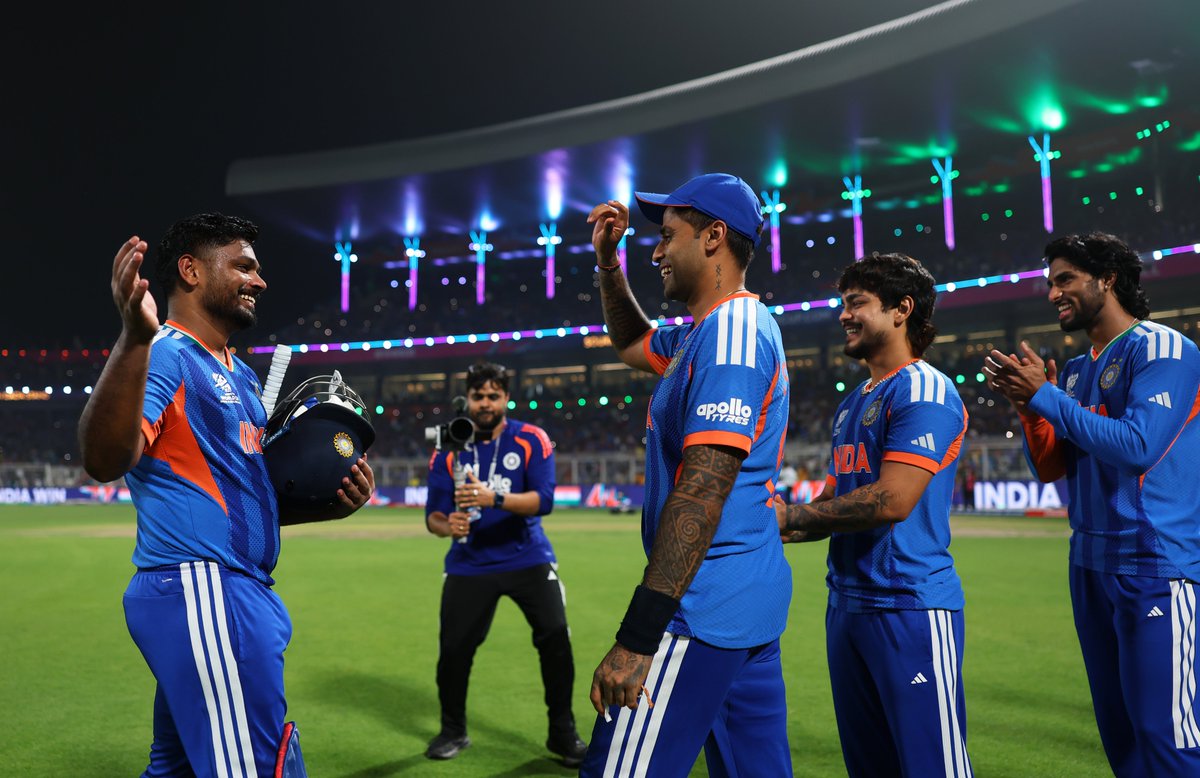
A memorable night at Eden Gardens 🥳
#TeamIndia register their highest successful chase in ICC Men's T20 World Cups ✅
Scorecard ▶️ https://t.co/ur4pr8Bi3K
#T20WorldCup | #MenInBlue | #INDvWI
चार मिसाइलों में |
देशों की सारी चमक उजड़ गई |
यहां हजारों में से एक जमीन पर गिरने नहीं दी |
क्योंकि देश की सुरक्षा में हमारे नेता की देशभक्ति खड़ी थी |
@narendramodi