@remilouf What do you find hairy with structured generation and speculative decoding? (I happen to be interested in both topics! See the 3 latest posts of https://t.co/XsqKdSpiQn).
@DannyHabibs I experimented with this idea: https://t.co/kppNyF1SMd
... But I just built a basic proof of concept. I'm curious to see what you'll create.
Little lockdown project: simulating 3D perception with face tracking in the browser @TensorFlow@threejs_org
Demo (for webcam-equipped laptops or desktops): https://t.co/joA2zenbPl
Code and write-up: https://t.co/szYqF3675d
Thanks @JohnnyChungLee for the inspiration
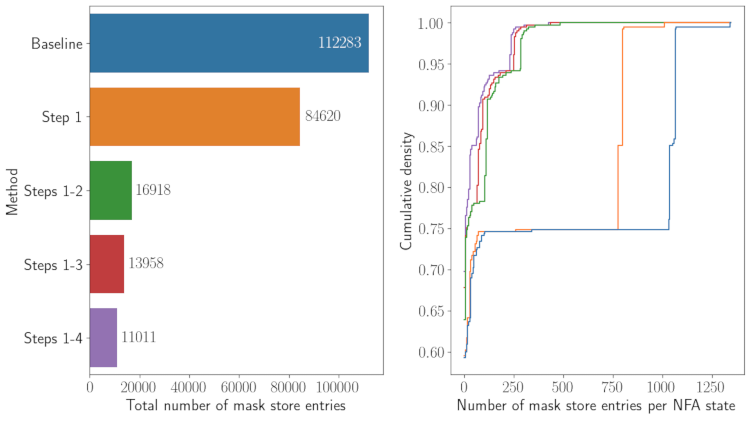
The results: a 10x smaller mask store for the Python grammar and the Mistral 7B tokenizer.
Experiments empirically confirm the streamlined mask store produces exactly the same masks as the original mask store and that the masks are neither too lenient nor too strict.
Constraining LLM outputs (e.g. regex, JSON schema...) is key to develop robust LLM use cases. In this context, I'm happy to introduce a novel, fast, high-fidelity constrained decoding method. It applies to regex constraints and builds on the approach implemented in Outlines. 🧶
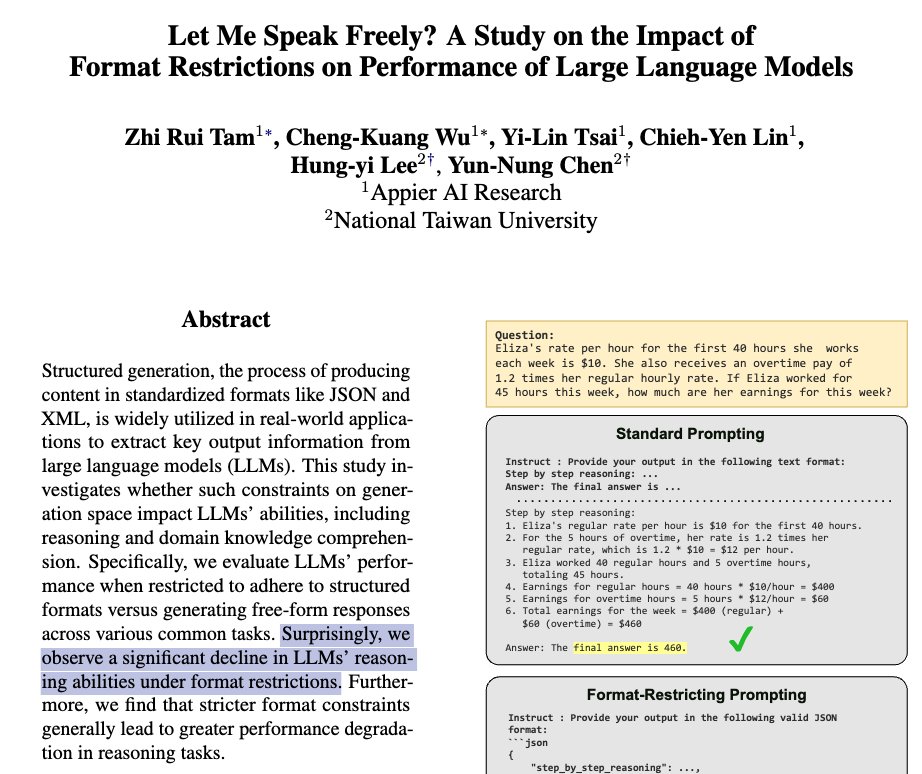
A few thoughts on a recent paper discussing the relationship between formatting constraints and performance for LLMs. It suggests that structured text generation decreases performance in reasoning tasks and seems to contradict earlier empirical results. How can that be? (1/n)
@omarsar0 Interesting results but the paper doesn’t really elucidate the mechanisms through which formatting restrictions may be harmful so it’s hard to draw strong practical conclusions on the use or design of structured generation techniques.
A few thoughts on a recent paper discussing the relationship between formatting constraints and performance for LLMs. It suggests that structured text generation decreases performance in reasoning tasks and seems to contradict earlier empirical results. How can that be? (1/n)
Final comment: the article is somewhat ambiguous about the notion of "JSON mode". Are we talking about guaranteeing any JSON output or enforcing a specific JSON schema? It's a key distinction with significant impacts on performance.
A few thoughts on a recent paper discussing the relationship between formatting constraints and performance for LLMs. It suggests that structured text generation decreases performance in reasoning tasks and seems to contradict earlier empirical results. How can that be? (1/n)
This is not good, "Surprisingly, we observe a significant decline in LLMs’ reasoning abilities under format restrictions."
Link: https://t.co/SDhgjHsEMS
Overall, the article brings new experimental data points on an increasingly consequential topic (thanks @zraytam and colleagues!) but additional work is needed to draw practical conclusions on the use or design of structured generation techniques.