Five years out, when billions of coding agents exist, software development will be largely solved. The traditional moat of “we have better engineers” disappears. Products will be copied, improved, and open-sourced almost instantly. Defensibility will shift away from code itself, toward distribution, data, brand, and community.
I'm not joking and this isn't funny. We have been trying to build distributed agent orchestrators at Google since last year. There are various options, not everyone is aligned... I gave Claude Code a description of the problem, it generated what we built last year in an hour.
I'm Boris and I created Claude Code. Lots of people have asked how I use Claude Code, so I wanted to show off my setup a bit.
My setup might be surprisingly vanilla! Claude Code works great out of the box, so I personally don't customize it much. There is no one correct way to use Claude Code: we intentionally build it in a way that you can use it, customize it, and hack it however you like. Each person on the Claude Code team uses it very differently.
So, here goes.
I feel this way most weeks tbh. Sometimes I start approaching a problem manually, and have to remind myself “claude can probably do this”. Recently we were debugging a memory leak in Claude Code, and I started approaching it the old fashioned way: connecting a profiler, using the app, pausing the profiler, manually looking through heap allocations. My coworker was looking at the same issue, and just asked Claude to make a heap dump, then read the dump to look for retained objects that probably shouldn’t be there; Claude 1-shotted it and put up a PR. The same thing happens most weeks.
In a way, newer coworkers and even new grads that don’t make all sorts of assumptions about what the model can and can’t do — legacy memories formed when using old models — are able to use the model most effectively. It takes significant mental work to re-adjust to what the model can do every month or two, as models continue to become better and better at coding and engineering.
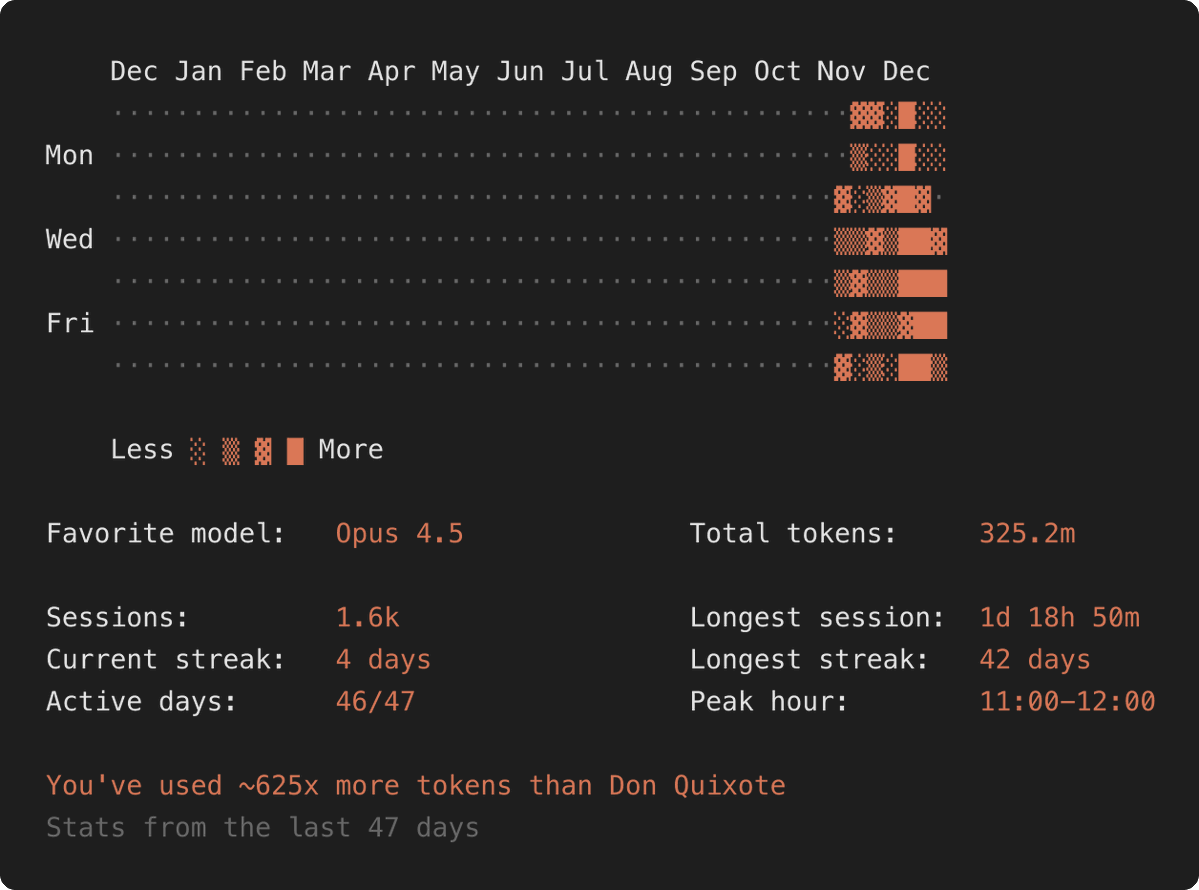
The last month was my first month as an engineer that I didn’t open an IDE at all. Opus 4.5 wrote around 200 PRs, every single line. Software engineering is radically changing, and the hardest part even for early adopters and practitioners like us is to continue to re-adjust our expectations. And this is *still* just the beginning.
I've never felt this much behind as a programmer. The profession is being dramatically refactored as the bits contributed by the programmer are increasingly sparse and between. I have a sense that I could be 10X more powerful if I just properly string together what has become available over the last ~year and a failure to claim the boost feels decidedly like skill issue. There's a new programmable layer of abstraction to master (in addition to the usual layers below) involving agents, subagents, their prompts, contexts, memory, modes, permissions, tools, plugins, skills, hooks, MCP, LSP, slash commands, workflows, IDE integrations, and a need to build an all-encompassing mental model for strengths and pitfalls of fundamentally stochastic, fallible, unintelligible and changing entities suddenly intermingled with what used to be good old fashioned engineering. Clearly some powerful alien tool was handed around except it comes with no manual and everyone has to figure out how to hold it and operate it, while the resulting magnitude 9 earthquake is rocking the profession. Roll up your sleeves to not fall behind.
When I created Claude Code as a side project back in September 2024, I had no idea it would grow to be what it is today. It is humbling to see how Claude Code has become a core dev tool for so many engineers, how enthusiastic the community is, and how people are using it for all sorts of things from coding, to devops, to research, to non-technical use cases. This technology is alien and magical, and it makes it so much easier for people to build and create. Increasingly, code is no longer the bottleneck.
A year ago, Claude struggled to generate bash commands without escaping issues. It worked for seconds or minutes at a time. We saw early signs that it may become broadly useful for coding one day.
Fast forward to today. In the last thirty days, I landed 259 PRs -- 497 commits, 40k lines added, 38k lines removed. Every single line was written by Claude Code + Opus 4.5. Claude consistently runs for minutes, hours, and days at a time (using Stop hooks). Software engineering is changing, and we are entering a new period in coding history. And we're still just getting started..
Aggressively JIT your work. It's not about the task at hand X, it's a little bit about X but mostly about how you should have had to contribute ~no latency and ~no actions. It's digital factorio time.
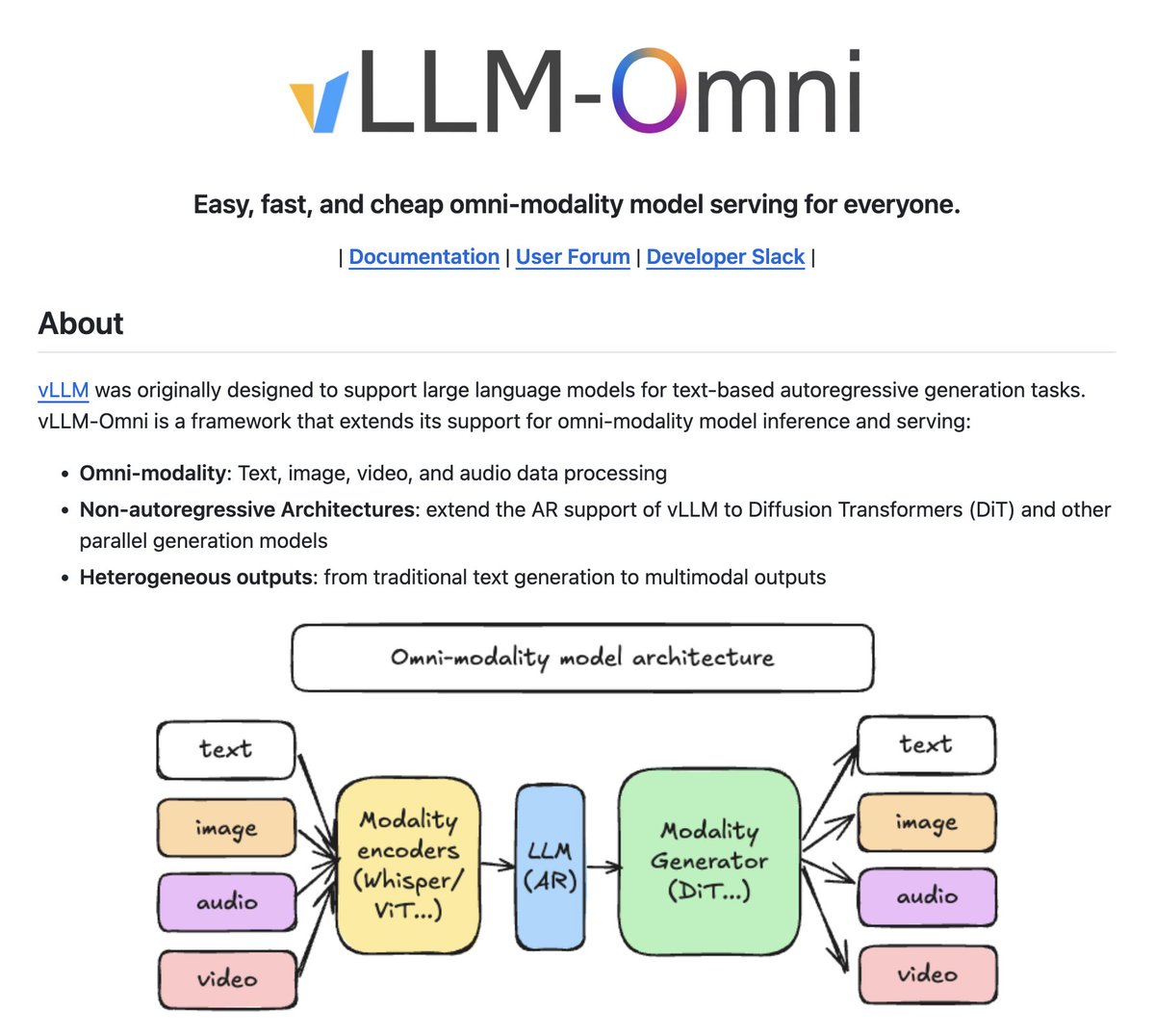
vLLM just got a major upgrade!
Originally built for autoregressive text-based LLM serving, vLLM-Omni now lets you serve text, image, video, and audio models - all from a single framework.
You can also serve diffusion models for fast parallel generation.
100% open-source.
How long have you been "planning to understand" how modern LLM inference works?
We just gave you a readable version of SGLang you can finish over the weekend.
Introducing mini-SGLang ⚡
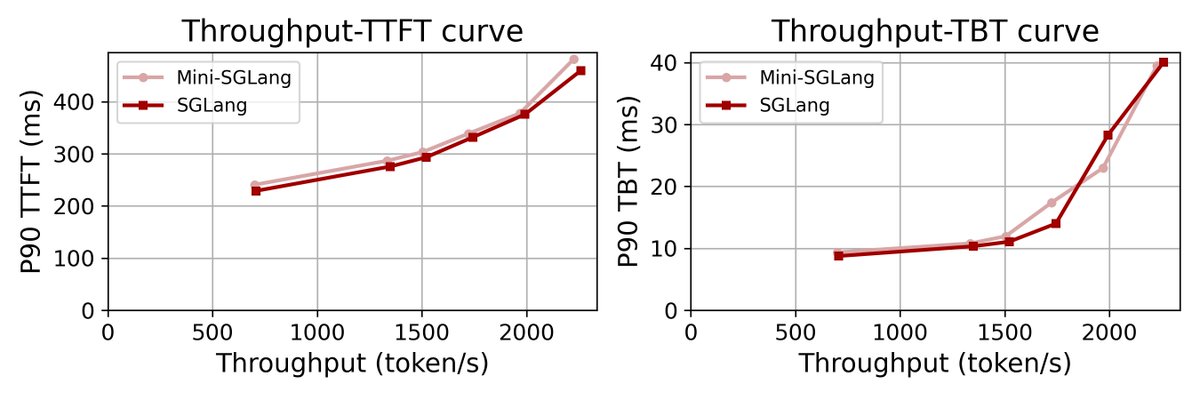
We distilled SGLang from 300K into 5,000 lines. Kept the core design, cut the complexity. Without sacrificing performance — nearly identical to SGLang online.
It is built for engineers, researchers, and students who want to see how inference really works and learn better from code than papers.
⭐ Star us on GitHub: https://t.co/Nk5NCXXdTz
🧵 (1/3)
Welcoming a new state-of-the-art reranker, Rerank 4! :)
It's smarter, faster, and packed with insanely powerful features no other model has.
Give it a try on the Cohere API, AWS Sagemaker, and Azure Foundry! Let us know what you think!
We managed to get Claude code, Codex and Gemini CLI to train good AI models thanks to @huggingface skills and you can too even (especially?) if you've never trained a model before 🤯🤯🤯
After changing the way we build software, AI might start to change the way we build AI (autocatalysis much?)!! 🔥🔥🔥
The wait is over! Microsoft Research is sharing Skala, the new exchange-correlation functional, marking a major milestone in the accuracy/cost trade-off in DFT. Help us learn from your testing so we can improve. Available on Azure AI Foundry and GitHub. https://t.co/XbOp9pC7ew
Sharing because it’s the best clip I’ve seen in a few weeks.
“Who are you jealous of?”
“Anybody who’s still got little kids at home.”
The purpose of life is to be a parent. To create an unbreakable family unit with a true partner.
Everything else secondary.
🚀Our rStar-Coder dataset is now released!
A verified dataset of 418K competition-level code problems, each with test cases of varying difficulty. On LiveCodeBench, it boosts Qwen2.5-14B from 23.3% → 62.5%, beating o3-mini (low) by +3.1%.
Try it here: https://t.co/4y50CBcJzi
NotebookLlama is our open-source @streamlit clone of NotebookLM 🦙📓 - and we just launched a v2 that makes it a way better tool for document research!
1️⃣ When you upload a knowledge base of files, you can now extract/download images/tables, and even visualize tabular data as a chart 📊
2️⃣ There’s a full claims verification assistant that will verify any research directly with citations from the source documents.
Amazing work by @itsclelia, check it out 👇
NotebookLlama repo: https://t.co/RAIfDRsHvw
Check out LlamaCloud: https://t.co/rlDaAlE4SH
It’s been a tough few weeks. My 10yo daughter was diagnosed with a very rare, aggressive cancer called interdigitating dendritic cell sarcoma (IDCS). I’m reaching out to identify clinicians/patients who have encountered pediatric IDCS, indeterminate dendritic cell histiocytosis or other (non-LCH) histiocytic sarcomas cases.
I'm trying to understand non-surgical chemo and targeted therapy options, new pathology markers to better diagnose subtypes/treatments, and any data on progression in pediatric patients. Please feel free to share – I’m trying to cast a wide net due to the rarity of this condition and how little is known.
People can contact me directly at my first name (as written in my profile) at https://t.co/ubo0zQRMn0.
I’ve confirmed that Mark Zuckerberg is serious about fighting @elonmusk and is now waiting on the details (if Musk decides to follow through)
“The story speaks for itself,” a Meta spokesperson says re: Zuck’s IG post saying “send me location”
https://t.co/4g1IkqOl47
Twitter has set a very high bar for the rest of us designing and building distributed systems:
Build systems so robust that even if 70% of you get fired, it can chug along for as long as possible, prompting ignorant people to wonder why you even had a job in the first place. 😞