@sanjayuvacha@airtelindia If you're referring to the Airtel Thanks app (the one meant to be installed on a phone), you probably should be aware that this is one of the worst apps in terms of atrociously intrusive and dangerous permissions.
https://t.co/abwAHGGgHr
Progress or lack thereof 🤯
Now even the 10 ministers have disappeared - link says file not found!
https://t.co/WdShvSQv5c
@R_Kumar_TVK FYI.
This is becoming like a how many people to change a lightbulb joke!
How long does it take to update the TN Govt website which still shows only 10 ministers? https://t.co/4jiYM1M38k
It's a week since revised list of 35 ministers was issued :
https://t.co/01ZMvC1k1G
The entire portal needs an overhaul, stuck in an unresponsive timewarp @R_Kumar_TVK
How long does it take to update the TN Govt website which still shows only 10 ministers? https://t.co/4jiYM1M38k
It's a week since revised list of 35 ministers was issued :
https://t.co/01ZMvC1k1G
The entire portal needs an overhaul, stuck in an unresponsive timewarp @R_Kumar_TVK
What a refreshing change from the tiny plastic water bottles handed out at govt meetings.
Well done @MtcChennai !
Hope other govt offices follow suit and reduce waste.
@TANGEDCO_Offcl brownout off Spur Tank Road, Egmore division, Chennai. Power is fluctuating almost like strobes for over 90 minutes, inverter can't work. Why is FOC landline not accepting any calls? FOC van not picking up. Complaint placed with central helpline still unresolved.
@ranjim@Guruvanmikanat1 Where is the list published of 717 TASMAC outlets, and list of 150 closed?
Field level assessment defeats the spirit (pun intended) of the decision which is of nuisance value by errant, inebriated customers.
If bus stops are thrown into equation, then how does one reach TASMAC?
The popcorn queue at Sathyam Cinemas is ripe for a time-motion study on efficiency.
Also, @_PVRCinemas when are we going to see at least a nod to India's RPDA accessibility mandate?
The requested drop-off zone, railings, contrast markings & seats for waiting seniors are absent!
Express Investigation:
A fund meant for India’s top athletes was used to upgrade sports facilities for bureaucrats - by bureaucrats.
🏊 Heated swimming pools
🎾 Tennis courts
🏸 Officers’ clubs
All funded through National Sports Development Fund (NSDF).
https://t.co/kZRYaLa6ug
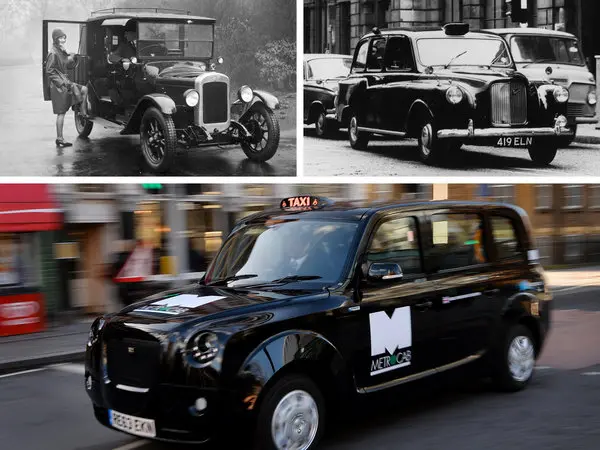
To get a license to drive a black cab in London, you have to memorize 25,000 streets, 20,000 landmarks, and the fastest route between any two points in a six-mile radius of Charing Cross. It takes most people three to four years.
A British neuroscientist asked the obvious question nobody had thought to ask. What does that actually do to a human brain?
Her name was Eleanor Maguire. The study changed neuroscience forever.
The exam is called The Knowledge. It was introduced in 1865, and the format has barely changed since.
Applicants ride a moped around London for years with a clipboard strapped to the handlebars, tracing every possible route between every possible pair of points in the city.
They get tested in person by an examiner who can ask them, on the spot, for the shortest legal route between any two addresses in a database of tens of thousands. Half the people who attempt it fail.
The ones who pass have spent an average of four years studying full time and have taken the test 12 times before getting through.
Maguire was watching a TV movie about it in 1995 when she had the idea. These were not ordinary people. They were people running one of the most extreme spatial memory training programs that exists anywhere on Earth.
If the human brain could be reshaped by experience, this was the cleanest natural experiment anyone was ever going to find.
She put 16 of them in an MRI machine.
Their posterior hippocampi were significantly larger than the brains of matched controls. The longer a driver had been working, the bigger the difference got.
A 40-year veteran had a measurably more developed hippocampus than a 5-year veteran, and both had more than someone who had never driven a cab.
Here is why that finding broke a century of consensus.
Until 2000, every neuroscience textbook in the world taught a version of the same idea. The adult brain is essentially fixed. You are born with a set number of neurons. Childhood is the window where the wiring gets laid down. After puberty, the structure freezes, and the rest of your life is just slow decline.
Maguire's study was one of the first pieces of human evidence that this was simply wrong. Adult brains physically remodel themselves in response to what you ask them to do. Not metaphorically. Structurally. With grey matter you can measure on a scan.
The skeptics had an obvious objection. Maybe people with bigger hippocampi were just more likely to become taxi drivers in the first place. The brains were not changing. The job was selecting for brains that already looked that way.
So Maguire ran the experiment again. Properly this time.
She recruited 79 trainees who were just starting to study for The Knowledge and 31 controls who were not. She scanned all of them at the start. Then she waited four years. Of the 79 trainees, 39 eventually passed the exam and 20 failed. She scanned them again.
The trainees who passed had grown larger posterior hippocampi over those four years. The trainees who failed had not. The controls who never studied had not. The brain change was not selection. It was construction.
The act of memorizing the city had physically rebuilt the part of the brain responsible for spatial memory, and the rebuild only happened in the people who actually did the work.
There is a quieter finding from this research that almost nobody quotes, and it is the one I cannot stop thinking about.
The drivers had a bigger posterior hippocampus, but they had a smaller anterior hippocampus. The brain had not magically expanded. It had reallocated. Tissue that was being used for one type of memory had been compressed to make room for another.
When Maguire ran follow-up cognitive tests, the cabbies were measurably worse than controls at certain visual memory tasks unrelated to navigation. They had paid for The Knowledge with something else. The trade was real.
She also ran a second control experiment that is the part of the story most people never hear. She scanned London bus drivers. Same hours behind the wheel. Same city. Same traffic. Same stress. The only difference was that bus drivers follow fixed routes. They do not have to navigate. Their hippocampi looked completely normal.
The cab drivers had not grown bigger hippocampi from driving. They had grown them from the constant, active, effortful retrieval of spatial information from memory.
That distinction is the entire study.
Then in 2020, McGill researchers ran the inverse experiment. They tracked 50 regular drivers and measured how often they used GPS. The participants who relied most heavily on turn-by-turn navigation had measurably weaker spatial memory. When the researchers retested a subset of them three years later, the heavier GPS users had declined fastest.
The hippocampus, the same region the cabbies had built up by ignoring shortcuts, was being slowly hollowed out in everyone else by accepting them.
The mechanism Maguire spent 25 years documenting works in both directions. Brains grow what you make them grow. They lose what you stop asking them to do.
The taxi drivers were running the most intense spatial memory training program on Earth. Most of the rest of us are running the opposite program without realizing it.
Maguire died in early 2025. UCL's tribute described the cabbie study as a stroke of creative genius. She had spent her entire career on a single question. What does it physically take to remember something, and what changes inside a person who remembers a lot of it.
The answer is the part that should change how you live.
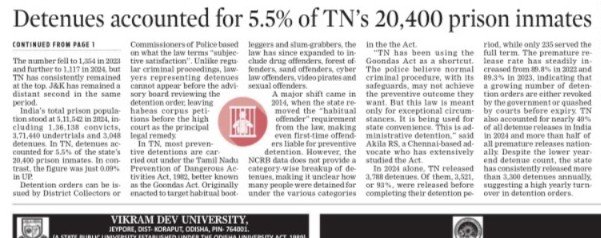
One-third of all prisoners under preventive detention in India are from Tamil Nadu, according to NCRB’s 2024 prison data.
Among them, Dalits account for 31.2% of detainees, despite forming only around one-fifth of TN’s population. The data also shows a large number of detainees are young and from economically vulnerable backgrounds.
Police defend preventive detention as necessary to control crime and violence. But lawyers and rights activists argue that these laws are increasingly being used beyond exceptional situations, pulling more first-time and marginalised offenders into the system.
Worked on this story looking beyond the numbers and into what preventive detention really means in practice.
@xpresstn
Read Here : https://t.co/kiKtJUVDQw
#Prisoners #Tamilnadu #Goondas
Two things that IFF doesn't note:
1. The BNS provision cited is s. 189 on unlawful assembly! How do tweets violate s. 189??
2. At least one of the tweets in the police notice is a *complaint tagging the police*, calling for another tweet to be blocked for abusive language. 😂
IFF's Statement on web censorship accompanying the elections results in Tamil Nadu and swearing in of C. Joseph Vijay
Recent reports around C. Joseph Vijay’s swearing in as Tamil Nadu Chief Minister point to a familiar problem in India’s web censorship architecture where political speech is being restricted through a mix of formal takedown notices, opaque platform enforcement, and disputed claims of government involvement. Here, the regulatory framework for this has been created by the Union Government acting through the Ministry of Electronics and IT which has continued to amend and expand censorship powers under the IT Rules, 2021.
On May 8, 2026, a notice was issued by the Tamil Nadu Police Cyber Crime Wing to X Corp, directing the removal or blocking of 18 URLs within three hours. The earliest accessible press report we found is PTI’s copy carried by The Print on May 10 at 8:49 PM IST, which states that the notice invoked Section 79(3)(b) of the Information Technology Act, 2000 and the IT Rules, 2021, and described the posts as “unlawful”, “provocative” and capable of disturbing public order.
This sits alongside two related platform incidents. First, Rahul Gandhi’s Instagram reel and photo post featuring Vijay’s swearing in were reportedly blocked or restricted after going viral. The earliest publicly accessible report alleging such restriction appears to be Congress leader Srivatsa’s X post of May 10, which was embedded or quoted by The Week, PTI/Daily Pioneer, ANI, and IANS. These reports also record MeitY’s denial, with government sources attributing the restriction to Instagram’s internal systems mistakenly flagging the post. While the post was later restored, the brief restriction impeded its reach and virality. Second, the official X handle of the Viduthalai Chiruthaigal Katchi (VCK) was reportedly suspended shortly after a purported post supporting TVK’s coalition bid. X permanently or temporarily suspended the official VCK handle, displaying the standard notice that the account “violated X rules.” No further public explanation was provided by X.
Taken together, these incidents show how web censorship now operates through a blurred chain of responsibility. Sometimes a public authority or state government acts directly, as with the Tamil Nadu Police notice to X. Sometimes platforms restrict content while users are left with vague references to “legal requirements” or the IT Rules. The result is the same that political speech is interrupted at moments of democratic significance, while the public is left without clear information on who ordered the restriction, under what law, and with what remedy. Such abrupt and arbitrary restrictions also interfere with uncovering an accurate timeline or record of historical events, like assembly elections.
IFF emphasises that legality and process cannot be afterthoughts. Rule 3(1)(d) of the IT Rules, 2021 requires “actual knowledge” through a court order or notification by the appropriate government or its agency under Section 79(3)(b). In Shreya Singhal, the Supreme Court read Section 79(3)(b) narrowly and held that such court orders or government notifications must conform to Article 19(2). IFF calls on all public authorities and platforms to disclose the legal notices, affected URLs, issuing authorities, timelines of restriction and restoration, and remedies available to affected users.
We also call on social media companies to do better since automating content moderation on the basis of laws and rules cannot become a shield for arbitrary restriction and the IT Rules, 2021 cannot be allowed to function as a shadow censorship system in which political speech disappears first and explanations arrive later, if at all.
Internet Freedom Foundation
May 11, 2026
Delhi
This is a blow to the pro-transparency movement, especially in the highly opaque Tamil Nadu police department.
Other states, city police units publish FIRs and a lot more on their own websites.
My earlier report: https://t.co/JfaZu5MFpY
It's ludicrous to use eminent domain to acquire land for data centres. (It's a different matter that eminent domain is misused all over India.)
These tech companies have enough capital to actually pay full market price for the lands they're acquiring.
#land
The #DMK's counter to #TVK is not building a better manipulation engine. Such tweets are the #CambridgeAnalytica playbook rewritten in 2026 procurement language. It reminds me of the Great Hack (2019), a Netflix documentary! 1/5