An information-theoretic model shows that distributing expression across many noisy target genes maximizes information transmission — resolving a long-standing problem in #biophysics.
🔗 https://t.co/Tbx11Gx2Bs
Today, we’re launching @TuvaAI to build a human-centric future for agentic science.
Humans collaborating with AI can learn more than either working alone: humans guiding the research, equipped with agents that can test ideas quickly and autonomously, will deliver the next wave of scientific discovery. But science is all about the details. Neither Einstein nor AGI can drive your project forward without intimately understanding your growing, interrelated web of hypotheses, intermediate results, working threads, failed experiments, datasets, notes, and water cooler conversations.
Our first product, Rao, was born out of my frustration having to reteach LLMs these constantly changing details for every single task in my own research. Rao maintains a persistent, dynamic research memory that learns and remembers project context, history, and threads. This research memory then links into our scientific agents as well as other AI software you may already be using, such as Claude or Codex. With Rao, every scientist turns into a PI managing a proactive, agentic research team that automatically stays on the same page.
Rao is live in VS Code and by CLI, and can help with any scientific task that can be done in a computer. Our early users include computational biologists, theoretical neuroscientists, chip designers, and polymer physicists who use Rao daily to ideate, do math, analyze data, and write papers and grants.
Now, we’re excited to announce Rao in closed beta. If your science mostly happens in a computer—theory, computational modeling, experimental data analysis, scientific writing—Rao can help you discover more, faster. Sign up for our waitlist, and if you’re a fit, we’ll work with you to tailor new, contextual agents that augment the way you do science. Link in the comments.
More personally: I’ve been doing scientific research since I was a kid. Scientists do so much for the world, choosing a painstaking career for the joy of discovery, developing technologies we use every day along the way. And yet, the tools scientists use are often cumbersome and woefully out of date. For me, Tuva is much about empowering the people of science with products they love as it is about the discoveries we’ll help them make. And I’m lucky to work with some wonderful humans along the way—@SamsaraDurvasu1@anuvellore@KimchiOfer among many others. If our mission resonates, please reach out.
New blog post: Jailbreak Scaling Laws for #LLMs
Prompt-injection attacks can boost jailbreak success from slow polynomial to exponential growth as inference-time samples increase.
New on the Deeper Learning blog: https://t.co/5m0vogzXuB
#AI@_ihalder@cpehlevan@BanerjeeAnnesya
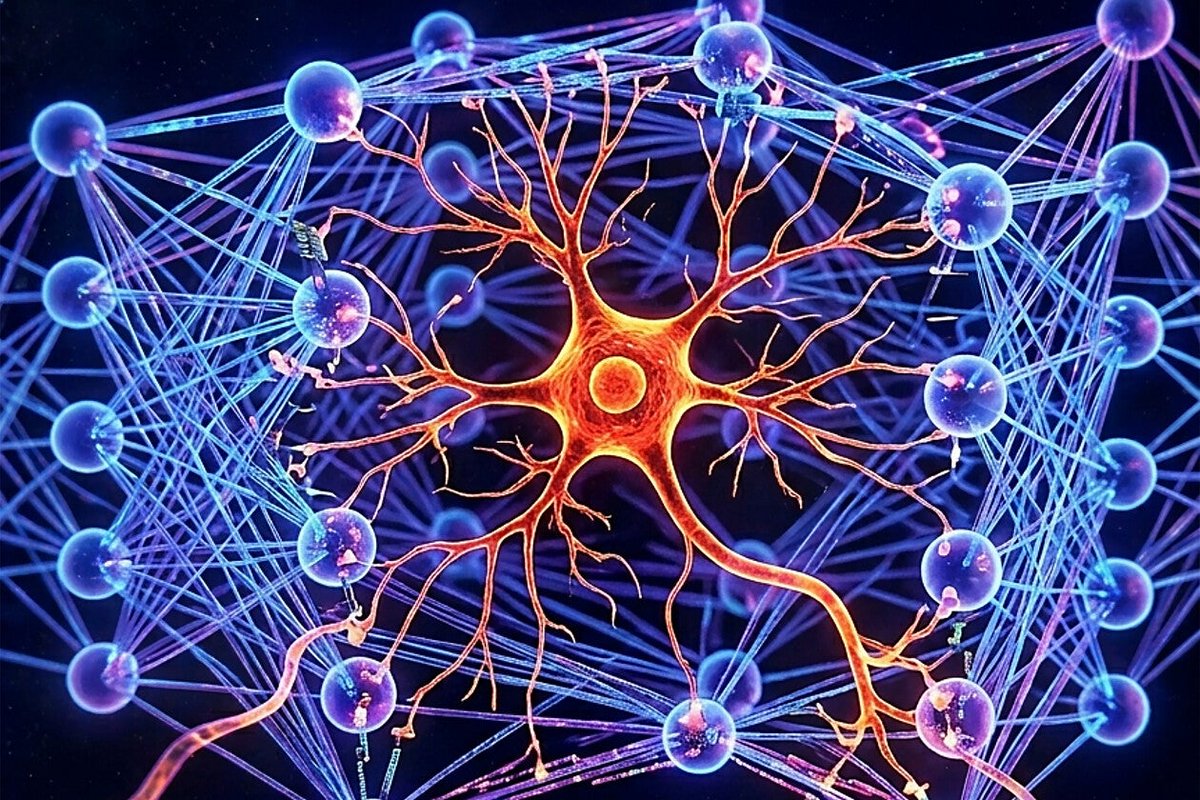
Complexity in the brain may begin with surprisingly simple patterns.
Yale physicist Christopher Lynn studies how thousands of neurons work together to create complex systems. By zooming in on individual neurons, he found that these intricate cells may operate in simpler ways than previously understood, offering new insight into how larger neural systems function.
Learn how this research is reshaping our understanding of the brain: https://t.co/JK4wBnyGVi
How life began remains one of science’s biggest questions.
Inspired by a Yale course on complex systems, researchers have developed a new mathematical approach to explore how life may have first emerged on Earth.
See how this study sheds light on life’s earliest beginnings: https://t.co/Wl1SZeKtmo
Very excited to share our new preprint: “Thermal fluctuations set fundamental limits on ion channel function”, with @machtagroup. We ask: how does the need to overcome noise limit the function of ion channels?
https://t.co/qSxM7ADdgR
@ZyphraAI releases research on a new way to build hybrid models. We introduce a new architecture leveraging the complementary strengths of Transformers and RNNs for greater flexibility and performance than existing approaches.
We call it Hybrid Associative Memory (HAM). 🧵
AI won't replace scientists. It will change what it means to be one.
“Something big is happening.”
Investor @mattshumer_ wrote that this week about AI’s impact on jobs, saying the change is “bigger than Covid” and that he’s already no longer needed for the technical parts of his own job.
I want to share a perspective from a very different corner of the world: scientific research.
I’m both a working scientist and a founder building with AI. And while there’s a lot of fear right now, I’m honestly seeing something more nuanced. And more optimistic.
Somewhat surprisingly, AI adoption is quite low among researchers. Most scientists I know still use LLMs the way they’d use Google: quick lookups, minor coding help, maybe cosmetic edits to plots. If a chatbot hallucinates a reference or fails once, many write the entire technology off.
Of the hundreds of researchers I’ve interacted with over the last six months, maybe 10–20% have meaningfully experimented with Claude, let alone agentic tools.
I don’t think this is because scientists are slow adopters.
I think it’s because AI represents the first *real existential threat* to research as a profession — especially in today’s political and funding climate. And much of the rhetoric coming from the AI ecosystem emphasizes automating science rather than augmenting scientists.
So I don’t think it’s a coincidence, given this, that scientists are reluctant to use this technology. It is psychologically difficult to embrace tools that people are loudly claiming will replace you.
But here’s why I think science is uniquely positioned to benefit from AI rather than be displaced by it:
The “entry-level workers” in science are graduate students and postdocs. From day one, they are expected to think independently, generate hypotheses, and navigate uncertainty. Unlike many white-collar roles, they are not primarily trained to execute well-defined tasks. They are trained to discover.
The hardest part of becoming a scientist is learning how to operate with that autonomy, and it only gets hairier from there, whether you’re a PI, R&D executive, or research scientist in industry.
AI is extraordinarily good at removing execution bottlenecks: writing code, analyzing data, exploring literature, running simulations, generating experimental scaffolding. That means scientists can spend more time doing what they are actually trained to do: deciding what questions matter and how to pursue them.
And deciding what's worth discovering is something humans still need to do.
Science is vast, messy, and grounded in reality. It requires curiosity, taste, and contact with the natural world. Progress is often serendipitous. It is also frequently tedious and frustrating.
If AI reduces the tedious and frustrating parts, I’m optimistic that we’ll see MORE curiosity-driven, creative, and impactful science. Not less. Across both academia and industry.
Something big is happening.
But in science, I suspect it won’t look like replacement.
It will look like amplification.
I’m working on some things in this direction that I’m excited to share soon. If you care about AI and the future of scientific discovery, I’d love to connect.