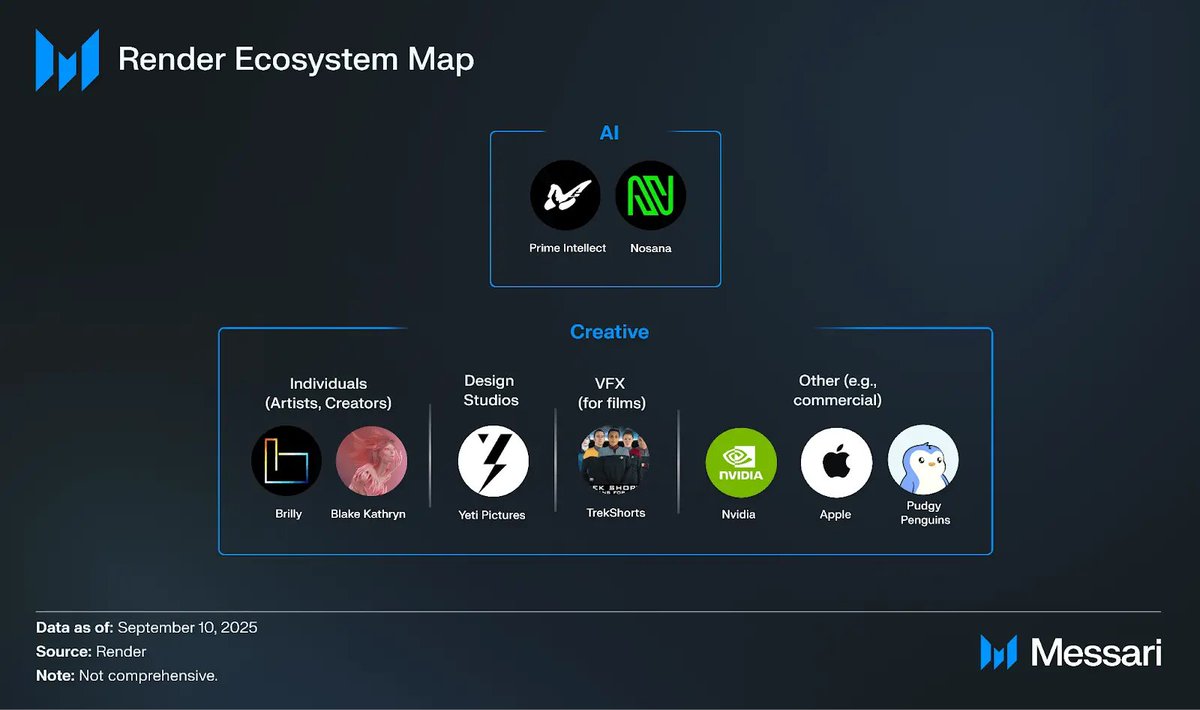
render network hit negative GPU supply availability in Q2 for the first time since 2018. 60,000 new GPUs onboarded across 180 countries in 6 months and every single one gets immediately utilized. token burns up 279% YoY, direct 1:1 proxy for actual compute purchased. AI workloads grew from under 10% of network activity in 2024 to 35-40% today. 50k AI agents processing $76m in transactions need compute infrastructure somewhere. the market is pricing agent frameworks and payment rails. it is not pricing the physical GPU layer that makes all of it run
Pulse has been running strong since March 13 → https://t.co/tXkRVYchuV
If you want clean, independent chart analysis with proprietary tools + solid macro context, this is worth checking.
Key sections I recommend seeing:
• Post Log → real posted examples & history: https://t.co/SOHchgEnob
• Sample Pulse posts & channel structure
• Pre-Trade Best-Practices Checklist → https://t.co/sO33AlWVjT
Serious traders — take a look and see if it fits your style.
#Crypto
Render Network solves one of the biggest problems in modern computing: getting enough GPU power when you actually need it.
Anyone who has ever tried to render a heavy scene, train a model, or run a complex animation knows the pain. You either wait an eternity for your own hardware to finish the job, or you spend a ridiculous amount of money buying GPUs that will sit idle most of the time. Neither option feels great.
@rendernetwork flips that equation. Instead of owning the hardware, you tap into a global pool of GPU power that other people already have. You submit your job, the network finds available GPUs around the world, and the work gets done while you get your time back.
No massive upfront investment. No waiting in line behind your own bottlenecked machine. No praying your GPU doesn’t overheat halfway through a 12‑hour render.
It’s simple. You borrow the power you need, when you need it, and you only pay for what you use.
The best part is how scalable it is. If your project needs a small boost, the network handles it. If your project needs the kind of GPU muscle that would normally require a data center, the network handles that too.
It’s the same shift that cloud computing brought to servers, but applied to rendering and GPU‑intensive workloads. A decentralized marketplace of unused GPU capacity becomes your on‑demand supercomputer.
The result is faster work, lower costs, and zero hardware headaches.
Render Network turns GPU power into a utility instead of a luxury.
At @CES 2026, XR and spatial computing are converging with AI world models as the sector evolves across hardware, displays, and spatial AI – bringing us closer to @JulesUrbach's vision for a @rendernetwork powered holodeck 🧵
"Helium really helped us when we made the decision to move to Solana… a really great partner to have in the DePIN ecosystem."
@drjonessf talks about how @rendernetwork has been used by people worldwide to power Hollywood-grade productions and most recently, AI.
Our Foundation Grants and Social Engagement Lead, @SunnyOsahn delivered our product keynote @SolanaConf a few hours ago, showing how the largest DePIN on Solana is growing:
Landmark immersive art, new AI-3D tools, and the launch of Dispersed AI compute network.
Rendering was just the beginning.
The future of creative compute starts now.
@VinnyLingham Knowing what RN building, I am not convinced to sell last year. Holding for more than 3 years, hopefully patience will pay back. Never Sell Render.
AI and rendering share the same fuel: GPUs.
@rendernetwork is transforming idle GPUs into a distributed engine for 3D rendering and AI workloads — secured by encryption, coordinated onchain, and governed by $RENDER.