Technical Thread 🧵 on Polygon ID 🆔
Topics to be covered:
1️⃣ What is Polygon ID?
2️⃣ What impact can Polygon ID create in society?
3️⃣ Technical overview of Core Components of Polygon ID
4️⃣ Use cases that can be built with Polygon ID
Let's dive in! 💡(1/n)
This is something I enjoy explaining. Follow the logic:
1.
ZK is the endgame for crypto.
Why?
Scale, privacy, security (in STARKs case: post-quantum security).
This is now consensus.
2.
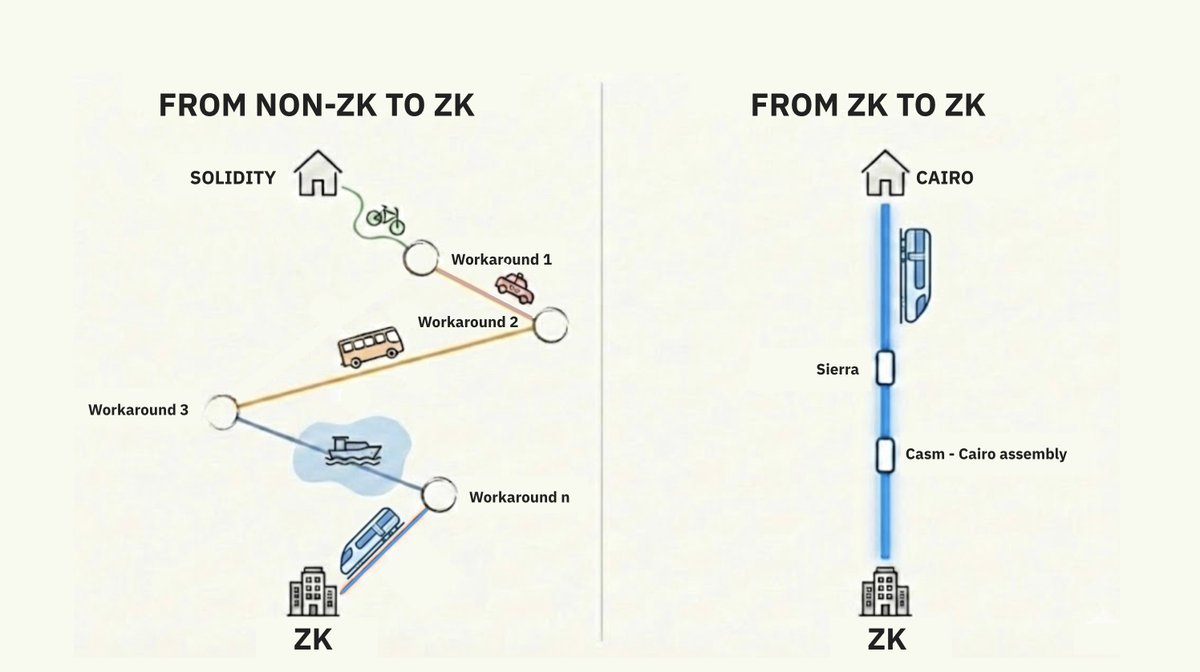
zkVMs work better with a ZK-friendly programming language.
Why?
Because for a zkVM to process a non-ZK-friendly PL, it needs to go through several workarounds before the code can be processed by the zkVM.
What happens through these workarounds?
You lose accuracy and increase the risk of bugs.
3.
Therefore, the logical approach is to use a ZK-friendly PL for a zkVM.
This should be clear by now.
This is why:
* Self-sovereign identity, data and money (so you control your account, not a third-party provider)
* CROPS AI (so other people cannot do this to *your computer* https://t.co/zmG8wrfzAi )
sit your ass down and read
we've all been building, shipping, doing an insane amount of stuff recently with ai tooling and agents offloading the work. the thing that got me thinking is what keeps this cycle going. the way i see it is that we as humans are hardcoded to "work and see a visible result," and the relationship between us and the thing we're working on is getting thinner by the day.
when we wrote a function at 2am, line by line (lol that sounds like ages ago), the work and the mental model of it were the same object. now with agents doing the work, the stuff exists and the mental model exists separately. so building survives, but it bifurcates.
How i see this bifurcation is three category of it:
at the top are the people shaping the substrate itself, the ones building the models, designing the agent arch , setting the patterns of how everyone else builds inside it. they're upstream of everyone, including the deep makers.
below them are the deep makers, people who use agents but read carefully enough to understand and own everything they ship. this is the version of the maker identity that survives the transition, operating at much higher throughput because they're using agents as leverage on a real foundation. this is also where "vibecoding" actually adds the most value, which sounds wrong, because it is usually code for slop but that done from this foundation is the highest leverage mode in the new regime. you're stacking agent throughput on top of real comprehension.
below them are the surface makers, people who ship things but don't read what they ship. they're functionally orchestrating a process whose substance they don't grasp. from the outside indistinguishable from deep makers, from the inside hollow.
below them are the pure consumers, downstream of everyone above, using the products, scrolling the feeds, not engaging with the production of anything numerically the biggest group, and probably growing with the trends.
one thing worth noticing is that the real chasm in this stack isn't where it looks.
It isn't symmetric imo:
So substrate shapers and deep makers are doing the same cognitive thing at different scales, both engaging deeply with substance, surface makers and pure consumers are also doing the same cognitive thing at different scales, both accepting outputs they didn't shape. the actual fault line is between tier two and tier three. between people who engage with substance and people who don't, regardless of how many "repos" they ship.
a surface maker pushing a hundred repos a year is closer, in the way that matters, to the consumer scrolling twitter than to the deep maker pushing the same hundred repos.
so what keeps you going upward in this stack?
simple. it's reading. and by reading i don't just mean books. i mean close engagement with substance in whatever form it shows up in front of you. the code the agent produced. its reasoning. the user feedback. the underlying paper. the system logs. the production action.
all of it, with the willingness to slow down on any of it and actually understanding.
reading is the one thing that determines whether you slide down the gradient or hold position and move above. without the reading habit, even today's deep makers drift toward surface making within a few years, because the path of least resistance with these tools is to accept the output and ship.
So from where i see the gradient pulls everyone downward by default. reading and understating is the only upward force that counteracts the pull.
both directions compound
reading produces taste, taste lets you direct agents more precisely. precision produces better results. better results give you sharper material to read your own work against. that's the upward loop.
surface making produces results that just barely work, which trains you that you don't need to read deeply, which produces more results that just barely work. that's the downward loop.
both are gentle quarter to quarter, both are invisible in any single decision, both are devastating across years. which means the small move that feels low stakes ("i'll just accept this pr, it looks fine") is actually a vote for which loop takes root in your habits.
we move up and down this gradient based on what we cultivate. the slowing down. the sitting your ass down and engaging with what's actually in front of you. that's not just a way to stay a maker. it's the one way to keep "agency" in a world that's optimised to take it from you quietly.
Though the debate for the auth of the results that the agents are producing is still debatable, but that comes next, You at least need to see and tell what is happening and how it is, To even survive.
Really Good Explanation on Schwartz Zipple Lemma,
also sharing one more resource here : https://t.co/jHuHpq2x5f - without mathematical formulas
@LauriPelto
the Schwartz-Zippel lemma is probably the most important result in all of ZK cryptography.
three lines of math carrying an entire field. let me break it down from scratch.
1/Introducing ACTA: Anonymous Credentials for Trustless Agents.
A composable privacy layer above ERC-8004 so agents can prove: personhood, reputation, model provenance, user jurisdiction, and more — without publishing the interaction graph.
🧵 https://t.co/A7WSJ5pJND
Learn fast. Unlearn faster. Repeat.
The biggest career shift is not AI.
It is how quickly skills are becoming irrelevant.
If we look at how careers worked earlier, the model was simple.
A person learned a skill early, and it lasted decades.
That is what the top part of this visual shows. One long stretch of stable skills.
Example:
A mechanical engineer from the 80s could work on the same systems for 25–30 years or a government job meant one skill, one path, one career.
But where we are today is very different.
Skills are breaking into shorter cycles.
10 years became 5.
Then 2–3.
That is the middle layer.
Example:
A developer who learned one framework 5 years ago has already had to switch stacks or Digital marketing itself has changed multiple times in a decade.
And what comes next is even more clear.
Continuous learning is not optional anymore.
It is the career.
Which means the real advantage is changing.
Not degrees. Not experience.
But speed of learning.
Can you pick up a new skill quickly?
Can you let go of what no longer works?
That is the new baseline.
Careers will no longer be built on stability.
They will be built on being relevant.
Give your team the tools and permission to experiment with AI and just get out of their way.
To me its clear that AI is raising the bar of whats expected from every person in their role and the competition to provide value is going up globally, fast. The ppl who figure out how to use these tools early are gonna have a massive edge.
This is why we gave every employee at Polygon 200 dollars (apart from the tokens they use daily on Claude et al) a year for AI tools, use whatever you want, experiment whatever you want. Thats nothing for a company but it tells your ppl go experiment, figure this out, this isnt going away.
F**k learning.
I’m honestly tired of people coming to me saying,
“I want to do something where I can enhance my learning and excel.”
My answer is always the same: Stop trying to learn. Start doing.
Learning is wildly overrated when it becomes an activity by itself.
The people who become great at anything didn’t sit around trying to “learn.”
They built things. Broke things. Tried things. Repeated things.
Learning wasn’t the goal.
It was the side-effect.
So instead of asking: “What should I learn?”
Ask: “What should I start doing today?”
Do things you enjoy. Do things obsessively. Do things repeatedly.
Learning will take care of itself.
I introduced a Private Member Bill titled The Asset Tokenisation (Regulation) Bill, 2026 in Parliament.
The Bill is a forward-looking framework to bring legal clarity, transparency and investor protection to the emerging ecosystem of tokenised real-world assets in India.
Key Features of the Bill:
1) It provides legal recognition to asset tokenisation in India.
2) It establishes a statutory framework for issuance, trading, custody and settlement of tokenised real-world assets.
3) Introduction of regulatory oversight and supervision of tokenised asset markets.
4) Ensures investor protection and safeguards market integrity.
5) Aims to maintain financial stability while fostering innovation in digital finance.