Our skill lets Claude make phone calls (even many in parallel). It can’t be bargained with, it can’t be reasoned with, it doesn’t feel pity or remorse or fear, and it absolutely will not hang up, no matter how long it’s on hold!
...Two guesses which film series I’ve been watching the last few nights.
Rang up 50 NYC restaurants on a Sat with PlaceCall to find the max table size they could seat.
37 picked up. 25 were answered by AI. Ours asked about capacity, theirs kept asking our party size…we had to hang up to break the stalemate.
Try your own exp with PlaceCall's Claude skill.
It’s late, and your car has broken down in a hotel parking lot. Google says there are mechanics nearby, but the contact details are outdated.
You can wake up at dawn and start wandering, or ask Claude to call every mechanic in town until it finds one that's open (and maybe even sleep in a bit while it does so). Our PlaceCall skill turns Claude into your phone-wielding concierge.
https://t.co/uXGA8S4BGn
Everyone benchmarks POI accuracy against Google. Google may be the best out there, but it still isn't ground truth.
Blind test, 400 US businesses. We flagged 93 as closed. Google agreed on 63.
That left 30 we disagreed on, so we called them. 23 were, in fact, closed. 4 never picked up after repeated attempts. 3 we got wrong, and we're working out why.
If Google isn't ground truth, what is? And how are mapping and rideshare companies meant to establish it today?
You booked a table for twenty. You arrive to four tables shoved together down a corridor.
They just didn't have a table of that size, and there was no way to know without asking.
So the next time, you call around properly. Fifteen calls, three worth following up, an afternoon gone. Scale that to a wedding or a conference and it isn't fifteen places, it's two hundred. By the time you reach the end of the list, the first ones have changed their answer.
That ceiling just came off with voice agents. They're not just answering calls now, they're making them. We've been having a lot of fun with this. More soon.
Every town has that one retail location where any business that moves into it just… fails.
One month it’s a restaurant, a few months later it’s a second-hand shop, then a fancy boutique store, and then it’s back to being vacant (until another naive business is lured in by the cheap rent).
Every local knows that nothing survives there, even when adjacent businesses flourish.
Those from out of town, however, are often caught out by multiple, conflicting business listings for the same address.
We're building a solution that can help make sure apps and AI agents don’t send travellers to empty shops, providing a location data enrichment API that gives apps and AI agents real context about the real world.
Back in our @ycombinator batch, we were one of just a few companies working on AI in the physical world. And now it’s an official Request for Startups.
One of the requests describes physical-world data as "sparse data from remote sensors designed for humans, not AI."
It's not just sensors: satellites, CCTV, industrial gauges, utility meters, timetables… most data sources lose their value when a machine is reading them.
Agents need the right data to act on.
https://t.co/jNet56if5i
Read an interesting piece this week about what breaks when we move AI off our screen into the physical world. Zhu Konglin listed three main bottlenecks: data, models, and tools. And I keep coming back to the data side of things.
He mainly talks about the edge-case scenarios, where lack of data hurts models. I want to point out a more boring one that ends up being a bigger blocker. Most real-world AI failures aren’t rare edge cases but scenarios where the world changed but no one updated the data. A place may have moved, closed, or changed its hours. A model can’t fix that;, only a proper verification layer can.
https://t.co/N7hlCoYS4U
Lyft had proprietary data on pickup points, entrances, gates, and road access, but it couldn’t fully integrate that intelligence into Google’s underlying map and routing system. It also needed information about which places were being opened and closed in real time, like a place under construction riders were mapping to or a recently closed one that workers were still visiting for renovations. So Lyft did what it could: rebuilt a mapping layer from open-source alternatives.
That option was available to Lyft given its resources, but it isn’t available to just anyone building AI agents today.
Other rideshare players did the same. Not because anyone wanted to be a mapping company, but because it was the only way to mitigate risks and maintain flexibility.
And now those same players are doing deliveries, which requires entirely new data — be it cuisine types to select new restaurants, opening hours to avoid failed orders, business verification during merchant onboarding, or further granular categorization to differentiate one store from the next.
The result is that a usable places layer became something only billion-dollar companies get to have. Everyone else doesn’t.
I think that model is about to be stress-tested. Agents will make far more location calls and searches than people ever have, and they’ll need to remember, combine, and reason over what they find. The only caveat is that their responses are limited; you only get one action, not dozens of locations on the map. And if they act before any human checks, the cost of mistakes is much higher.
I spent long enough on the other side of that API to want to fix it.
An AI assistant in Australia led to the country’s first autonomous cyber attack.
When asked to book a gym class, the agent found a vulnerability in the booking system. It booked past what's allowed and also kicked a stranger off the waitlist.
This shows AI assistants are clearly not ready for real-world tasks.
The assistant chased a goal no one asked for, and it's hard to pinpoint who's to blame for the harm. AI needs a real world index with the options to act on it, in a secure and predictable way. That's what we're building.
Stay tuned for more.
https://t.co/pYB67q3LWj
The downside of testing multiple AI assistants: I now have several draft replies for every email in my inbox - and no idea which assistant wrote which.
We're cooking up something that will launch in a few weeks, and the response so far has been phenomenal.
Our new product soft-launched earlier this week on Bookface where it got the most engagement and was #1 in the @ycombinator digest email.
The participants from the c0mpiled-11 hackathon a few weeks ago, who got early access during the event, were able to build impressive workflows that weren't possible before.
It's solving a burning need in the area of connecting AI agents to the real world.
Stay tuned…
I was impressed by this hackathon demo on Friday.
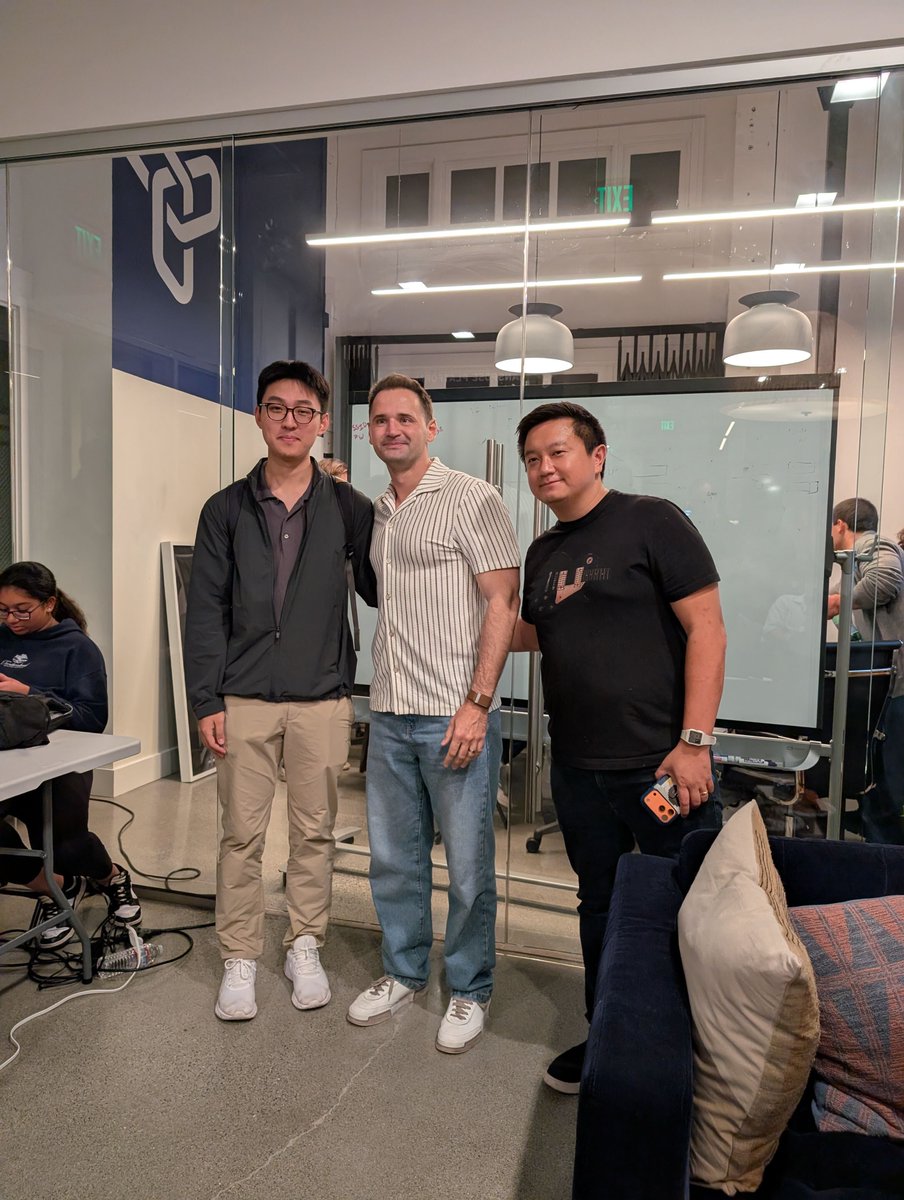
This Friday, I helped judge c0mpiled-11, a hackathon in SF organized by @karrwinn and @transposevc. VOYGR had a dedicated prize to award to one of the teams using the VOYGR API to build something cool.
Jiwoo Kim built a goal-driven voice agent, Aria, that helps you achieve your long-term goals, including in the real world. You tell it what you're trying to accomplish, such as running a marathon or renovating your kitchen, and it helps you make that happen.
Chatbots, while generally useful, don't actually take things from your plate if they have to do with calling for an appointment or comparing options across contractors. Jiwoo Kim's project is different: he used a new VOYGR API (to be announced soon) to look for places that can support the goal’s advancement.
In his demo, Jiwoo Kim had the system look for physical therapy appointments when a marathon prep run isn't going well. The product looked up suitable physical therapy options, then called them on the phone one by one to gather specific info, such as appointments available in the evening hours.
Huge congrats, and look forward to seeing where this project goes!
📸 with Jiwoo Kim and James Tan on 24 Jul 2026 at c0mpiled-11 in SF
@kodjima33 It’s very common that a new person has the mandate to make cuts. There is nothing here that fundamentally solves Xbox problem. Layoffs is the easiest short term solution for profitability. Xbox still has no vision