@TopiEero Kaspi's management skills deserve the separate deep dive. I'll do it soon probably too. I started from the biggest market misreadings of Kaspi's strategy and later can move to less obvious ones
The market reads Turkey wrong on $KSPI.
The bear case: "Trendyol is 2x bigger. Kaspi will burn billions fighting a losing e-commerce war."
Wrong frame. Here's what actually happened.
1.Turkey's e-commerce law (in force since 2023) is built to block the winner-take-all strategy itself.
Limits kick in by size tiers, indexed to total market volume every year — so they work as market-share ceilings, not fixed numbers.
As market volume expands, higher tiers don't just add a progressive license fee — they actively cap advertising budgets, private labels, delivery integration, and proprietary financial services.
Trendyol sits above the top tier being capped in every way mentioned above. $Heps pays already a license fee but still keeps every strategic option open.
The market this law creates is not a monopoly race. It's a protected oligopoly by design.
Ironically, the law succeeded in its primary objective — neutralizing a single-player monopoly. But in penalizing the leader for its scale, it accidentally helps the second-largest player to thrive.
2. Fintech integration is a separate, heavily regulated and genuinely complex topic — it deserves its own deep dive. The short version - Trendyol is in the harder legal position — its own group sits above the top tier
Heps has a clear window to deploy its services, and Kaspi already owns a licensed Turkish bank (ex-Rabobank) to fully capture this opportunity
3. Turkey also closed the discount flank: from Feb 2026, simplified customs for cross-border parcels is gone. The Temu/Shein model got a hit there. The oligopoly is protected from below too.
4. So what did Kaspi actually buy for ~$1.5B (est., incl. injections)?
Not "a smaller Trendyol." A customer acquisition machine:
— 12M active shoppers
— 20.6M opened wallets with KYC consent
— ~100K merchants + own logistics
That's roughly $75 per warm, transacting customer — cheaper than Turkish banks pay for cold leads.
And cheaper is half the story. TIME is the other half: Papara needed roughly 8 years to build a 20M user base. A new bank would spend 5-8 years and a marketing war for this. Kaspi got it on day one — and every new product (loans, deposits, cards) launches INTO an existing transacting network, compounding through it instead of starting cold.
5. The prize in fact isn't e-commerce share.
Heps doesn't need to beat Trendyol. It needs to stay a healthy #2 (the law protects exactly that) while the bank monetizes this base across Turkey.
Crucially, Hepsiburada’s 20M+ user base isn’t just a captive audience to monetize — it’s the initial flywheel. It creates the distribution and network effects needed to scale Kaspi’s fintech, deposits, and payment rail way beyond e-commerce, capturing market share across the broader Turkish banking sector.
That's the base case. Anything the marketplace adds beyond it — share gains, ad revenue scaling from today's 0.8% of GMV, EBITDA turning — is pure upside on top, priced at zero.
The market may be reading National QR backwards. It does not necessarily weaken $KSPI . It may help Kaspi consolidate the merchant endpoint.
The timeline:
• Dec 2025: Alaqan launched (first in Almaty and later across the country)
• Feb, 2026: it reached 9.2% of Kaspi transactions at participating stores.
• Jun 30: Kaspi Gold entered Apple Pay and Google Pay.
• Jul 19: National QR became available nationwide.
Historically, many merchants kept two terminals because the payment rails were fragmented. Kaspi QR required Kaspi infrastructure, while another POS was used for cards, wallets or another bank’s QR.
National QR removes much of that fragmentation. One terminal can now cover almost all standard payment methods.
That creates a winner-takes-most fight for the single physical slot at checkout.
Kaspi has two structural advantages.
1. A larger payment-method set
Competitor POS accept:
National QR, cards, mobile wallets
Kaspi POS accept:
National QR, cards, mobile wallets, Kaspi QR + Alaqan
Kaspi’s set is a strict superset. Alaqan is already 9.2% of Kaspi transactions at enabled locations. It does not need to become the main rail; it only needs enough usage to make removing the Kaspi terminal costly for the merchant.
2. Better blended economics than the headline tariff suggests
The merchant does not pay one QR rate. It pays a weighted average of:
• cheaper on-us payments from customers of the acquiring bank;
• more expensive off-us National QR payments.
Illustrative Kaspi mix:
70% * 0.95%+ 30%* 1.35%= 1.07%
Illustrative Halyk mix:
20% * 0.50% + 80% * 1.25% = 1.10%
Despite a higher off-us rate, Kaspi can produce a lower blended take rate because its on-us consumer share is much larger.
The strategic role of Alaqan is therefore not simply to generate palm-payment volume. It helps Kaspi become the default universal terminal.
National QR opens the payment rail. Kaspi shifts its moat into terminal distribution, payment coverage and blended merchant economics.
So, Kaspi partly sacrifice margin on individual transactions to win bigger on volume, data, and platform lock-in.
@varuninvesting Mikheil Lomtadze $KSPI
Made a dominant super app in a country like Kazakhstan and owns >20% of it. Working without pay since he joined in 2006. (he obviously gets boat loads through dividends)
My favorite video of him: https://t.co/pvdr76EqbP
@grok@meduzaproject Покажи подробнее где Медуза манипулирует в статье. Давай копнем глубже - осознанная ли это политика Медузы, когда она началась и с чем связана скорее всего
Finally the smart money is waking up to the real hidden gems.
While the whole crowd — now with Mike Burry repeat how “undervalued” $MELI is at 45x after its Q1 print, look at the comparable market.
$KSPI just posted $526M net profit in Q1 (vs $MELI’s $417M) on a fraction of the revenue, with ~23% net margins vs MELI’s 4.7%.
Beating the “stellar” MELI in almost every profitability metric while still growing the business and delivering an 8%+ dividend yield.
Mohnish Pabrai saw it early. The party is still late.
$KSPI
The Peer Multiple Massacre
Screenshot this. Tape it to your monitor.
MercadoLibre. Latin America super app. 45 times earnings. $MELI
Sea Limited. Southeast Asia super app. 35 times earnings. $SE
Adyen. European payments machine. Around 30 times earnings. $adyey
Kaspi. Higher margins. Higher ROE than all of them. Stronger moat than all of them.
The dot at the end of the URL is the only reason you can still buy this at 7 times earnings. $KSPI @MohnishPabrai
https://t.co/8O4bnV1xS1
I was thinking why Lomtadze didn’t go Revolut’s way — launching payments app in 40 countries. $Kaspi instead bought a leading marketplace in one.
Most people see this as Revolut moving faster. I think Lomtadze is playing a fundamentally different — and smarter long term game.
Here’s the core insight: fintech without commerce data is a commodity.
Revolut sees your payment metadata — merchant ID, amount, date. That’s it.
Kaspi sees what you bought (SKU level), from which merchant, how often, whether you returned it, how you paid, where you picked it up, your salary deposit, your utility bills, your credit history — all in a closed loop that bypasses Visa and Mastercard entirely.
This is why Kaspi’s cost of risk is 2.1% at 88% loan-to-deposit ratio while Revolut sits at 6% LDR afraid to lend — they don’t have the data to underwrite.
This is why Kaspi gets 77 transactions/month per user while Revolut gets ~15. You can’t reach that engagement with a banking app alone. You need the commerce flywheel. It’s easy to launch fintech from marketplace but it’s almost impossible to make the way around.
And this is why Hepsiburada isn’t just “entering Turkey.” It’s buying 12M consumers with real purchase behavior, a logistics network (HepsiJet), 264M SKUs, and a merchant base — then layering fintech on top via a banking license (Rabobank acquisition pending).
Lomtadze builds bottom-up: commerce → payments → fintech.
Revolut builds top-down: payments → trying to add commerce via affiliate deals.
With AI, this gap only widens (not even mentioning HALO effect). Models are only as good as their training data. Kaspi’s multi-layered behavioral data across commerce + payments + lending + logistics is orders of magnitude richer than payment-only metadata.
The moat hierarchy:
1.Payments app — easy to copy, compete on UI
2.Payments + lending — deeper, but credit-only data
3.Payments + marketplace — commerce data advantage
4.Payments + marketplace + logistics + closed-loop — maximum moat ← Kaspi is here. $meli is playing exactly the same playbook
$KSPI vs Revolut — the chart JPMorgan forgot to include
Revolut “valued” at $75b . Kaspi trades at $16B
Kaspi: $2.1B net income, 42% margins, 51% ROE, 8% div yield
Revolut: $1.6B net income, 29% margins, 35% ROE, 0% div yield
Kaspi earns MORE. Costs 5.4x LESS.
Per user monetization:
Kaspi $435 rev, $165 profit
Revolut $83 rev, $24 profit
JPM’s own report calls the super-app model “largely unproven outside China.” Kaspi already runs one — 77 transactions/month/user, 70% of Kazakhstan on the platform, closed-loop payments bypassing Visa/MC entirely. No Western fintech is remotely close.
Revolut: 6% loan-to-deposit ratio, earning on float, untested credit cycle.
Kaspi: 88% LDR, 2.1% cost of risk, 10+ year track record.
Both target 100M users. One trades at 44x earnings. The other at 6.5x.
Tencent just bought in. CEO increasing stake. Dividend reinstated.
I was thinking why Lomtadze didn’t go Revolut’s way — launching payments app in 40 countries. $Kaspi instead bought a leading marketplace in one.
Most people see this as Revolut moving faster. I think Lomtadze is playing a fundamentally different — and smarter long term game.
Here’s the core insight: fintech without commerce data is a commodity.
Revolut sees your payment metadata — merchant ID, amount, date. That’s it.
Kaspi sees what you bought (SKU level), from which merchant, how often, whether you returned it, how you paid, where you picked it up, your salary deposit, your utility bills, your credit history — all in a closed loop that bypasses Visa and Mastercard entirely.
This is why Kaspi’s cost of risk is 2.1% at 88% loan-to-deposit ratio while Revolut sits at 6% LDR afraid to lend — they don’t have the data to underwrite.
This is why Kaspi gets 77 transactions/month per user while Revolut gets ~15. You can’t reach that engagement with a banking app alone. You need the commerce flywheel. It’s easy to launch fintech from marketplace but it’s almost impossible to make the way around.
And this is why Hepsiburada isn’t just “entering Turkey.” It’s buying 12M consumers with real purchase behavior, a logistics network (HepsiJet), 264M SKUs, and a merchant base — then layering fintech on top via a banking license (Rabobank acquisition pending).
Lomtadze builds bottom-up: commerce → payments → fintech.
Revolut builds top-down: payments → trying to add commerce via affiliate deals.
With AI, this gap only widens (not even mentioning HALO effect). Models are only as good as their training data. Kaspi’s multi-layered behavioral data across commerce + payments + lending + logistics is orders of magnitude richer than payment-only metadata.
The moat hierarchy:
1.Payments app — easy to copy, compete on UI
2.Payments + lending — deeper, but credit-only data
3.Payments + marketplace — commerce data advantage
4.Payments + marketplace + logistics + closed-loop — maximum moat ← Kaspi is here. $meli is playing exactly the same playbook
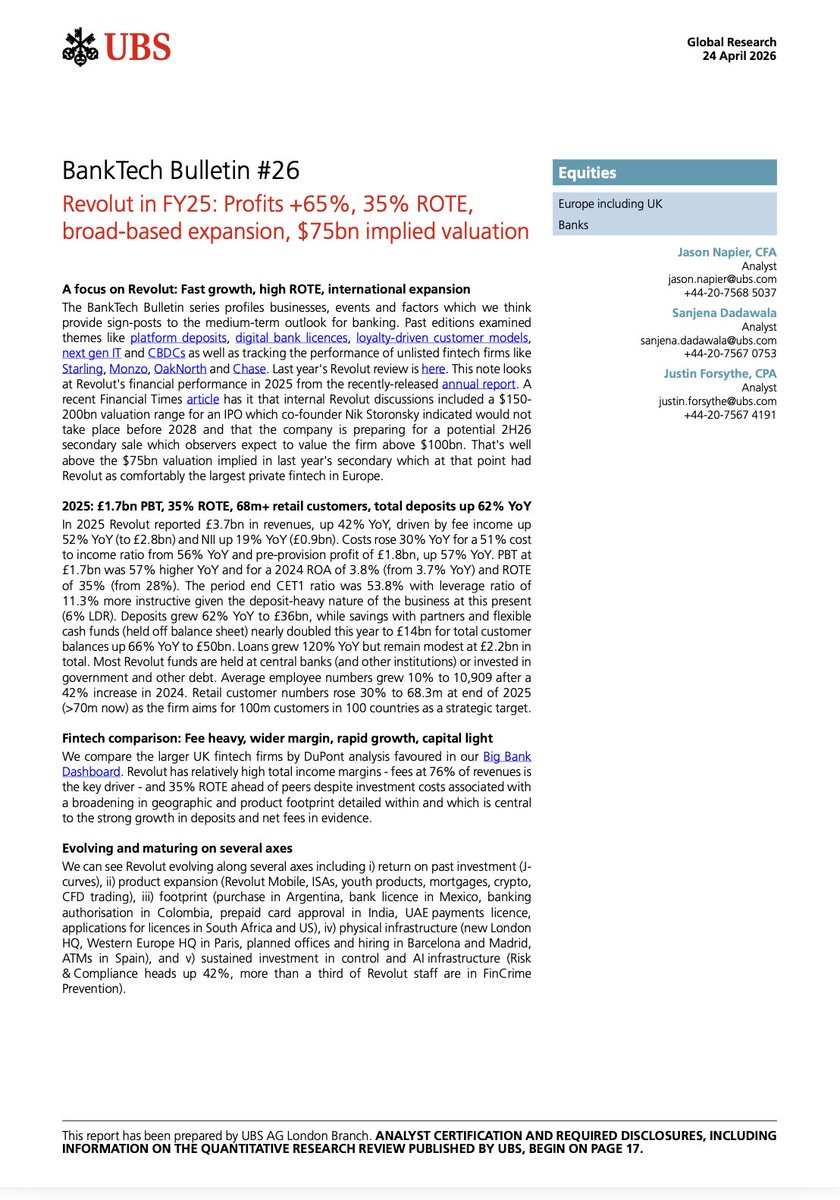
JPMorgan and UBS dropped research notes on Revolut back-to-back.
@lorenz_swen posted the covers:
• JPM (23 Apr): “The ‘Super-app’ Revolut(ionizing) Traditional Banking” — initiation of coverage
• UBS (24 Apr): “Revolut in FY25: Profits +65%, 35% ROTE, broad-based expansion, $75B implied valuation”
First major Wall Street sell-side notes on Europe’s biggest private fintech.
Full reports still private, but the signal is clear: Revolut is scaling hard as a global super-app, printing record profits, and creating IPO attention.
$150–200B valuation at IPO?
#Revolut #JPMorgan #UBS