Oh yeah, it's finally here! Welcome #HyperEVM to Symbiosis 🥳
Thanks to @unitxyz for powering the security of uETH and to @HyperSwapX for enabling on-chain swap routes 🤝
https://t.co/AQf5YW4CxL
$HYPE, $stHYPE, $unitBTC, $unitETH, and $USDT0 are now available cross-chain in the app. What tokens should we add next? 😎
Thank you to everyone who took the time to thoughtfully respond to my post on transparent markets. I understand that the thesis is controversial and that Hyperliquid is at a new frontier as the first fully transparent order book venue of its scale.
I could well be mistaken, and welcome the continuous dialogue on market structure innovation. However, many criticisms I saw stemmed from misunderstandings, with some points actually supporting transparent systems like Hyperliquid. Market structure is notoriously counterintuitive, and novel approaches often challenge established paradigms, leading to understandable skepticism.
For example, Hyperliquid pioneered protocol-level cancel prioritization, which has since been implemented by new DEXs and even inspired novel transaction ordering ideas on other blockchains. But at the time, it was considered controversial because it went against traditional market design. I hope that transparent trading will follow a similar path to adoption.
I may have been too ambitious trying to cover a complex argument in a single post. Given the specific patterns in criticisms, I'd like to take this opportunity to zoom in on nuances that were missed in the high level summary. What follows is an argument for the final state of efficient markets, with the understanding that Hyperliquid is far from fully efficient today. However, inefficiency is opportunity for those hungry to act. Hopefully this post can also be a call to action for traders, market makers, and builders to translate transparent markets into the highest quality execution venue for all.
--
Before delving into specific concerns, let’s crystallize some counterintuitive principles that can form a helpful mental model for market structure:
1. Counterparty principle: Benefits of counterparty curation are misattributed to privacy.
Users ultimately care about execution. As studies have shown though, privacy sells. Alternative trading venues often market privacy as the causal feature for improving execution. In reality, the primary source of benefit for users is the screening of counterparties allowed to participate on the venue. Hyperliquid’s market design provides these same benefits more directly and effectively than patchwork solutions. Hyperliquid’s solution also democratizes access, improving execution for all traders large and small.
Note that transparency does not mean doxxing. Of course, the exact identity of some traders will fundamentally change the value of the asset. But those traders need not dox themselves, e.g. Warren Buffet can buy BTC and benefit from transparent markets, without tying his identity to his address.
2. Competition principle: Maximizing competition is key to improving execution.
Many traders who want to execute in size have some form of alpha. However, the group of informed medium/long term traders in aggregate is difficult to distinguish even over yearly timeframes, as their realized sharpe is too low for statistical significance. It is challenging to distinguish between a trader with solid medium term alpha and a degenerate gambler who got lucky. Therefore, while the desire to minimize market impact and alpha leakage is natural, it’s usually outweighed by the improved liquidity from transparent markets.
Traders therefore see improved execution despite revealing their strategy, as market makers are bound to provide liquidity to the entire range of flows in the market. Competition is the bedrock of capital markets and economics. As an example, the Hyperliquid order books support an onchain TWAP. Such a broadcasted intent to trade is in fact a reasonable proxy for optimal execution. Market makers will immediately fill some size so that the earlier TWAP orders receive worse execution, but will also compete to fill the remaining flow. The competition between market makers ensures near optimal overall execution over the course of the TWAP. Any inefficiency in execution is an opportunity for another market maker to undercut the others.
3. Repeated games principle: Execution improves when one-time games become repeated games.
Market makers evaluate each decision from a game-theoretical framework, as they are in the business of making positive expectancy bets. On Hyperliquid, every account placing more than one order is playing a repeated game. Repeated games have dramatically different optimal strategies from the one-time games of private venues, and the resulting equilibrium is better execution for everyone other than toxic extractors. Competition is essential for the optimal market marker strategy to benefit the end user, which is amplified by the next principle.
4. Full transparency principle: Benefits from transparency are non-linear and only manifest when transparency is at the system level.
When optimizing for execution, “the system knows” > “no one knows” > “some people know.” The worst of the three states is where some insiders have privileged information. Those insiders can act exploitatively to extract profit from end users. Because L3 books are not transparent in tradfi, the “darker” venues often implement systems to unilaterally apply counterparty-specific filtering to trades. Hyperliquid achieves the same effect on a lit venue and therefore maintains the benefits of efficient order book execution.
--
Common criticisms to the initial post, and my responses [I’ve bracketed references to the different principles]:
1. Many large desks in tradfi trade OTC, which is evidence that public venues cannot support large size.
Response: This point actually supports Hyperliquid. In tradfi's L3 books, there is no reliable way to broadcast your identity trustlessly to all counterparties. Using an OTC desk is a compromise, telling a small set of professional counterparties that you are non-toxic. Like trading on an L4 order book, trading OTC is a repeated game where the OTC desk is quick to ban any counterparties that adversely select a small fraction of quotes, or engage in otherwise toxic behavior [repeated games principle]. The OTC desks offer quotes where their own algorithmic execution/hedging costs are below the markup, which is only possible when their fills’ immediate markouts are positive.
A Hyperliquid whale who places an onchain TWAP order is effectively routing their flow to every "OTC desk" plugged into Hyperliquid. When OTC counterparties expand from a select few to all market makers, the competition improves execution for the user compared to the bespoke OTC quote [competition principle]. In summary, execution on Hyperliquid incorporates the efficiency of lit venues with the counterparty signaling of OTC. This high quality execution is available to all users equally.
2. A large percentage of tradfi volume happens on dark pools, retail internalizer systems, etc.
Response: This argument also supports Hyperliquid. The basic idea behind dark pools is that two large whales with a "coincidence of wants" can match immediately and bypass the spread that lit markets charge. Until such a match exists, orders are attempted to be kept private to reduce market impact. While a neat idea at first glance, the privacy of dark pools is unlikely to meaningfully protect intentions or improve execution. For example, sophisticated actors participate in dark pools themselves. At a minimum, their fills are a strong signal on the supposedly private flow. This shares many parallels with the insider information discussed in the following section. Information that will be deduced anyway is better made public [full transparency principle].
As another argument against the effectiveness of privacy properties, dark pools rely heavily on participants having identities known to the pool operator [repeated games principle]. This is necessary because the private information is easily leaked. There are strict requirements for participation, e.g. high fill rate, minimum order size, and negative short term markouts. Offenders with toxic behavior are banned or deprioritized [counterparty principle]. Like OTC desks discussed above, transparent L4 books on Hyperliquid incorporate and improve upon many of these positive properties of dark pools within an open, systematic framework.
3. Public data allows hunting of liquidations/stops.
Response: Most would agree that unlike size information, preserving margin privacy is beneficial for the end user. Perhaps a ZK privacy implementation can accomplish this in the future. However, until then, users are less likely to be successfully hunted if everyone knows liquidation and stop prices than when only the exchange operator knows [full transparency principle]. Two reasons:
a. On CEXs, your position information is far from private. Based on empirical data of insider trading leading up to listings, one should assume that liquidations and stops are also vulnerable to misuse. This can be despite best efforts from management: it is extremely difficult to completely control large organizations from leaking information. When insiders hunt stops and liquidations, there is no public data for other market makers to understand the source of the temporary dislocation. This decreases the required capital to successfully push the price.
b. In the game theoretical equilibrium of transparent data, stop and liquidation hunting are likely unprofitable endeavors on average. Whales are protected by the entire system of market participants acting rationally. People trying to hunt liquidations and stops will be counteracted by people trying to trick them into the hunting. For example, someone who wants to open a large long position can execute half of their position on high leverage, bait the hunters to short, then increase collateral and enter the remaining desired position at a more favorable price. As long as some profit seeking “anti-hunters” exist, all whales benefit from the cover.
While point (b) will take time to play out, markets are ultimately efficient. Even before this equilibrium is reached, the full transparency principle in point (a) suggests Hyperliquid's model offers more robust protection for whales. Liquidity is generally deeper when lit venues are more transparent [competition principle], which further increases the cost of liquidation and stop hunting.
4. Some users have alpha and will not benefit from transparency.
Response: The users that are disadvantaged by Hyperliquid’s system are a very small set of “toxic” participants. These are the same adversarial traders that dark pools, OTC desks, and other solutions try to avoid. A small number of professional HFT firms have alpha on this timescale, and it’s a failing of traditional market structure that these toxic takers have the ability to tax all other users of the system.
As an aside, short term alpha and toxicity is a continuous spectrum, so I’m oversimplifying for sake of argument. For example, there are intraday quantitative strategies that can realize significant sharpe ratios, whose flow could be a reliable momentum signal for market makers. The technical reason this is not a problem is that cost to rotate accounts is proportional to fee sensitivity of the strategy, which is inversely proportional to the time it takes for others to detect the strategy with statistical significance. In other words, the more execution matters to a quant strategy, the less the burden of obfuscation.
Regardless, the vast majority of users on Hyperliquid do not fall remotely close to this category of quantitative, toxic alpha. Note that “toxic” does not mean “informed,” but rather traders who profit non-constructively from slight infrastructural or other structural advantages such as latency. Hyperliquid's cancel prioritization and L4 order book essentially boost the short term liquidity available to non-toxic small and large orders, respectively. As a conservative lower bound, as long as market maker counterparties on Hyperliquid can hedge in time on other venues, the trader benefits from Hyperliquid’s system.
--
I know I’ve missed other points, but will stop here to keep this post digestible. Thanks again to everyone for their thoughtful feedback, especially those who took time to review an earlier version of this post. I look forward to continuing this discussion!
Before Bitcoin.
Before the US Dollar.
Before fiat currencies.
There was gold: the world's most enduring store of value.
Your Gold, Anywhere.
https://t.co/vVfwOHzN2t
> Hyperliquid eating Binance's market share (10%)
> CZ writes tweets saying "forget the hype, think longterm"
> James Wynn main character arc loads, $1B positions opened
> CZ writes article about dark pool DEXs
> CZ and James Wynn start DM convo
> $HYPE listed on Binance US Spot
For some reason I can't help but think some 4d chess is afoot
Why transparent trading improves execution for whales
Throughout Hyperliquid’s growth, skeptics questioned the platform's ability to scale liquidity. These concerns have been resolved now that Hyperliquid is one of the most liquid venues globally. With Hyperliquid’s adoption by some of the largest traders in crypto, discussion has shifted to concerns around transparent trading. Many believe that whales on Hyperliquid are:
1) frontrun as they enter their position
2) hunted because their liquidation and stop prices are public
These concerns are natural, but the opposite is actually true: for most whales, transparent trading improves execution compared to private venues.
The high level argument is that markets are efficient machines that convert information into fair prices and liquidity. By trading publicly on Hyperliquid, whales give market makers more opportunity to provide liquidity to their flow, resulting in better execution. Billion dollar positions can have better execution on Hyperliquid than on centralized exchanges.
This post covers a complex line of reasoning, so it may be more compelling to start with a real-world example from tradfi to demonstrate this universal principle. After all, actions speak louder than words.
Example
Consider the largest tradfi ETFs in the world that need to rebalance daily. Examples include leveraged ETFs that increase positions when prices move favorably and decrease positions in the other direction. These funds manage hundreds of billions of dollars in AUM. Many of these funds choose to execute on the closing auction of the exchanges. In many ways this is a more extreme version of whales trading publicly on Hyperliquid:
1. These funds’ positions are known almost exactly by the public. This is true on Hyperliquid as well.
2. These funds follow a precise strategy that is public. This is not true on Hyperliquid. Whales can trade however they want.
3. These funds trade predictably every day, often in massive size. This is not true on Hyperliquid. Whales can trade whenever they want.
4. The closing auction gives ample opportunity for other participants to react to the ETFs’ flows. This is not true on Hyperliquid, where trading is continuous and immediate.
Despite these points, these ETF managers opt into a Hyperliquid-like transparency. These funds have full flexibility to make their flows private, but proactively choose to broadcast their intentions and trades. Why?
History of transparency in electronic markets
A complementary example is the history of electronic markets. As summarized above, markets are efficient machines that convert information into fair prices and liquidity. In particular, electronic trading was a step-function innovation for financial markets in the early 2000s. Prior trading occurred largely in trading pits, where execution quality was often inconsistent and spreads wider. With the advent of programmatic matching engines transparently enforcing price-time priority, spreads compressed and liquidity improved for end users. Public order books allowed market forces to incorporate supply and demand information into fairer prices and deeper liquidity.
The spectrum of information
Order books are classified by their information granularity. Note that L0 and L4 are not standard terminology, but are included here as natural extensions of the spectrum.
L0: No book information (e.g. dark pools)
L1: Best bid and offer
L2: Levels of the book with price, total size of level, and optionally number of orders in the level
L3: Individual anonymized orders with time, price and size. Some fields including sender are private
L4 (Hyperliquid): Individual orders with complete parity between private and public information
Each new level of order book granularity offers dramatically improved information for participants to incorporate into their models. Tradfi venues stop at L3, but Hyperliquid advances to L4. Part of this is necessity, as blockchains are transparent and verifiable by nature. However, I argue that this is a feature, not a bug.
Zooming out, the tradeoff between privacy and market efficiency spans the full spectrum from L0 to L4 books. On this scale, L3 books can be viewed as an arbitrary compromise, not necessarily optimal. The main argument against L4 books is that some strategy operators prefer privacy. Perhaps there is some alpha in the strategy that is revealed by the order placement. However, it’s easy to underestimate the sheer talent and effort going into the industry of quantitative finance, which backs out much of these flows despite anonymized data. It’s difficult to enter a substantial position over time without leaking that information to sophisticated participants.
As an aside, I believe financial privacy should be an individual right. I look forward to blockchains implementing privacy primitives in a thoughtful way in the coming years. However, it's important not to conflate privacy and execution. Rather than hand-in-hand concepts, they are independently important concepts that can be at odds.
How market makers react to information
One might argue that some privacy is still strictly beneficial. But privacy is far from free due to its tradeoff with execution: toxic flow can commingle with non-toxic taker flow, worsening execution for all participants. Toxic flow can be defined as trades where one side immediately regrets making the trade, where the timescale of "immediate" defines the timescale of the toxicity. One common example is sophisticated takers who have the fastest line of communication between two venues running toxic arbitrage taker strategies. Market makers lose money providing liquidity to these actors.
The main job of a market maker is to provide liquidity to non-toxic flow while avoiding toxic flow as much as possible. On transparent venues, market makers can categorize participants by toxicity and selectively size up to provide as a non-toxic participant executes. As a result, a whale can quickly scale into a large position faster than on anonymized venues.
Summary
Finally returning to the example of ETF rebalancing, I imagine the conclusion of rigorous experimentation confirmed the points above. Addressing the specific subpoints in the introduction:
1) A transparent venue does not lead to more frontrunning than private venues. Rather, traders with consistently negative short term markouts benefit by broadcasting their autocorrelated flow directly to the market. Transparent venues offer a provable way for every user to benefit from this feature.
2) Liquidations and stops are not “hunted” on transparent venues more than on private venues. Attempts to push the price on a transparent venue are met with counterparties more confident to take the mean reversion trade.
If a trader wants to trade massive size, one of the best things to do is tell the world beforehand. Though counterintuitive, the more information that is out there, the better the execution. On Hyperliquid, these transparent labels exist at the protocol level for every order. This enables a unique opportunity to scale liquidity and execution for traders of all sizes.
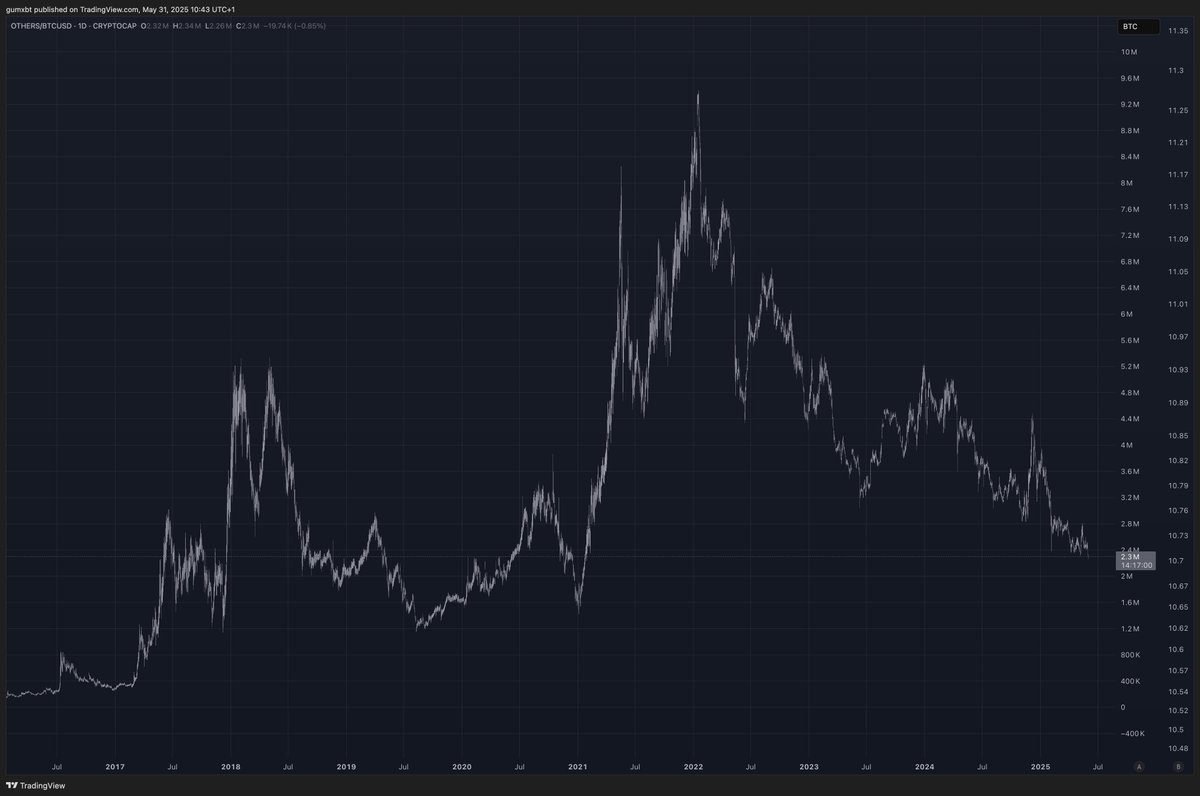
People calling for a true altseason have lost the plot
We will never get a full-blown altseason again because BTC maturing directly translates to a maturing altcoin market
This means markets are starting to shift into real value generation, and most crypto protocols are technically worth $0
It's unironically easier than ever to find the good businesses because almost no one in crypto seems to care to find them
Even if they do, they would rather gamble on pumpdotfun
i have so far succeeded in getting 0 large accounts to come up on stream
they don’t seem to like the format of “it’s not just me interviewing u, there’s gonna be 8 unhinged trenchers with us and it’s impossible to predict what they’ll say or do”
everyone wants a curated stream
When you’re not a pro trader, don’t play against the casino.
Especially when you can own its chips.
Accumulate $HYPE.
Don’t gamble - hold the chips.
Over time, that’s the better strategy.
@JamesWynnReal - maybe that’s your way back.
They built the rails for mobile.
Now they secure the rails for crypto.
@mms_Blockchain is now live as a DVN, available to any app built with LayerZero looking to move messages between chains with institutional-grade security.
To all the fans and haters:
We had a good run gambling on perps
At peak the account was up $87,000,000 profits from like $3-$4m.
Now decided to leave the casino with my $25,000,000 profit
It’s been fun, but now it’s time for me to walk away a wynner
Wynn 1-0 Haters
🎰🌴
Attention cults! 👀
All @boopdotfun tokens are now supported by @InsightXnetwork Bubblemaps (˶˃ ᵕ ˂˶) .ᐟ
Head to https://t.co/X1RHFAVgEf and verify https://t.co/m6j5cpTSRb tokens with ease ♡