Very excited to share this! Looking for candidates for a #PhD position on the intersection of #GenerativeAI and Material Science. Supervised by Prof. Sofia Calero and co-supervised by me. https://t.co/b49cN7PjiU
An excellent opportunity to work on the intersection of ML and Physics. A vacancy on Machine Learning-based Simulation for Materials Discovery. Supervised by prof. Sofia Calero and co-supervised by me: https://t.co/VKq7TuSpUk
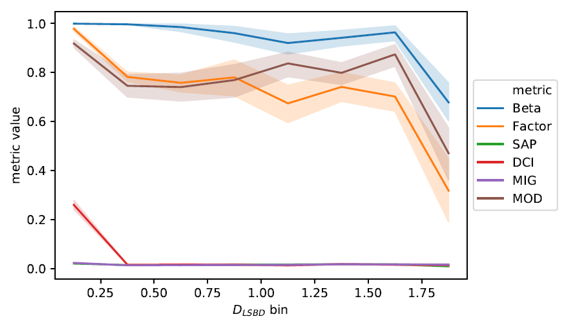
3) LSBD representations also satisfy previous disentanglement notions:
Good scores for D_LSBD (lower is better) typically imply good scores on traditional disentanglement metrics (higher is better), even if the reverse is not true.
9/
2) LSBD-VAE and other LSBD methods *can* learn LSBD representations with limited supervision on transformations:
Methods that specifically target LSBD indeed score better on D_LSBD.
8/
1) Traditional disentanglement methods don't learn LSBD representations:
Methods without a notion of the underlying symmetry group structure don't score well on D_LSBD, even if they do score well on traditional disentanglement metrics.
7/
We perform experiments on a number of datasets with underlying symmetries, using our own LSBD-VAE and other LSBD-oriented methods, as well as various traditional disentanglement methods. From this we draw 3 main conclusions:
6/
We show an intuitive justification of our D_LSBD metric, as well as its theoretical derivation. We also provide a practical implementation to compute D_LSBD for SO(2) symmetry groups of 2D rotations.
5/
In our paper we present the following contributions:
i) D_LSBD, a well-formalized general metric to quantify LSBD in learned representations.
ii) LSBD-VAE, a weakly-supervised method to learn LSBD representations under certain assumptions.
4/
However, there is currently no metric to quantify LSBD. Such a metric is crucial to evaluate methods aimed at learning LSBD, and to compare to previous notions of disentanglement.
3/
Disentanglement is an important goal in representation learning, but there is no consensus on a formal definition. Higgins et al. (2018) propose such a definition based on the idea that real-world symmetries provide a structure to disentangle, which we refer to as LSBD.
2/
Our paper "Quantifying and Learning Linear Symmetry-Based Disentanglement" got accepted at #ICML2022@icmlconf!🥳🎉
Congrats to co-authors @tezcatlipocta (joint first), @vlamen, Mike Holenderski & Jim Portegies.
Paper: https://t.co/8EzL6zPkVi
Code: https://t.co/tkzVMWyglz
1/🧵
Best Paper Award at #icpm21 goes to ....
Dominique Sommers, Vlado Menkovski and Dirk Fahland @dfahland with the paper Process Discovery using Graph Neural Networks
We have a vacancy for PhD in Artificial Intelligence for Computational Pathology.
Goal: develop new methods for end-to-end training of DL models from whole slide images with application in oncology.
#digitalpathology#deeplearning#machinelearning#AI
https://t.co/w1wM7ll8oA
Can Machine Learning be a driver for scientific discovery? Join our multidisciplinary team of scientists and help us push Machine Learning forward to drive progress in natural sciences! https://t.co/mpV7Is9bzN via @TU/e
Pedestrian orientation dynamics from high-fidelity measurements.
Open Access on Scientific Reports
https://t.co/6B8PsY6jL4
with J willems, @vlamen@ftoschi
New preprint available 😀 "Deep learning velocity signals allows to quantify turbulence intensity"
https://t.co/LOXVlMASYa
with @vlamen, Roberto Benzi and @ftoschi