"design tools continue to fall behind CSS" was a recurring theme at @CSSDayConf
- typography features (so many!)
- scroll animation
- meaningful math tricks
- layout capabilities
- container queries / responsive capabilities
- anchor positioning
- :has() and presence awareness
- quantity queries
- scroll snap
and so much more…
it seems like design tools are competing against each other to be the best Photoshop variant. meanwhile, the web's features are pushing fast into a mega capable future and designers are blissfully unaware. (i'm aware this isn't all teams, but it's def the majority)
web designers, sit with your web developers
web developers, sit with your web designers
also, someone (i wish i could work on this) make a tool that unlocks these features for designers. help them wield these capabilities, they're super fun and very meaningful.
the delta is growing too fast between CSS and design tools, someone or something close this gap!!
When everyone is debating how X framework is better than Y language, remember what Why the Lucky Stiff taught us:
> when you don't create things, you become defined by your tastes rather than ability. your tastes only narrow & exclude people. so create.
Data | #Rainwater harvesting could make a dent on the freshwater needs of Bangalore, but it pales in comparison to wastewater, @ShashankPalur and @RKulranjan write.
https://t.co/tV0AlBiNgM
Our interview with @guy_laron looks into Israel's attempt to become an 'energy hub' transit state between the Middle East & Europe, and into Netanyahu's extremist settler friendly policy to prevent Palestinian unity by supporting Hamas with $$ from Qatar.
https://t.co/5eI2OK80Os
There's a lot to say about the Humane AI pin, but top for me:
Why does this industry constantly expend so much capital to solve non-issues (no more scrolling, now you just pinch your fingers!) at the cost of greater data surveillance and enormous environmental cost?
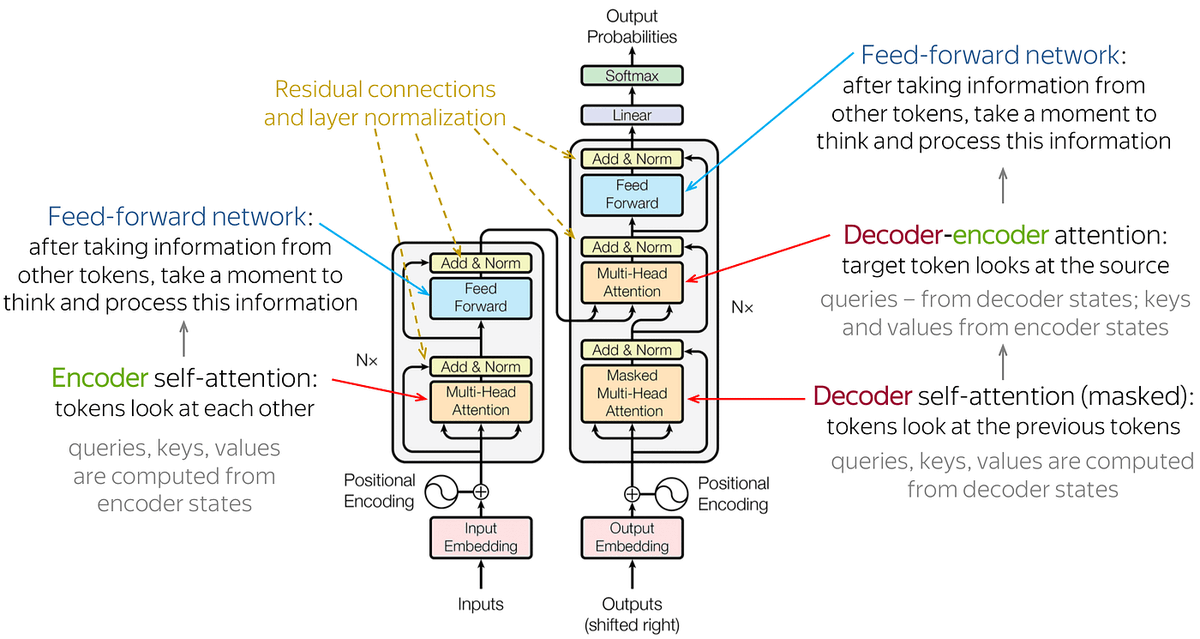
How transformers evolved to become the dominant neural architecture
All large language models and most state-of-the-art language, forecasting, and personalization AI models are based on Transformers.
Before transformers, recurrent neural nets (RNNs) were used to process sequential data, like text. They had their issues, such as slow training times and the vanishing gradient problem, which made them hard to optimize for longer sequences.
The vanishing gradient problem in RNNs occurs when gradients (the values used to update the network's weights) become extremely small as they are propagated back through time during training. This leads to earlier layers in the network receiving minimal updates, making it difficult for the model to learn and capture long-term dependencies in the data.
The other popular architecture was convolutional neural networks (CNNs) which are excellent for image processing but aren't suitable for sequential tasks like natural language processing.
In 2017, Vaswani and his team introduced transformer architecture, which was a game-changer. It solved many of the problems associated with RNNs by introducing the following key components:
- Attention Mechanism: This allowed the model to focus on different parts of the input, making it more context-aware.
- Parallel Processing: Unlike RNNs, which process sequences step-by-step, transformers could process all parts of a sequence simultaneously, making training much faster.
Fundamentally, Transformers are optimized for GPUs - the chips that are used to train large neural networks. Unlike RNNs, where computations are dependent on the previous step, transformers can process all positions in the sequence simultaneously. This means that the computations for each position (or word) can be carried out at the same time, making full use of the parallel processing capabilities of GPUs. This leads to much faster training and inference times, making transformers more efficient and scalable when using GPU hardware.
- Scalability: Transformers were designed to be scalable, making them suitable for large models and extensive datasets.
- Continued Innovation: The success of models Like BERT and GPT: Following the introduction of the transformer architecture, models like BERT, GPT, and their variations demonstrated remarkable success in various NLP tasks, cementing the prominence of transformers. This led to a virtuous feedback cycle of investment and innovation.
A lot of research community has been focused on Transformers and this has led to continual improvements and adaptations, making them even more effective and efficient.
Versatility: The transformer architecture proved to be incredibly versatile, applicable to a wide range of tasks, not just in NLP but in other fields as well. In fact, we at https://t.co/dJ2B4Jig2U, use Transformers for SOTA forecasting and personalization (both sequential data problems) as well.
In summary, the rise of transformers as a dominant neural network architecture can be attributed to their efficiency, scalability, and versatility, along with the well-timed solving of problems that plagued earlier models like RNNs. They provided an elegant solution to challenges faced in processing sequential data, leading to wide adoption across various domains.
Paper introducing transformers: https://t.co/N7AK1dcaUN
Pic credit and good reading - https://t.co/gXecXMUnlw
I don't talk much about this - I obtained one of the first FDA approvals in ML + radiology and it informs much of how I think about AI systems and their impact on the world. If you're a pure technologist, you should read the following:
There's so much to unpack for both why Geoff was wrong, and why his future predictions should not be taken seriously either.
Geoff made a classic error that technologists often make, which is to observe a particular behavior (identifying some subset of radiology scans correctly) against some task (identifying hemorrhage on CT head scans correctly), and then to extrapolate based on that task alone.
The reality is that reducing any job, especially a wildly complex job that requires a decade of training, to a handful of tasks is quite absurd.
Here's a bunch of stuff you wouldn't know about radiologists unless you built an AI company WITH them instead of opining about their job disappearing from an ivory tower.
(1) Radiologists are NOT performing 2d pattern recognition - they have a 3d world model of the brain and its physical dynamics in their head. The motion and behavior of their brain to various traumas informs their prediction of hemorrhage determination.
(2) Radiologists have a whole host of grounded models to make determinations, and actually, one of the most important first order determination they make is whether there is anything notably wrong with a brain structure that "feels" off. As a result, classifiers aren’t actually performing the same task even as radiologists.
(3) Radiologists, because they have a grounded brain model, only need to see a single example of a rare and obscure condition to both remember it and identify it in the future. This long tail of rare conditions to avoid missing is a large part of their training, and no one has any clue how to make a model that acts similar in this way.
(4) There’s so many ways to make Radiologist lives easier instead of just replacing them, it doesn’t even make sense to try. I interviewed and hired 25 radiologists, whose primary and chief complaint was that they had to reboot their computers several times a day.
(5) A large part of the radiologist job is communicating their findings with physicians, so if you are thinking about automating them away you also need to understand the complex interactions between them and different clinics, which often are unique.
(6) Every hospital is a snowflake, data is held under lock and key, so your algorithm might not work in a bunch of hospitals. Worse, the imagenet datasets have such wildly different feature sets they don’t do much for pretraining for you.
(7) Have you ever tried to make anything in healthcare? The entire system is optimized to avoid introducing any harm to patients - explaining the ramifications of that would take an entire book, but suffice to say even if you had an algorithm that could automate away radiologists I don’t even know if you could create a viable adoption strategy in the US regulatory environment.
(8) The reality is that for every application, the amount of specific and UNKNOWABLE domain knowledge is immense.
LONG STORY SHORT: thinkers have a pattern where they are so divorced from implementation details that applications seem trivial, when in reality, the small details are exactly where value accrues.
Should you be worried about GPT5 being used to automate vulnerability detection on websites before they’re patched? Maybe.
Should you be worried GPT5 is going to interact with SOCIAL systems and destroy our society single-handedly? No absolutely not.
The best thing about switching your web search to ChatGPT is then the people who put all this info on the web don't get any credit and you have no idea how reliable the info is since all sources are jumbled into a giant opaque probability distribution.
Oh wait, that's terrible.
Did you know this? 👀
When using @github, include “[skip ci]” in your commit message if you don't want to trigger CI.
It can go _anywhere_ in the commit message.
It can even go in the extended part.
Useful, for example, when working in a draft PR.
Thanks @_darrenburns