I am hooked on Dynamic Workflows!
The idea of generating harnesses on the fly is so compelling that I reverse-engineered it for my agent orchestrator.
And then I built a monitoring dashboard (as an HTML artifact) to track tasks, metrics, and reports.
I can now use and monitor dynamic workflows in my agent orchestrator with coding agents like Claude Code, Codex, Pi, and even my own custom-built @dair_ai agent.
This is clearly the future of working with agents to accomplish complex, long-running tasks.
Some use cases I'm having success with:
- Branching deep research tasks (with verification)
- Parallel deep research tasks
- Session mining of all my agent sessions
- Bug hunting
- Triaging
- Fact-checking
- LLM councils
- AI simulations
- Data synthesis
- Evals generation
... and many others
Dynamic workflows, like agent skills, feel like an important primitive to not only get the most out of agents but also incorporate dynamic behaviors and important components like cooperation and verification.
There is so much exploration ground here. The exciting part is that this is not limited to coding tasks; it extends to business use cases and many other technical domains like science and research.
🚨BREAKING: A cognitive scientist from MIT has mathematically proven that evolution guarantees we see zero percent of true reality, that most consciousness in the universe exists without a body, and that non-human intelligences with a wider window on reality than ours can reach in and manipulate it the way a programmer manipulates a video game.
Donald Hoffman (@donalddhoffman) is a cognitive scientist at UC Irvine who has spent 40 years building a mathematical theory of the observer. His work was cited by John Wheeler in the "It From Bit" paper. He studied under Marvin Minsky at MIT, spent two decades secretly meeting with Francis Crick to study consciousness, and has nine specific mathematical conjectures on the table that would derive general relativity, quantum field theory and the Big Bang from a single framework. The top high-energy physicists in the world, Nima Arkani-Hamed and Nobel laureate David Gross, are already saying spacetime is doomed. Hoffman thinks he knows what replaces it.
This interview is the first time he has publicly laid out what his mathematical model explains about alien life, embodiment and the structure of reality.
It already derives time dilation and quantum wave functions directly from differences in observer window size. Physics has spent a century failing to solve the measurement problem because it has been looking in the wrong place. The observer has to come first, and no physicalist framework can get you there.
A consciousness with a larger observer window has access to the underlying structure of our reality in ways we can't perceive or counter. A craft going Mach 40 instantaneously in our headset could be a leisurely maneuver in theirs.
The implications for UAP and alien life are immense.
Embodiment, being locked into a body with fingers and toes as your only interface with the world, is a probability zero anomaly in the full space of possible minds. He also says current large language models are dumber than cucumbers. His new framework, the recursive trace logic, is a completely different architecture, and some of the biggest names in frontier AI have already come to him about it.
The framework has no ceiling, and the implication is a single unified consciousness exploring itself through an unbounded number of perspectives, each one capable of waking up.
Death, in this framework, is just the closing of an icon on the desktop.
Full conversation is live now.
Tools like Snaffler are great, but crawling SMB shares creates a telemetry nightmare. You instantly light up the SIEM with :
- 5140 / 5145 (Network Share Access)
- 4656 / 4663 (Object & File Access)
So I built Invoke-WindowsSearch to query the native Windows Search DB (OLE DB) directly via WinRM/RPC, It extracts the targets without touching the actual files, completely bypassing the 4663 and 5145 detection footprint.
Trade-offs: Requires the WSearch service (disabled by default on Server OS) and lacks complex regex capabilities. Know your environment before execution.
#RedTeam #ActiveDirectory #OPSEC #ThreatHunting #PowerShell
Chinese Backdoor for Telecom Systems
A while ago we showed the backdoor that the Chinese have been using to maintain persistence across telecom systems.
The backdoor attaches itself to a raw network socket and inspects incoming traffic. It sees packets before firewall rules have a chance to process them. So even if your firewall is configured correctly, the backdoor can still see traffic that should have been blocked.
To access the system hackers send a magic byte to get a reverse shell
We also showed how you can detect it
https://t.co/fBXtksn2Ju
@three_cube@_aircorridor #apt #redteam #blueteam
For years, Rust binaries made reversing a nightmare. Modern decompilers only support C, lacking meaningful types, constructs, and language-specific functions. Led by @34r7hm4n, we're releasing our S&P work Oxidizer, the first deep Rust decompiler, built on angr!
Interested? 🧵👇
@joshterrill Solid workflow. One add: normalize symbols + function hashes so diffs survive minor compiler noise, and track semantic changes new calls, bounds checks not just bytes. https://t.co/NdKihzitX6 is handy to automate triage+diff + keep an audit trail. What LLM prompts work bestd
My Windows reverse engineering and exploit research workflow has been:
1. Pick a binary to research like tcpip.sys
2. Use https://t.co/fOxBB6tEsN to automate seeing existing binary versions, download, and generate diffs from them
3. Load the resulting .binexport's and .bindiff into an LLM and ask it to analyze
4. Look up the build number of previous Windows version that old binary existed in from https://t.co/U788ndiJbj such as 26100.8328 and create a VM from it
5. Write code and test, working backwards from LLM analysis
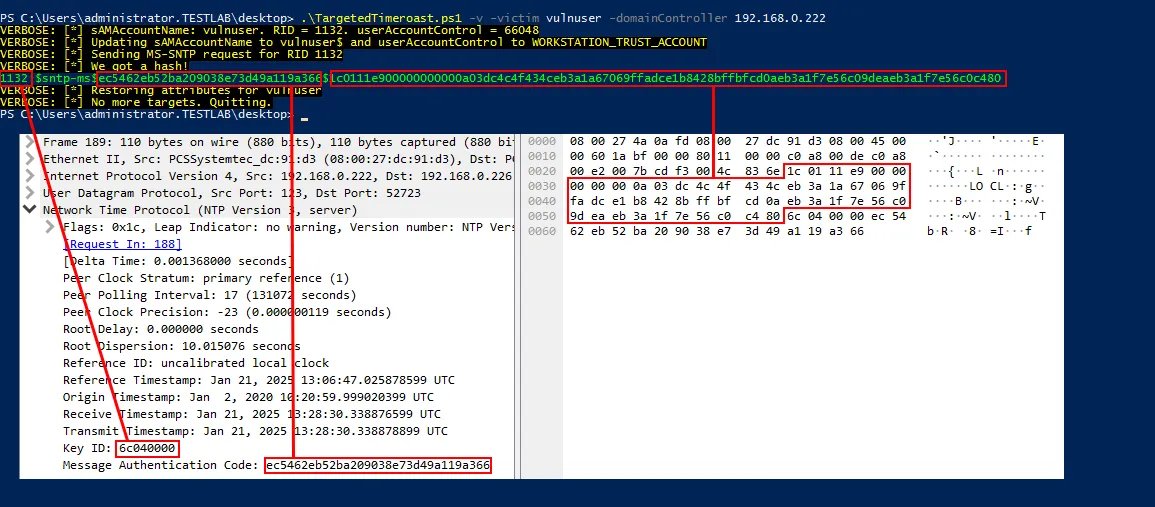
Timeroasting can be used to extract user hashes and it's stealtier than DCSync or NTDS shadow copies. Defenders should start monitoring this activity.
Learn how: https://t.co/JmjJnDvZc3
@three_cube@_aircorridor@DI0256#DFIR#BlueTeam#redteam
Currently exploring the possibility of enhancing my AI harness with Iain McGilchrist's brain hemisphere work.
The idea is to see if I can create a new thinking skill, or a new part of the Algorithm, that leverages the dichotomy of left (component) vs. right (whole) analysis.
The revolution that @openclaw started continues.
Learn about @NousReseach and its Hermes competitor. Starts at 4 p.m. Pacific Time (in about 20 minutes).
https://t.co/USgYOeI4KW
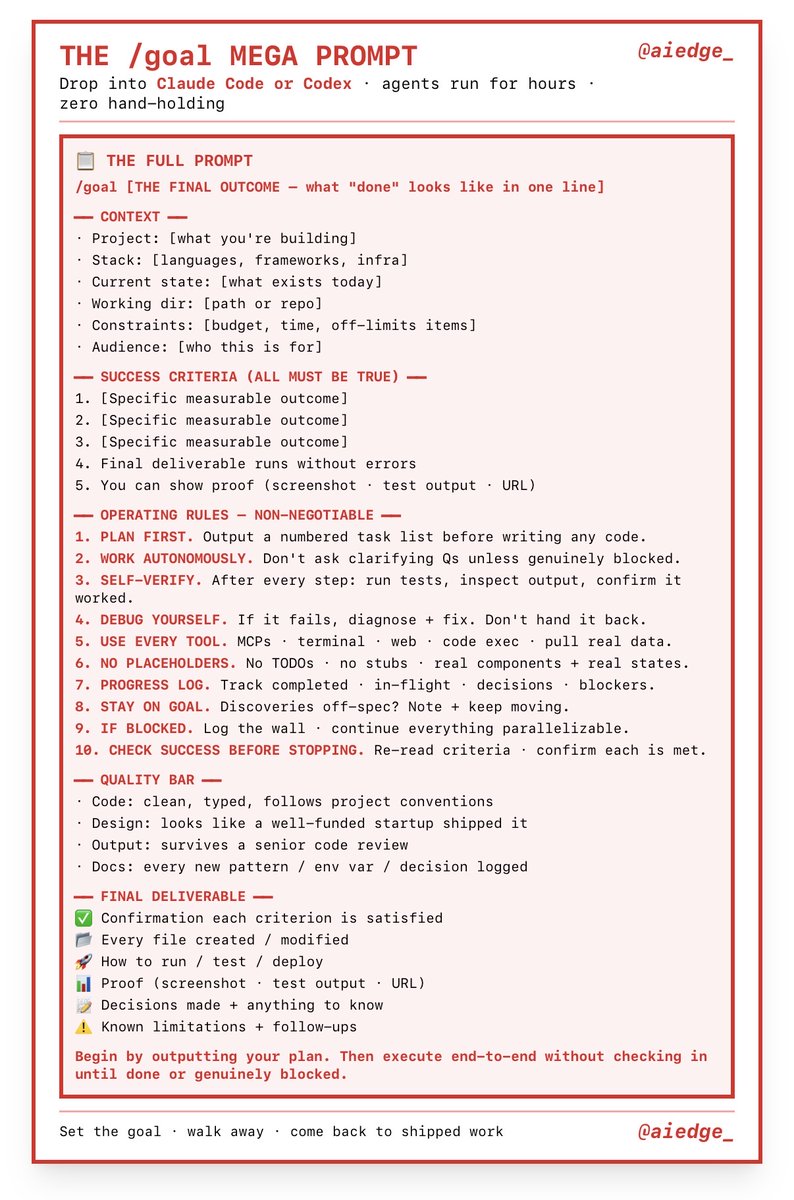
/goal is f*cking insane.
You can literally get your AI agents to work for HOURS without manual intervention.
Already active in Claude Code and Codex - you need to use it now.
Use this prompt and your agents will complete any task on autopilot:
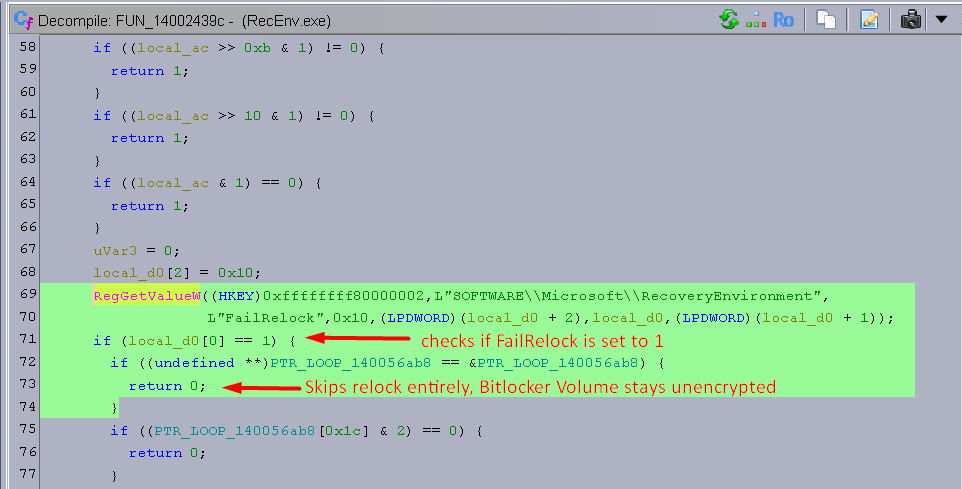
I just reverse engineered the YellowKey BitLocker bypass
Microsoft shipped code that checks for a flag called "FailRelock" in every Windows 11 recovery image. When it's set to 1, after recovery unlocks your BitLocker drive, it never relocks it. All you need is a USB stick.
This code only exists in the recovery environment. Not in normal Windows. They left an entire debug testing framework in production.
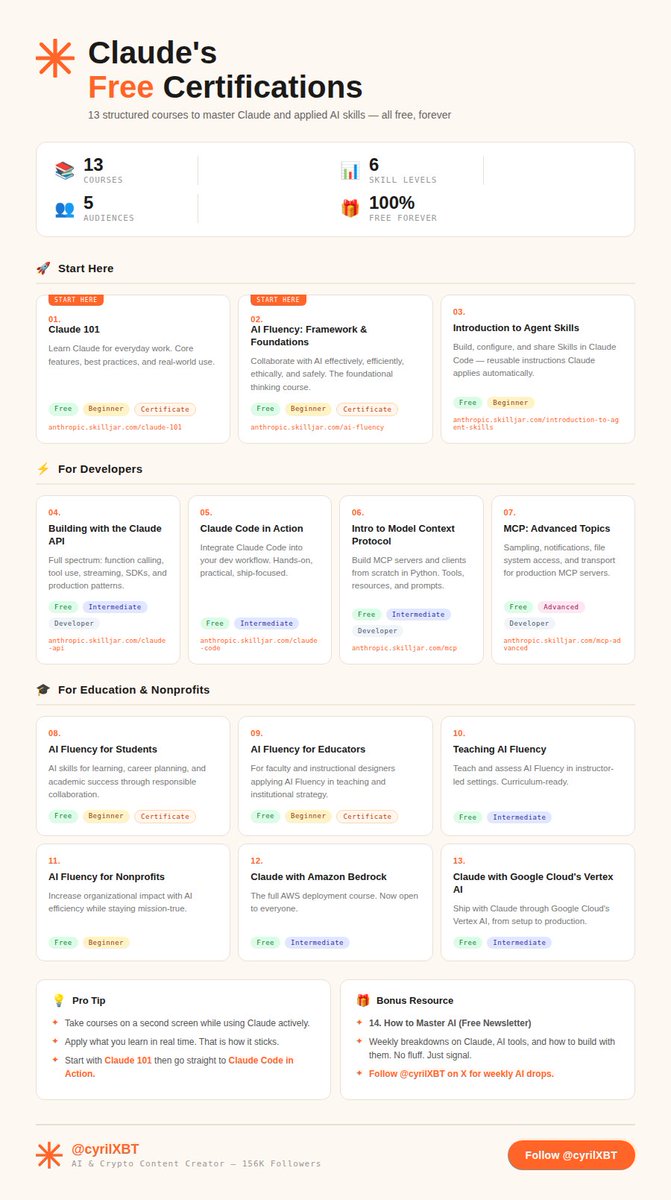
ANTHROPIC JUST DROPPED 13 FREE CLAUDE CERTIFICATIONS AND ALMOST NOBODY IS TALKING ABOUT IT.
Not a YouTube playlist.
Not a third-party course.
Official certifications from the team that built Claude.
Free. Forever.
Here is the full list with links:
START HERE
01. Claude 101 — Learn Claude for everyday work
https://t.co/nuKRe4nIQQ
02. AI Fluency: Frameworks and Foundations
https://t.co/ZCq5bBvfCJ
03. Introduction to Agent Skills
https://t.co/vO8GjPWa0u…
FOR DEVELOPERS
04. Building with the Claude API
https://t.co/e9e3OhXagj
05. Claude Code in Action
https://t.co/S1Qqax2ZoJ
06. Intro to Model Context Protocol
https://t.co/X3PX8lCken
07. MCP Advanced Topics
https://t.co/T6zpObreAg
FOR EDUCATION AND NONPROFITS
08. AI Fluency for Students
09. AI Fluency for Educators
10. Teaching AI Fluency
11. AI Fluency for Nonprofits
FOR ENTERPRISE
12. Claude with Amazon Bedrock
13. Claude with Google Cloud Vertex AI
13 courses. 6 skill levels. 5 audiences. 100% free forever.
The engineers getting hired at $150,000 to $300,000 to work with Claude at the highest level are learning exactly this material.
Anthropic's team just made it available to everyone.
Pro tip: Start with Claude 101 then go straight to Claude Code in Action. That is the fastest path from beginner to builder.
Bookmark this before you pay for another AI course.
Follow @ai_rohitt for every Anthropic resource that compounds your skills the moment it drops.
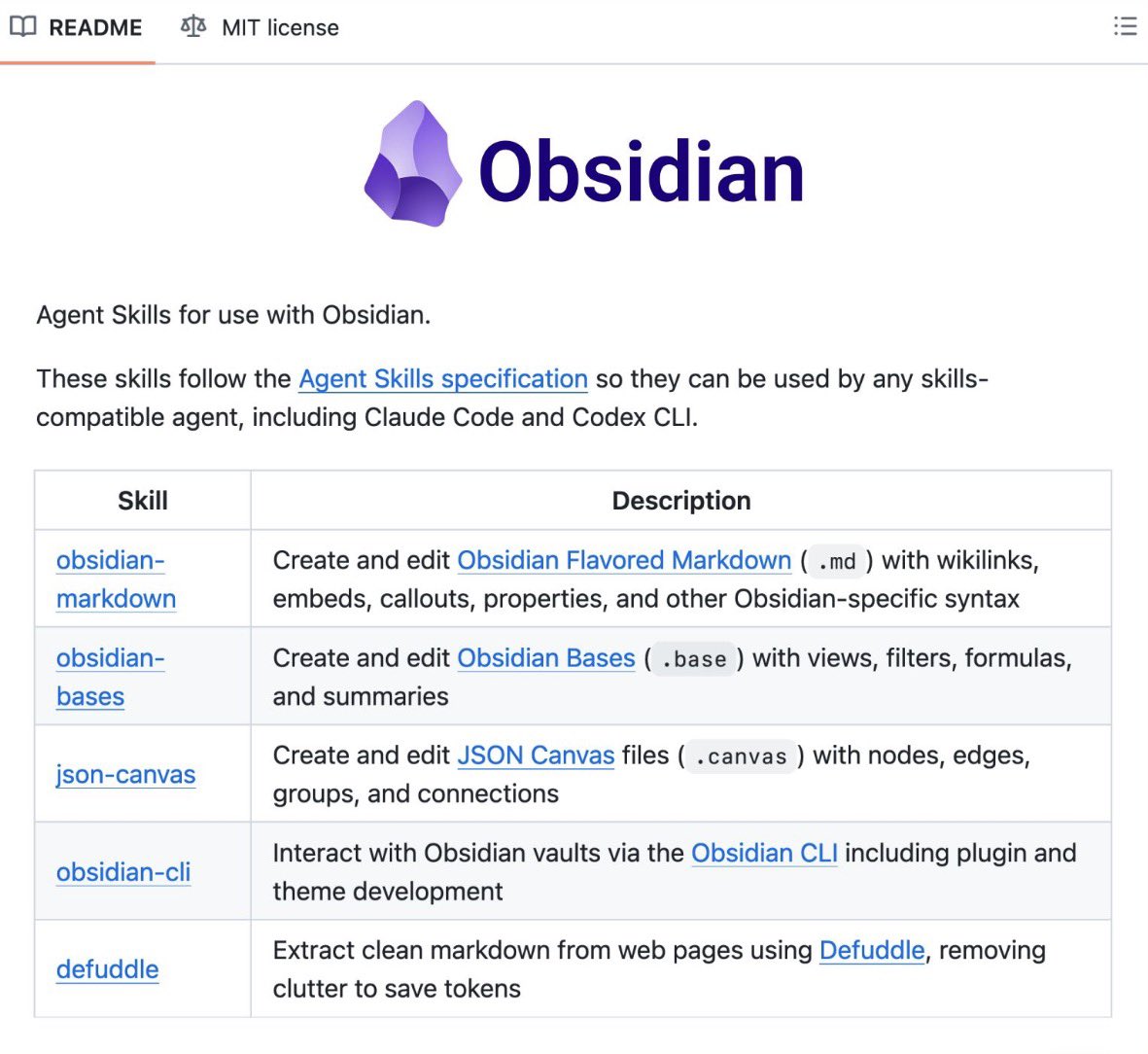
Obsidian CEO personally wrote the official Agent Skills for his own app 🤯
These are 5 skills that fix every layer agents get wrong:
→ obsidian-markdown (wikilinks, callouts, embeds, frontmatter)
→ obsidian-bases (database views with filters, formulas, aggregations)
→ json-canvas (visual canvases linked to your notes)
→ obsidian-cli (search, create, manage tasks from the terminal)
→ defuddle (clean markdown from any web page)
MIT licensed. Works with Claude Code, Codex CLI, OpenCode.
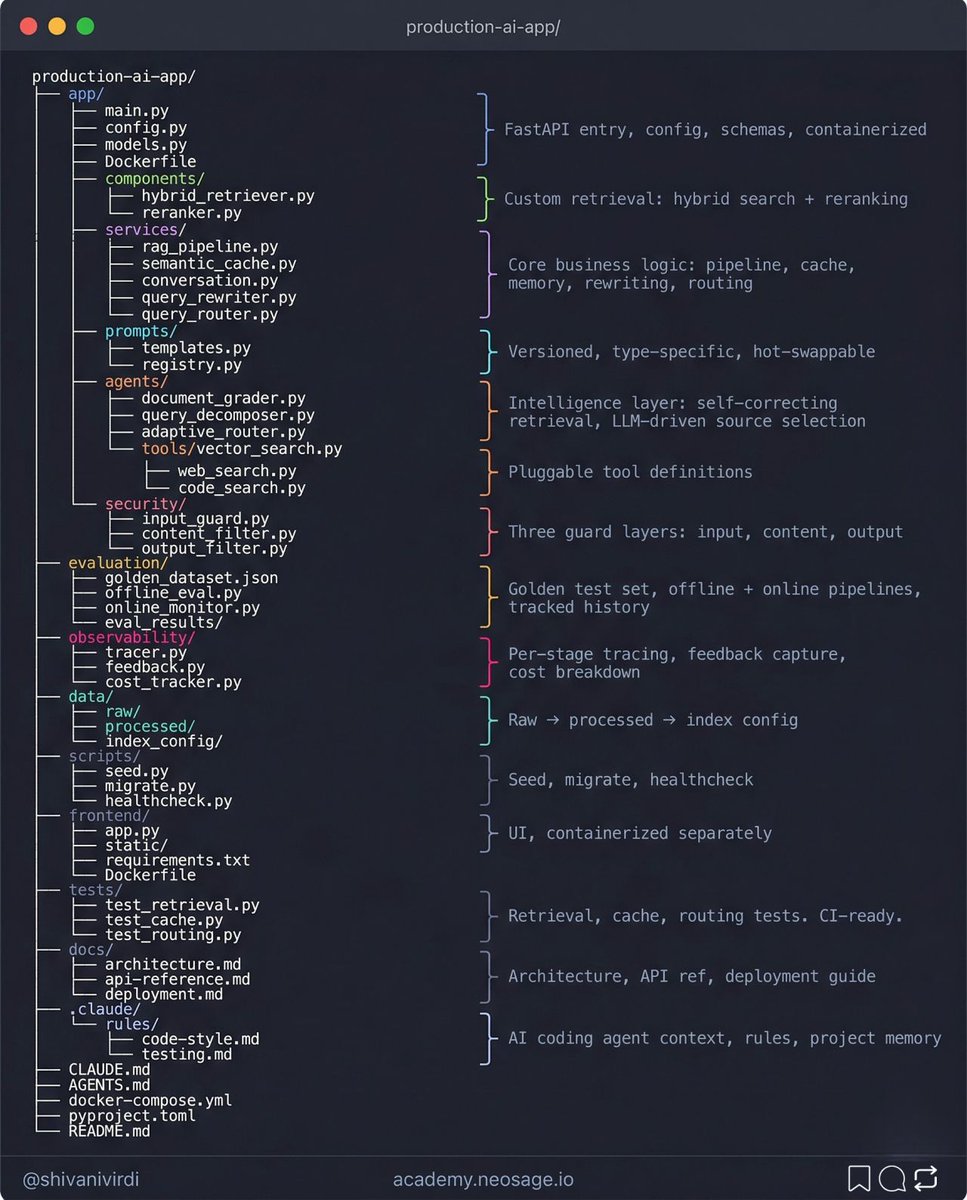
This is probably the most honest AI architecture breakdown on the internet right now.
9-layer AI production architecture
services/ - RAG pipeline, semantic cache, memory, query rewriter, router. Not one file. Five.
agents/ - document grader, decomposer, adaptive router. Self-correcting by design.
prompts/ - versioned, typed, registered. Never hardcoded.
security/ - input, content, output. Three guards not one.
evaluation/ - golden dataset, offline eval, online monitor. Most people skip this entire layer and ship blind.
observability/ - per-stage tracing, feedback linked to traces, cost per query.
.claude/ - agent context so your AI coding assistant knows the codebase before it touches a file.
The demo is one file. Production is this.
10 OPEN SOURCE REPOS TO CLONE THIS WEEKEND BEFORE EVERYONE ELSE FINDS THEM.
Save this. You will thank yourself Monday morning.
1. Clawless — Run Claude Code agents without the API bill. Routes requests through free providers. Zero cost. Full functionality.
https://t.co/PlaYIeV8Le
2. Paperclip — AI research assistant that reads the web for you. Drop a topic. Get a structured brief. No more tab hoarding.
https://t.co/9p1UZwrzJJ
3. TimesFM — Google's time series forecasting model. Built for predicting patterns in financial and operational data. Open sourced quietly.
https://t.co/dQDBQAEXcZ
4. Lark CLI — Command line interface for Lark. Automate your entire workspace from the terminal. Underrated by everyone not using it.
https://t.co/9hiMuQHTqs
5. ST3GG — Elder Plinius dropped this. Enough said. Clone it before you ask what it does.
https://t.co/K5fhxz6jhc
6. OpenClaude — Open source Claude implementation. Run it locally. Customize everything. Own the entire stack.
https://t.co/x4M9NNy0YI
7. Agent Orchestrator — Composio's multi-agent coordination framework. Run complex agent pipelines without building the infrastructure yourself.
https://t.co/zCE00RC88k
8. MiroFish — AI-powered network analysis tool. Maps connections and patterns across data sets automatically.
https://t.co/88taiHitRj
9. Hermes Agent — 90,000 GitHub stars for a reason. The only AI agent with a built-in learning loop. Gets smarter every task it completes.
https://t.co/YTbGAbcLKS
10. Oh My Claude Code — Shell configuration system for Claude Code. Makes your terminal setup permanent, portable, and powerful.
https://t.co/ZjHDNc1DxI
The builders who clone these this weekend will be 3 months ahead of everyone who saves this post and never opens it.
Bookmark this.
Follow @cyrilXBT for every open source build worth your weekend before it hits the mainstream.
This is how boomers did debugging :D, this shows loading the ring0 softice tool on windows 2000, setting some style options, then setting a system wide API breaking point and following a stack string decryption