Indonesian voice channel, packed on a random night, this is not hype, this is just what the community looks like now. Rethink X. Rethink Rialo. @RialoHQ
Auction-based execution has a shape everyone in MEV research recognizes. The top bidder captures most of the value, and it collapses fast after that, most participants walk away with close to nothing.
Rialo's reactive transactions never run that auction. A condition gets met, the transaction executes. No bidding war decides who goes first, because going first was never the thing being sold.
Value doesn't concentrate at the top when there's no top to bid for.
@RialoHQ@0x_kippo@0x_vibevortex
GIVEAWAY 5 GTD FREE MINT @TheVerdictNFT
Supply : 5000
Chain : INK
Platform : TBA Mint
Price : TBA
Requirements :
1. Follow @TheVerdictNFT & @0x_kippo
2. Like & Retweet This Post
3. Drop Your EVM Wallet Address On Comment
Note :
Only those who meet the requirements will win (24 hours only)
A food account I followed for two years reviewed a warung wrong, got corrected by the owner, and pinned the correction for months.
David Riodor says the old rule died: if it sounds human, believe it. Agreed. I dispute the replacement: who is behind is what machines fake first.
The signal I use now: what did this account do last time it was wrong? Voices copy in seconds. Owning a mistake costs something models avoid.
A voice can be forged. A consequence cannot. That pin outlived two more reviews and one apology, and it is still why I order from that street.
At agent scale the behind question collapses: no body to find, no desk to visit. What scales is a record where wrongs settle and stay.
Position: check less, weigh consequences more. @GenLayer is where I keep the record: different AI models settling who is right, so a wrong leaves a trace.
If one account ever earned your trust by being wrong out loud, name it in one line. I read every reply; mine stays pinned.
More latency recovered doesn't just raise the average. It makes rare, outsized captures possible.
At a 50ms offset, bid uplift stays tightly clustered, steep dropoff, barely any tail. Push the offset to 100ms and the tail stretches further out. At 150ms, the distribution spreads wider still, with a handful of isolated events reaching orders of magnitude higher than the typical case.
This is the shape underneath the average numbers usually quoted. Most of the value sits in the common, modest uplift. But the tail is where the outsized captures live, and that tail only gets longer as more latency gets recovered.
The average tells you what to expect most of the time. The tail tells you what's possible.
@get_optimum@PostMaklone@CryptoSundayz@cryptooflashh@blockchainjeff
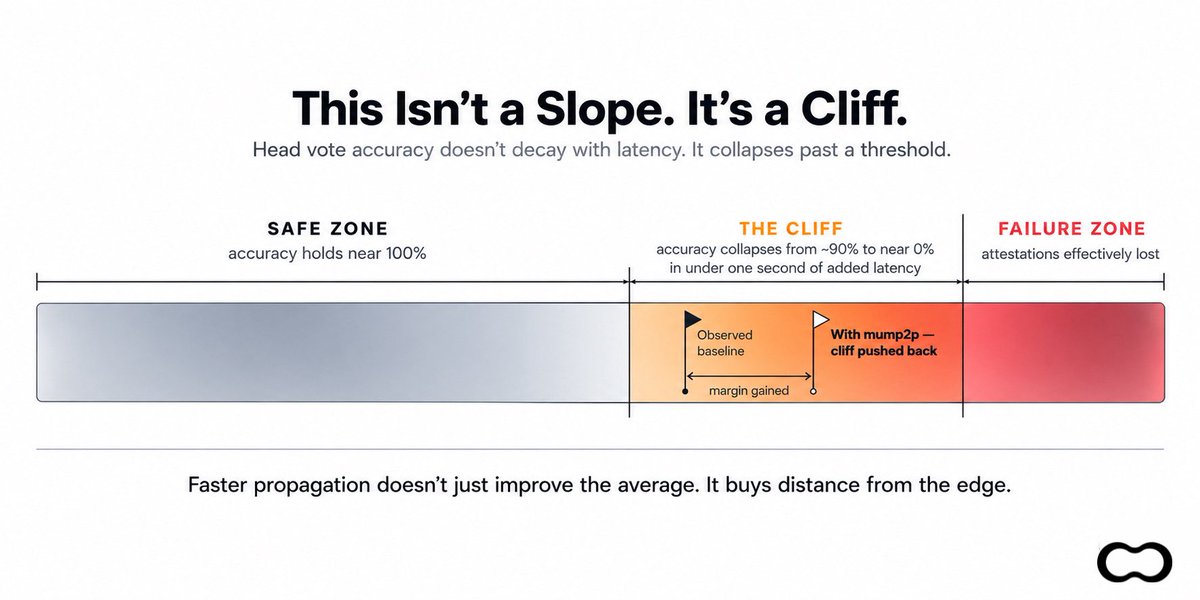
Head vote accuracy doesn't decay with latency. It collapses.
Look at the actual data and it stays flat, near 100%, all the way out to around 3.5 seconds of p80 latency. Then in under one second, it falls off a cliff straight to zero. Not a slope. A threshold.
That changes what "faster propagation" is actually buying you. It's not a smooth average improvement, it's distance from an edge. Optimum's own modeling shows the improved curve doesn't just sit higher, it pushes the whole cliff further right, buying margin before validators fall into the zone where attestations stop counting.
Most latency numbers get sold as "faster." The one that matters here is "further from the edge."
@get_optimum@PostMaklone@cryptooflashh@CryptoSundayz@blockchainjeff