Every deposit that goes into a Flutonized Vault looks identical to every other one. No exposed position, no visible strategy, nothing for anyone to see when the vault rebalances.
Yield pools across chains, accessed privately. AI automation moves capital where it performs best. Your balance and your strategy stay yours, even from the protocol routing your funds.
Private by default is not a feature you toggle. It is the only way the vault knows how to work.
@FlutonIO@0x_kippo@cryptoperseus_
Two encrypted numbers go in. An encrypted number comes out. At no point in between does a plaintext value exist anywhere in the computation.
This is the property that makes FHE different from every encryption scheme before it. You do not decrypt data to work with it. You compute directly on the ciphertext, and the math still holds. Five hundred plus three hundred still equals eight hundred, even though nothing along the way was ever readable.
Only the party holding the key sees the final number, and only because they chose to reveal it.
@FlutonIO@0x_kippo
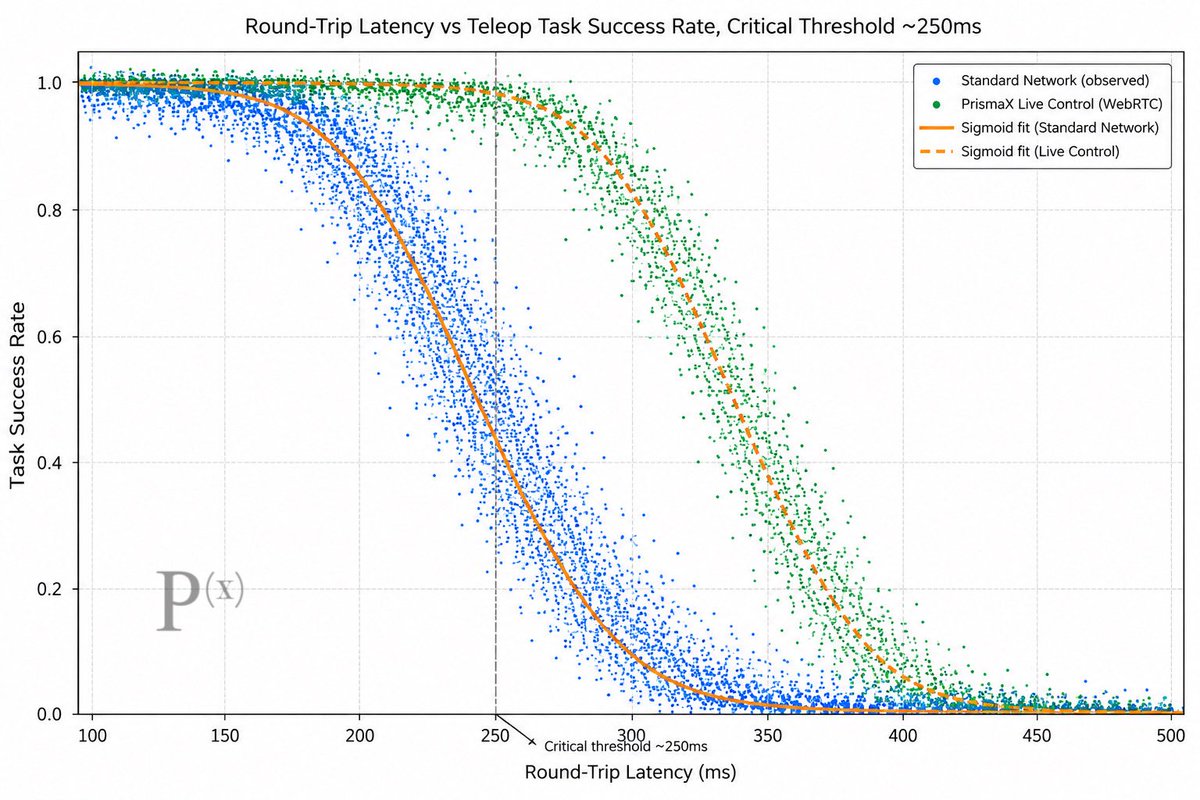
Teleoperation research has been consistent on this for years: past roughly 250ms round-trip latency, task success rate does not degrade gently, it falls off a cliff. Operators lose the ability to compensate, and accuracy craters.
That threshold is not a detail. It is the actual constraint that decides whether teleoperated data is even usable for training. A standard network pushes operators past that cliff early, well before 300ms, and success rate bottoms out fast. Low-latency infrastructure buys real headroom, shifting where that same cliff happens.
This is why runs Live Control on WebRTC and gRPC instead of treating network architecture as an implementation detail. Every millisecond of round-trip latency is directly a data quality problem before Proof-of-View ever gets involved. You cannot score your way out of a session that was never accurate to begin with.
Infrastructure choices upstream decide what is even possible to verify downstream.
@PrismaXai@MaxC16134@vivianrobotics
A single verification check tells you almost nothing. A submission can look fine on one dimension and still be worthless data.
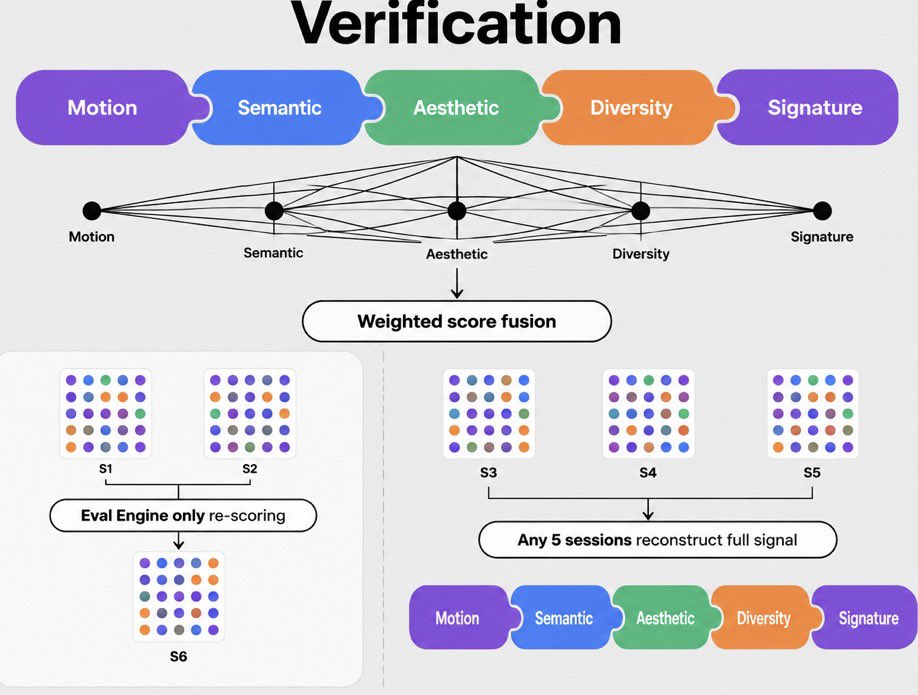
The Eval Engine scores every teleoperation session across five independent signals at once, motion, semantic value, aesthetic clarity, diversity, and signature authenticity, then fuses them into one composite score per session. No single signal decides pass or fail on its own. A session has to hold up across all five before it counts as verified.
That is also why the VLA Foundry does not need every raw submission that comes in. It needs a diverse enough subset of scored, verified sessions to reconstruct the full training signal, the same way a handful of well-mixed composite blocks can reconstruct a complete dataset without requiring every original piece. Coverage matters more than volume once verification is doing its job.
did not build a filter that checks one thing. It built a scoring system that has to agree with itself before any data counts.
@PrismaXai@MaxC16134@vivianrobotics
Reactive transactions are only as good as the data that triggers them. When a condition depends on an external feed, the trigger has to fire the moment that condition is true, not seconds after.
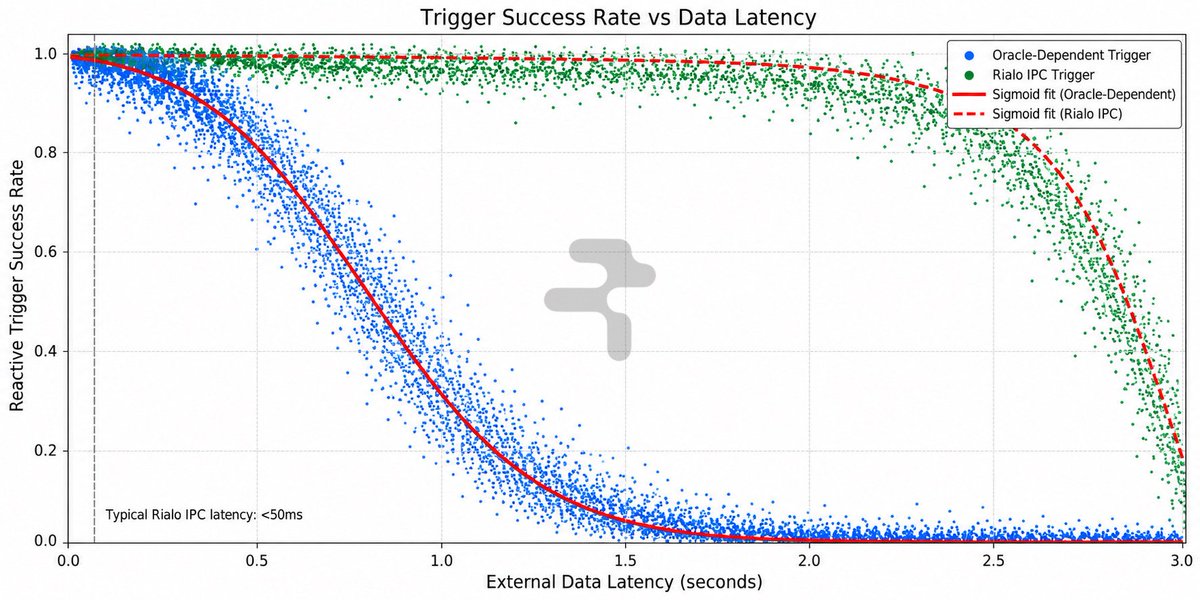
Oracle-dependent triggers start losing accuracy fast once latency crosses half a second, and by two seconds most triggers are firing on stale data or missing the window entirely.
Rialo IPC keeps typical latency under fifty milliseconds, far to the left of where that curve even starts to bend. The trigger fires when the condition is true, not sometime after it was true.
Rethink automation. Rethink Rialo.
@RialoHQ@0x_kippo@0x_vibevortex
Most chains treat oracles, bridges, bots, and middleware as separate pieces you bolt on one at a time. Each one works fine alone, but stacked together they don't add value, they just add fees. One provider's cost passes to the next, and the whole system gets more fragmented with every layer.
Rialo integrates the pieces natively instead. Oracles, automation, privacy, data feeds, and interoperability all live in the same base layer, reinforcing each other instead of sitting apart. The combined system does things none of the pieces could do separately.
This is supermodularity, not a buzzword, an actual design principle across three of Rialo's own research papers. Integration that compounds value instead of compounding fees.
@RialoHQ@0x_kippo@0x_vibevortex
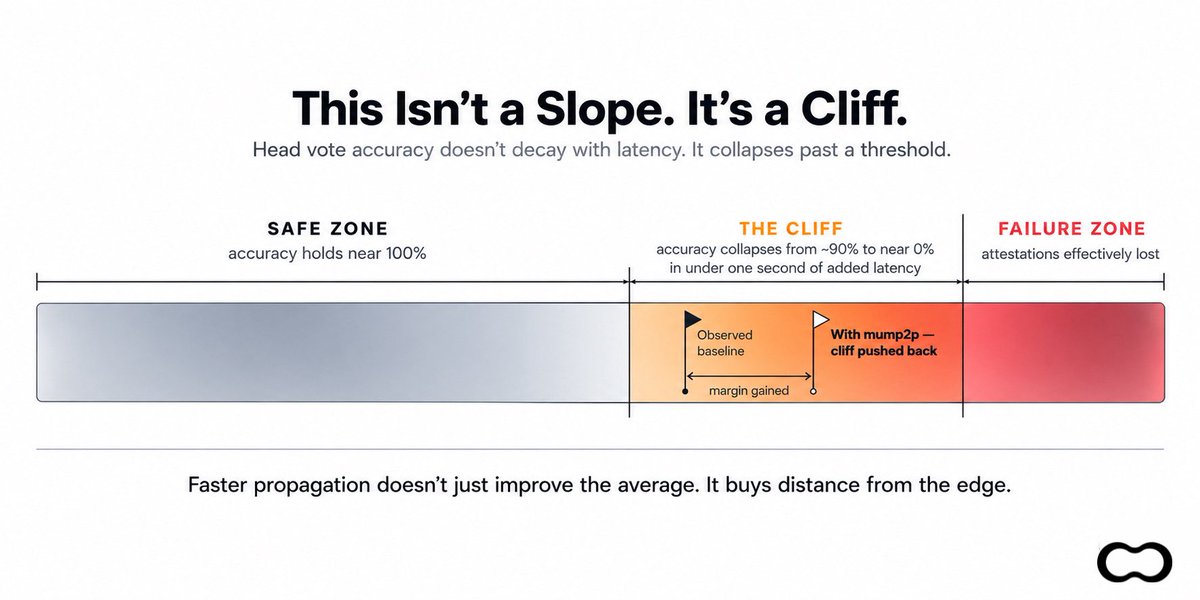
Head vote accuracy doesn't decay with latency. It collapses.
Look at the actual data and it stays flat, near 100%, all the way out to around 3.5 seconds of p80 latency. Then in under one second, it falls off a cliff straight to zero. Not a slope. A threshold.
That changes what "faster propagation" is actually buying you. It's not a smooth average improvement, it's distance from an edge. Optimum's own modeling shows the improved curve doesn't just sit higher, it pushes the whole cliff further right, buying margin before validators fall into the zone where attestations stop counting.
Most latency numbers get sold as "faster." The one that matters here is "further from the edge."
@get_optimum@PostMaklone@cryptooflashh@CryptoSundayz@blockchainjeff
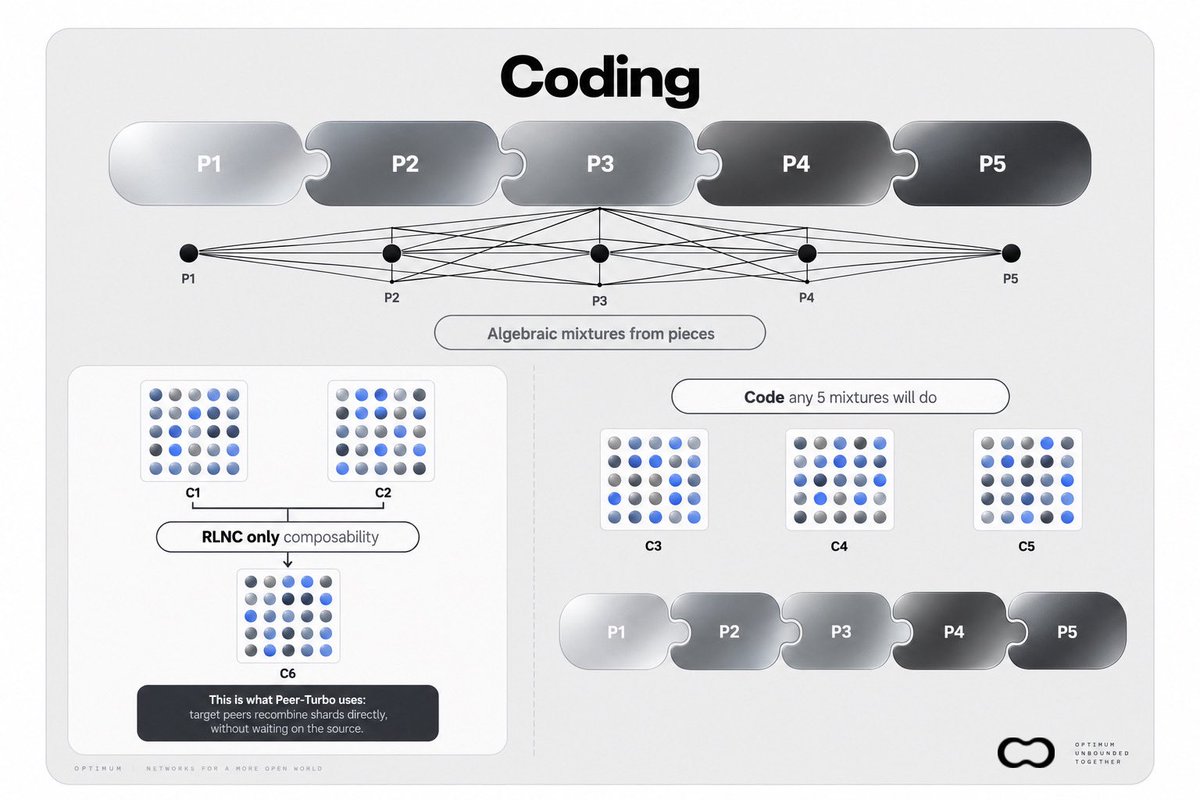
Same five pieces. Two completely different rules for putting them back together.
Ordinary coding needs any 5 of the mixtures, C3, C4, C5, or any other combination, and reconstruction works because each mixture was drawn independently from the same pieces.
RLNC composability goes further. C1 and C2 aren't just two mixtures sitting side by side, they can be combined directly into C6, a brand new valid mixture, without ever touching the original pieces. That property is what Peer-Turbo runs on: target peers trading shards with each other, generating new valid combinations on the fly, instead of every peer waiting on the source to send something new.
Most coding schemes let you reconstruct from pieces. RLNC lets you recombine the mixtures themselves.
@get_optimum@PostMaklone@CryptoSundayz@cryptooflashh@blockchainjeff
Two AI agents make a deal. One pays, the other delivers. Nothing in that sentence covers the moment the buyer says the work is wrong and the seller says it is fine.
Humans built an answer for this over centuries: contracts, courts, lawyers. It takes months and costs more than most jobs are worth. A deal between agents worth a few dollars will never survive that process, so today the disagreement is simply absorbed by whoever is weaker.
@courtofinternet is a court built for exactly those deals. Created by @raskovsky and built on GenLayer, it does three things, in this order:
Terms are set before funds move.
Evidence of what was done is preserved.
The dispute route is agreed upfront.
So on the day two agents disagree, nothing has to be invented under pressure. The place and the process already exist. Verdicts come from GenLayer validators, each running a different AI model, and there is a right to appeal.
That detail matters more than it looks. One model deciding alone is a single opinion nobody can check. Several models judging separately turn a subjective question into something with a procedure behind it.
I build intelligent contracts on GenLayer, and the hardest part has never been moving the money. It is writing down what counts as done, before either side knows who the answer will favour.
https://t.co/NWkSuS4WUC
@AhonJumaidil Our group bet on which Solana DEX would hit highest TVL. The admin used CoinMarketCap data which was lagging by three hours. He picked his favorite protocol.
Our group chat has a pinned bet board: eleven bets, zero clean settlements. Every one ended the same way: admin polled, loser called it rigged.
That board is every prediction market in miniature. The fight is never the bet. It is who gets to say it ended, and my admin was our oracle.
Most markets pick a committee nobody voted for. FUD went the other way: anyone can open a memecoin call on Solana, real money on it.
So the real question is not which coin charts. It is who says what happened when the market closes. My bet board never survived that question.
That resolution runs on @GenLayer: validators, each a different AI model, settle what happened, and the losing side keeps a right to appeal.
A settlement nobody can appeal is just the loudest voice with a timestamp. Fair payout keeps a settler you cannot DM and a verdict you can challenge.
If your own bet board got one appeal window, which settled bet would you reopen? Name it in one line. I read every reply.