@zer0ized@Yuchenj_UW Genuine question: why do you actually care who uses it? It's rather unique phenomenon regarding tooling that people enthusiastic about AI argue a lot about "dinosaurs" not using it.
Software has become extremely sluggish and bloated. There are many reasons for that, but one of them is definitely developer negligence and a lack of passion for the craft, something the recent MS news highlighted.
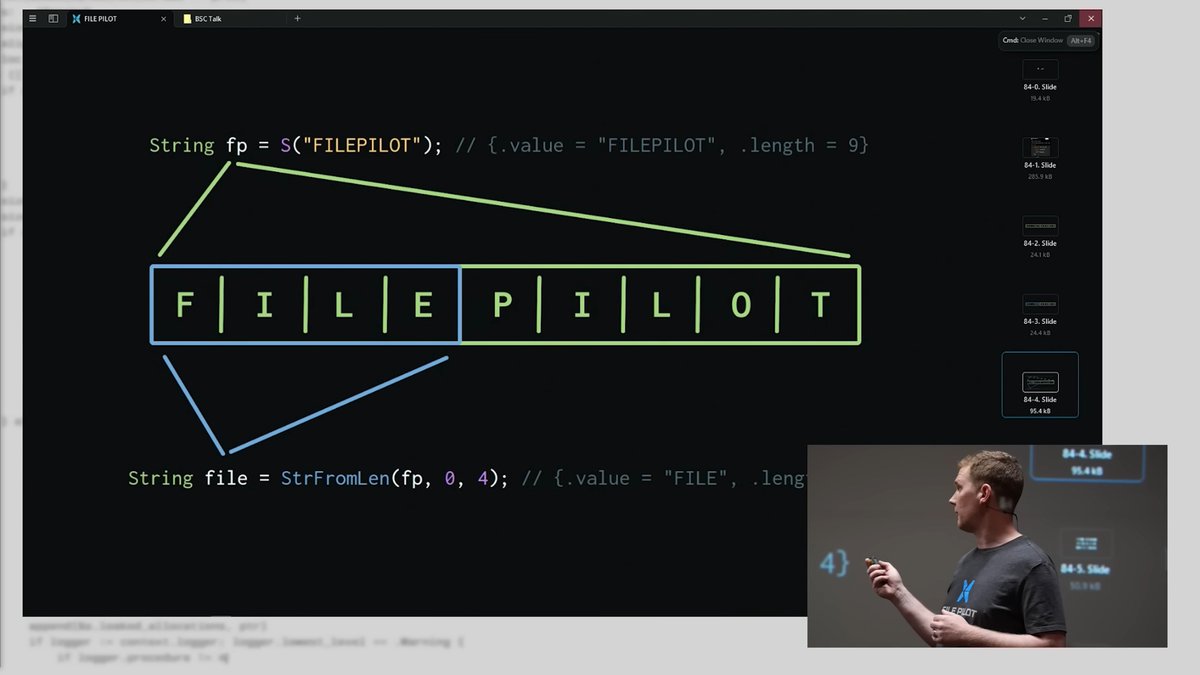
Since the recent buzz around File Pilot, I've received a lot of questions about how it was written, which language it uses, etc. Since I don't have an online devlog yet, I'll just share a link to my BSC talk from this summer:
https://t.co/lwTcvlOxaB
It only covers the basics of my base layer, but it should give you a glimpse into the mindset behind its development.
File Pilot was written in C, with no external libraries (aside from a few very small exceptions). It uses its own base layer (instead of libc), platform layer, rendering, UI, pretty much everything is custom built.
The two most influential sources were definitely Handmade Hero (https://t.co/dRvbatRZkm) by @cmuratori, which introduced me to a simpler and more straightforward approach to programming, and @rfleury, who synthesized a lot of HMH concepts into an excellent online blog. His article on UI (https://t.co/jIP6hvgdG9)
directly influenced how File Pilot's UI system is built.
Someone shared a fascinating visual of an AI agent moving through a real codebase - reviewing structures, making decisions, and committing changes.
It’s a reminder that software development is quietly entering a new phase.
I've been trying to share a particular message for a couple of years now, and I can never quite find the words. I doubt I will tonight, but I have to try again because I watched my great friend get murdered over it today.
We have a choice: catharsis or civilization.
There's no other choice for us. We can have a civilization, where people are civilized enough to live, work, and trade with one another in a productive way, a safe way, a trustworthy enough way, or we can abandon it for the pursuit of letting the negative emotions of the past years, decade, or decades consume us.
There's no other choice.
If we choose catharsis, we let our emotions, our Pathos, get the better of us. We turn to our anger and look to give it more justifications. We turn to our frustration and seek an orgiastic release through whatever deeds vents it. We turn to our oppression, our rage, our despair, our fear, and we let it flow through us until the Pathos pours out and covers the land in what will eventually be fire and blood.
Catharsis is tempting, and stepping into it will be libidinous, orgiastic, elevating, and divine, until we realize that it's the feast of demons upon everything we could have built and everything we could have passed on to our children and our posterity.
Civilization is harder. It's bitter, in fact, in comparison to catharsis. It means swallowing hard and taking all those negative emotions and sublimating them into something productive, something that builds rather than makes us feel better. Civilization feels like injustice, in fact, even though it is the only basis for justice outside of Heaven and Hell, if they exist.
If we choose civilization, we're allowed to be mad, but we must temper our anger into right action that builds something to leave a better world, which will dissolve it, of course. We're also allowed to be frustrated, but we must sublimate our frustration into the dedicated search for real and lasting solutions to our problems in a civilization worth living in and passing to our children. We are not allowed to despair, though, and we cannot persist in fear. We must have faith that swallowing and metabolizing all of our negativity to turn it into a flourishing society is possible and worth it, and faith will drive out fear and is the mortal enemy of despair.
Civilization is not available on the wide path. It is the narrow path, at least so far as worldly life goes. Veer too far to one side or the other, or even for too long a moment forget your purpose or principles, and you lose the path, lose civilization, and lose everything worth having.
Without civilization, though, we will find ourselves in a terror beyond our comprehension. Maybe it will be like the philosopher Thomas Hobbes described it in the wake of the terrible English Civil War, when civilization was nearly thrown aside. Violent, solitary or tribal, nasty, brutish, short, a wicked and selfish war of all against all. It looks like the favelas of Brazil.
Maybe we'll end up conquered, fighting among ourselves while our enemies feast on our folly. Maybe we'll end up holding it together, for a little while anyway, under a tyrant who can, for a time, make it all stop and demand order. Maybe we all just end up learning Mandarin and get along mastering the ins and outs of social credit existence.
Civilization is worth fighting for, and catharsis is the kind of momentary pleasure followed by pain that every virtue stands in opposition to. In a civilization we, and each of our children after us, can live as individuals, free to pursue our dreams in sufficient safety and opportunity to generate abundance. Catharsis will be a groupish disaster with all the allure and hangover of a drunken mosh pit.
Again, I'm not expressing myself the way I see this issue in my mind. It's such an important message that I just can't get right, no matter how I try.
What I will say is that, for any differences in the particulars my great friend Charlie Kirk and I have had, Charlie Kirk stood for, lived for, and acted to his dying breath for civilization. He was far too temperate and wise, even at 31, for catharsis.
How can I be sure?
Under strange circumstances once, I found myself out on a skiing boat on a lake with Charlie Kirk. Music was playing, we were having a good time enjoying the morning. Charlie, with his standard grin, bare chest in the sun, laughed a little and explained himself, "I had fun once, guys, and I hated it."
Then he made our host change the music from something fun and hip to... classical. And we ran up and down the lake alongside all the other party boats listening to Bach, Vivaldi, and Stravinsky, not having fun even once and loving it. Charlie Kirk lived for civilization, and nothing remotely like catharsis would have been near his mind, heart, or soul, even in its darkest, most frustrated moments.
Charlie wanted to win, but he wanted to win so that we can move away from evil and move away from cathartic, orgiastic destruction and toward civilizational order, where his family and children could grow up as strong, proud Americans.
That's how I know that Charlie understood the choice I still cannot articulate. We have two options, and only two. They are catharsis and civilization.
Charlie Kirk lived that we would have civilization. May Charlie Kirk not have died such that we spiral into catharsis and evil.
@cynicalgroyper @DeCesareStephen @LizzieMarbach@benshapiro@michaeljknowles To answer your question, I think it’s important to ask “are we free to choose hell”. Sure, none of those sacraments are tickets to heaven, but the reason why somebody rejects them matters. It matters what they truly want.
@RockChartrand@ConceptualJames Yeah, you’re right, that’s the only one, and it’s collective in the sense of the whole mankind, as in everyone has the same participation. In catholic teaching it’s also not a classic sin (one to confess), but default state of human being (state of imperfection).
@RockChartrand@ConceptualJames There is definitely no collective guilt, it’s obedience to Church authority (in things that belong to God) and its salvation through Christ (who took the suffering upon himself).
Universal Basic Income is only inevitable if the collapse of civilization is inevitable. In a healthy society, people do not need to be paid just to exist. They are free to think, create, produce, and trade with one another in a system built on mutual benefit and voluntary exchange. That is how prosperity is built—through ability, not dependency.
UBI does not represent progress. It represents surrender. It is what you propose when you no longer believe people can contribute, when you assume automation or inequality will make most of humanity permanently useless, and the only answer left is redistribution. That is not a solution, it is a quiet declaration that civilization no longer knows how to rise—only how to decay more gently.
If UBI ever becomes inevitable, it will not be because we advanced. It will be because we stopped trying.
@realAaronBergh@ConceptualJames 2) it’s not easy thing to differentiate political and theological sphere. I think Catholics who struggle with that will have higher propensity to be authoritarian in their political opinions.
Now it’s funny because most Catholics I know (Czech Republic) are the opposite of that.
@realAaronBergh@ConceptualJames 1) Catholic Church is the teaching authority. It operates internally on obedience, as the core believe is that as living body it’s protected by Christ in long term and “gates of Hell” can’t prevail over it in any ultimate sense.
Karl Marx never bathed and had boils all over his body, was an alcoholic, had an unpaid maid whom he might have r*ped (he certainly got her pregnant, despite what Wikipedia says). He smoked so much it killed one of his babies (which he left in the family bed - the only one they had - because he was too lazy to get a job to afford to bury it), and he made his aristocratic wife depressed and turn to drink.
Two of his surviving daughters committed suic*de, and the only child to survive into old age was the boy he fathered to the maid, who didn't live with Marx and was therefore the only sane one.
Engels and other family, friends and neighbours had to constantly give Marx money throughout his life because he never did anything productive. He had to beg and borrow, and sent his wife off to do the same. He worked briefly as a article writer for a newspaper, but never had another job and couldn't provide for his family, despite their need, and despite him being more than capable of working. He was constantly in debt, and because he didn't pay his rent the bailiffs took away the family furniture, even the crib. They owed everyone, even the bakers and the milkmen. Yet Marx still refused to work!
And to top it off, Marx was wrong about everything. We know this because his fairytale predictions about the future have simply not come true, and were proven to be wrong during his lifetime and not long after his death (e.g. by Eduard Bernstein). His policies have led to misery for billions of people, and death to many tens of millions. Why anyone pines over this monster is beyond me.
And if Karl Marx is the best "social theorist" we've ever had, then it's no wonder society is parasitical and anti-life. You should care whether he was wrong or not, but you won't because the socialist faith turns people into sleepwalking NPCs.
@civic_enjoyment Nothing moral becomes amoral because it’s used as a tool. But nothing amoral becomes moral because it’s used as a tool either. That’s what “tool is amoral” means. Being used as a tool doesn’t sanctify prior amorality.
@Nomadhidinghere@derekbalsley@BFrankzetta@Teaethics@ConceptualJames To add, Judeo-Christian civilization surely is compatible only with Judeo-Christian virtues. That doesn’t make me want to compel them by state, as discussed with Derek, but not because they have religious origin - but because state can only interfere!
@Nomadhidinghere@derekbalsley@BFrankzetta@Teaethics@ConceptualJames I don’t think it works like that :). Virtues are hard, even for Christians. It doesn’t matter whether they are popular. And they totally stem from the religion (communists prob have “destroy reality” as a virtue).