Forecaster. Geopolitics, military operations, finance. Analysis and forecasts at the intersection of three axes. Global team. Open-source intelligence.
took Goldman Sachs 6 months to catch up to what we said in February: $120+ oil if Hormuz closes. They were at $80–90 back then. We weren't. This isn't luck — it's structural analysis. Markets don't move on news. They move on reality. We just see it earlier.
@NewsNow4world1 Saudi Arabia shifts tone: "Aggression and hegemony lead only to insecurity." Riyadh is signaling that the era of containment is over. It wants Iran held accountable — but not through a war that others are fighting. A new line is being drawn in the Gulf.
Pakistan is everywhere in this war — mediator between US and Iran, partner of Saudi Arabia, and a key player in the new anti-Israel axis with Turkey and Egypt. But Israel rejects its role. This is the new multipolar reality: everyone plays everyone. The old alliances are dead.
US redirects $200B from colleges to AI — but investors are already fleeing the sector. Goldman Sachs reports record tech selloffs. This isn't a strategy. It's panic. AI won't fix debt, inflation, or the budget deficit. It's just another bubble waiting to burst.
@MarioNawfal Pickaxe Mountain is a symbol of the deeper problem: you can't bomb your way out of Iran's nuclear program. The only exit is a deal — or a ground war. Neither is easy. But pretending that more strikes will solve it is a strategy of exhaustion.
@MarioNawfal Direct flights are a good sign. But Lebanon's future depends on whether the US can contain Hezbollah — not just reward Beirut. The real leverage isn't in the air. It's in the straits. Iran is still pulling the strings.
@OmarBlooshiAE With respect, Omar — strikes on Tabriz hit IRGC logistics, not the nuclear program. Iran responds through proxies, not head-on. The real target isn't missiles — it's the straits. That's where this war is actually fought.
Two paths: 1) Managed reconfiguration — EU adapts, slowly, painfully. 2) Fragmentation accelerates — Brussels loses authority. Adapt or fragment. That's the real question. What's your call?
In our recent brief, we said Europe "won't recover." That was too absolute. What we actually mean: Europe won't return to pre-crisis stability in the next 2–3 years — not collapse, but a painful structural reconfiguration.
Why? Energy dependence on alternatives is expensive. Fertilizer shortages hit yields. Refugee flows test internal cohesion. Political fragmentation — from France to Germany — weakens decision-making. These forces won't destroy Europe. But they will change it.
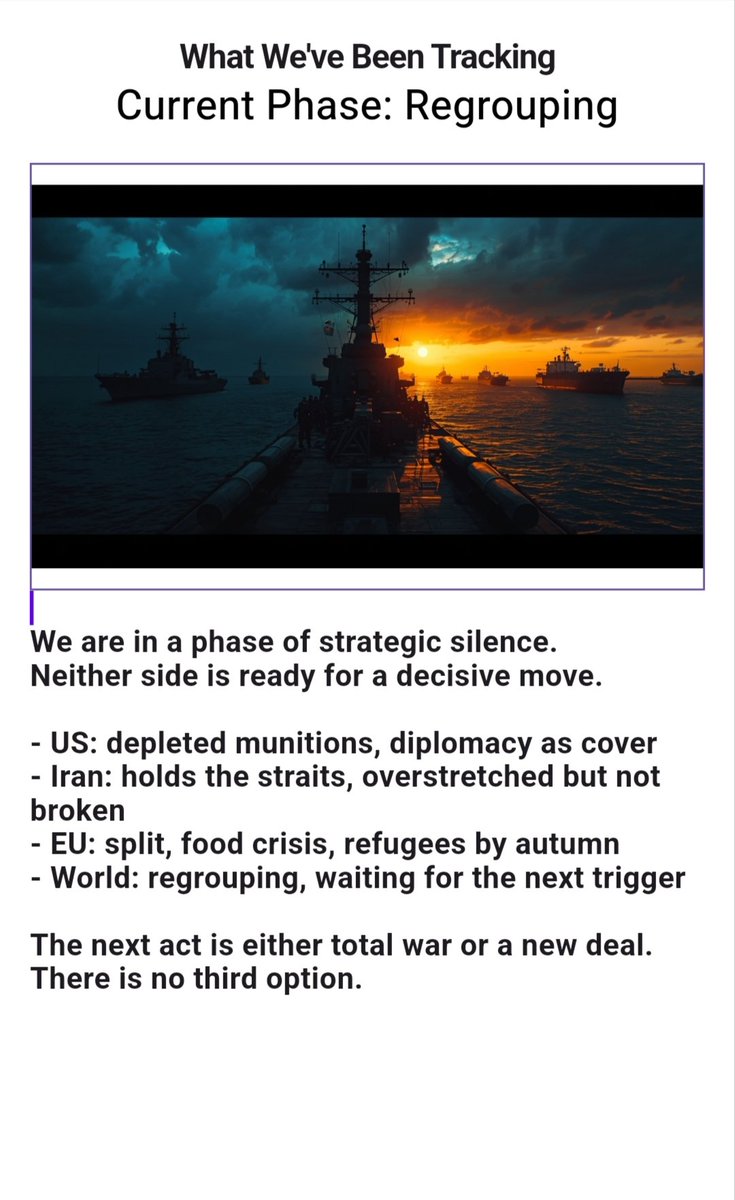
Our analytical brief — Iran, straits, oil, Europe. The world map we've been tracking on X since June. 4-part visual breakdown with forecasts, confirmations, and structural outlook. Markets are still catching up. We're already ahead.
@Alafasy كلامك صحيح، إيران تقبل قواعد روسيا وترفض قواعد أمريكا. الفرق: روسيا دعمت الأسد، أمريكا تريد السيطرة على المنطقة. إيران ليست ضد القواعد الأجنبية، هي ضد القواعد التي لا تخدم مصالحها.
@EdyCohen Edy is right: Iran is targeting Arab oil. But the US is trapped — its Gulf allies are its weak link. If the straits close, the US can't protect them, replace the oil, or walk away. Iran isn't fighting imperialism — it's fighting the US through Arab wallets.
Edy is right: Iran is targeting Arab oil, not Israel. But the US is trapped — its Gulf allies are its weak link. If straits close, the US can't protect them, can't replace the oil, and can't walk away. Iran isn't fighting imperialism. It's fighting the US through Arab wallets.
إيران بتهدد بإغلاق مضيق هرمز أو السيطرة الكاملة عليه، والدول العربية المنتجة للنفط هي أول المتضررين وليس اسرائيل على فكرة.
مش أمريكا اللي راح تدفع الثمن الأكبر، العرب هم اللي راح يدفعوا.
إيران ما بتحارب "الاستكبار"، هي بتحارب العرب وبتستخدم هرمز كسلاح اقتصادي ضدهم.
هذي هي الحقيقة اللي ما بدّن يحكوا فيها.
@NewsNow4world1 Gulf unity against Iran doesn't secure the region — it opens another gate of hell. Full-scale war means either Iran's destruction with massive collateral damage, or a regional war that drags everyone in. There's no quick end to serious escalation. Markets still don't get it.
It's amusing watching parts of the Islamic world thank Trump for bombing Iran. They don't realize they're next. Resources are the real target — always have been, always will be. Today it's Tehran. Tomorrow, it could be anyone with oil, gas, or a strait.
@isaacrrr7 The US is preparing a larger war — but it lacks munitions to sustain it. Patriot and THAAD are low. Escalation will close Hormuz and Bab-el-Mandeb, even temporarily. That alone sends oil to $120+. Iran doesn't need to win — just make the war too expensive.
Buffett selling isn't about stocks. It's about what he sees: Europe won't recover — crops failed, fertilizer is gone, Ukraine is dead, Russia won't sell. Refugees will flood the EU by winter. This isn't a market correction. It's a structural shift. Cash is waiting.
🚨 BREAKING 📷 WARREN BUFFETT SAYS THE U.S. DOLLAR WILL COLLAPSE DUE TO GOVERNMENT POLICY BERKSHIRE HATHAWAY JUST SOLD $24.1 BILLION IN STOCKS THIS EXTENDS ITS SELLING STREAK TO 14 STRAIGHT QUARTERS THE LONGEST IN BERKSHIRE’S HISTORY THIS IS NOT LOOKING GOOD...
@HamedMusher Confirms what I said back in March: Kharg is the red line. If the US lands, Iran will destroy it themselves — scorched earth, not surrender. 90% of their oil exports go through that island. They won't lose it. They'll burn it. That's not bluff. That's the final act.
@MarioNawfal This is what we've been saying: the US is running out of interceptors, precision weapons, and options. War of attrition isn't a theory—it's structural. Diplomacy is cover for regrouping. IRGC knows this. Markets don't. $120+ oil is still on the table.