Bitcoin just broke $64,000.
ETH is moving towards $1,900.
$135M shorts liquidated in 60 minutes.
Crypto market is surging because Low CPI inflation means high chances of rate cuts.
🚨 BREAKING: US inflation just STUNNED the experts and FELL -0.4% month over month, the largest plummet in 6 YEARS — CNBC
Gasoline and fuel nearly -9%
Year over year, inflation is 3.5%, lower than economists expected
KEEP IT GOING! 🇺🇸
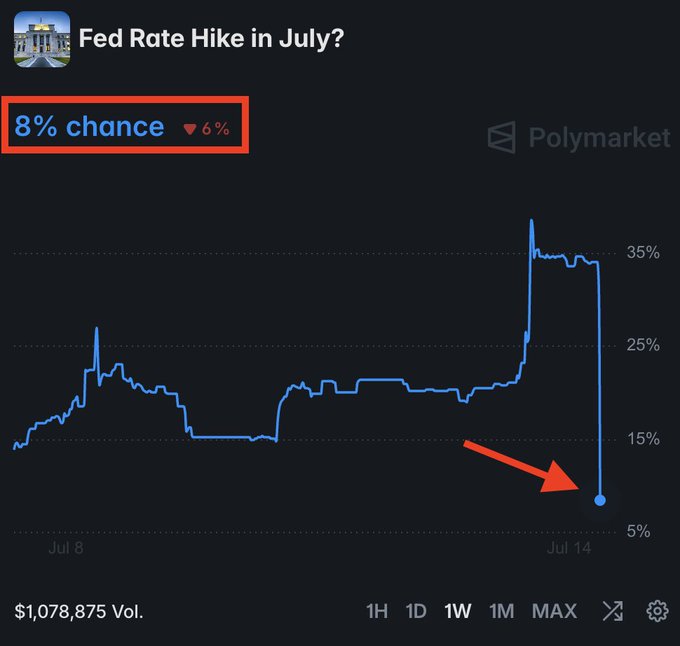
BREAKING: The odds of the Fed hiking rates at the July 29th meeting crash to 8% after CPI inflation unexpectedly posts its biggest monthly decline since April 2020.
You just can't make this up
The day before Trump announced a tariff pause that sent the S&P 500 up 9.5%
His accounts purchased 327 stocks worth up to $12.8 million
By law, those trades had to be disclosed within 45 days
Instead, they were disclosed over a year late, for a $200 penalty
42 agents. 216 threads. One dashboard. Every agent gets its own prompt, tools, skills, and budget. Deploy specialized agents across your company. From the team at Airtable.
Japan's economy is now breaking from three directions at once.
The Bank of Japan is running the most aggressive tightening in its history, and this is a central bank that has spent 25 years doing the exact opposite.
• The BOJ drained ¥23.5 trillion, about $146 billion, from the market in the quarter ending June 30. That is the largest quarterly drop of this entire QT cycle.
• Since its 2024 peak, the BOJ has shed ¥116.9 trillion, roughly $726 billion, or 15.6% of its total assets.
• It is now selling its equity ETFs and J-REITs outright. Nothing on the balance sheet is protected anymore.
The bond market is already showing the damage.
• The 10-year JGB yield hit 2.90%, the highest since September 1996. That is a 30-year high.
• It rose for nine straight sessions, the longest streak in 19 years.
• The 20-year is at 3.89%, the 30-year at 4.03%, and the 40-year at 4.055%. Both long ends are at record levels.
Inflation is now forcing the BOJ's hand.
• Japan's PPI just came in at 7.1% year over year, above the 6.8% forecast and up from 6.3%.
• The policy rate is still only 1.0%, far behind where inflation sits.
• Higher inflation means more rate hikes. More rate hikes means even less liquidity in a market that is already being drained.
That is the first problem. The second is the currency.
The BOJ has attempted small interventions over the last few days and none of them held. USD/JPY is still sitting near 162, close to a 40-year low for the yen. Japan already spent $72 to $73 billion defending it earlier this year and it did not work.
A weak yen is not a small problem. Japanese companies are going bankrupt because import costs keep rising. To actually strengthen the yen, Japan has to drain foreign reserves and hike rates harder.
Doing that risks breaking its own stock market, and something much bigger.
The yen carry trade is still estimated at $4 to $8 trillion. That money is borrowed cheaply in yen and parked in US stocks, emerging market debt, and crypto. In August 2024, a single 0.15% BOJ hike triggered an unwind that crashed the Nikkei 12.4% in one session, its worst day since 1987.
Then there is the third problem, and this one has no policy fix.
• Japan recorded 671,236 births in 2025, the lowest since records began in 1899.
• The fertility rate fell to 1.14, far below the 2.1 needed to hold a population steady.
• Deaths exceeded births by over 900,000 people for the second year in a row.
• Population has fallen from 128 million to around 123 million.
• Nearly 29% of the country is now over 65.
Debt is rising. The workforce that has to service that debt is disappearing.
Japan has the highest debt-to-GDP ratio in the world at 204.4%. Its central bank is draining liquidity, its bond yields are at 30-year highs, its currency is collapsing, and its future taxpayers are not being born.
Most people are watching the Fed. The next global shock is far more likely to start in Tokyo.
🚨 MICHAEL BURRY SAYS THE BIGGEST DEMAND FOR US STOCKS JUST VANISHED.
US equity net issuance turned positive again, the first time since 2021.
Companies are now issuing more new shares than they're buying back.
For most of the last 20 years, buybacks were quietly shrinking the total supply of stock, pushing prices up on their own, regardless of earnings.
The last time this flipped positive was 2021, right before the 2022 crash.
Buybacks have been the largest source of demand for US stocks for two decades. That demand is now vanishing.
In 2024: $63k In 2026: $63k Before Trump: $63k After Trump: $63k Before pro-crypto Fed: $63k After pro-crypto Fed: $63k Before the US-Iran war: $63k After the US-Iran war: $63k Before US stocks ATH: $63k After US stocks ATH: $63k