🚨 NOVO PEDE O AFASTAMENTO DO DIRETOR DA PF!
O partido Novo pediu hoje ao STF que afaste Andrei Rodrigues, diretor-geral da Polícia Federal, e Dennis Cali, diretor de Inteligência, até o fim das investigações do caso Master.
Segundo o partido, os dois tentaram interferir nas investigações quando afastaram os delegados do caso e mandaram refazer os relatórios que citavam ministros do Supremo a partir do celular do Vorcaro.
No Senado, Andrei disse que os delegados deveriam ter entregado uma minuta antes de colocar os relatórios no sistema. Mas quem conduz o inquérito é o delegado, não o chefe da PF.
Se a direção da PF manda refazer relatórios que incomodam ministros, quem garante que a investigação é isenta?
@marsiglia_andre Como o PT/Lula e o STF destruíram o Brasil.
Espero ver o tal do poder moderador e os coniventes ir para o ralo da miséria já que o cidadão honesto, impotente e acuado não pode mais se defender
“Ele tentou destruir minha vida, mas não vou me calar.”
Aline Magalhães @alinemagabr expõe no vídeo o terror que viveu nas mãos de Alexandre de Moraes.
Inocente pela Polícia Federal, virou ré, teve tudo bloqueado e foi forçada ao exílio nos EUA.
@knafo_sarah il faut penser solutions...
Edit Copy Paste... finit le diktat des politiciens qui se servent en lieu et place de servir
adopter ce modèle qui fait peur aux technocrate et politiciens
https://t.co/mqqrAdRRu0
@MLP_officiel Chère Madame,
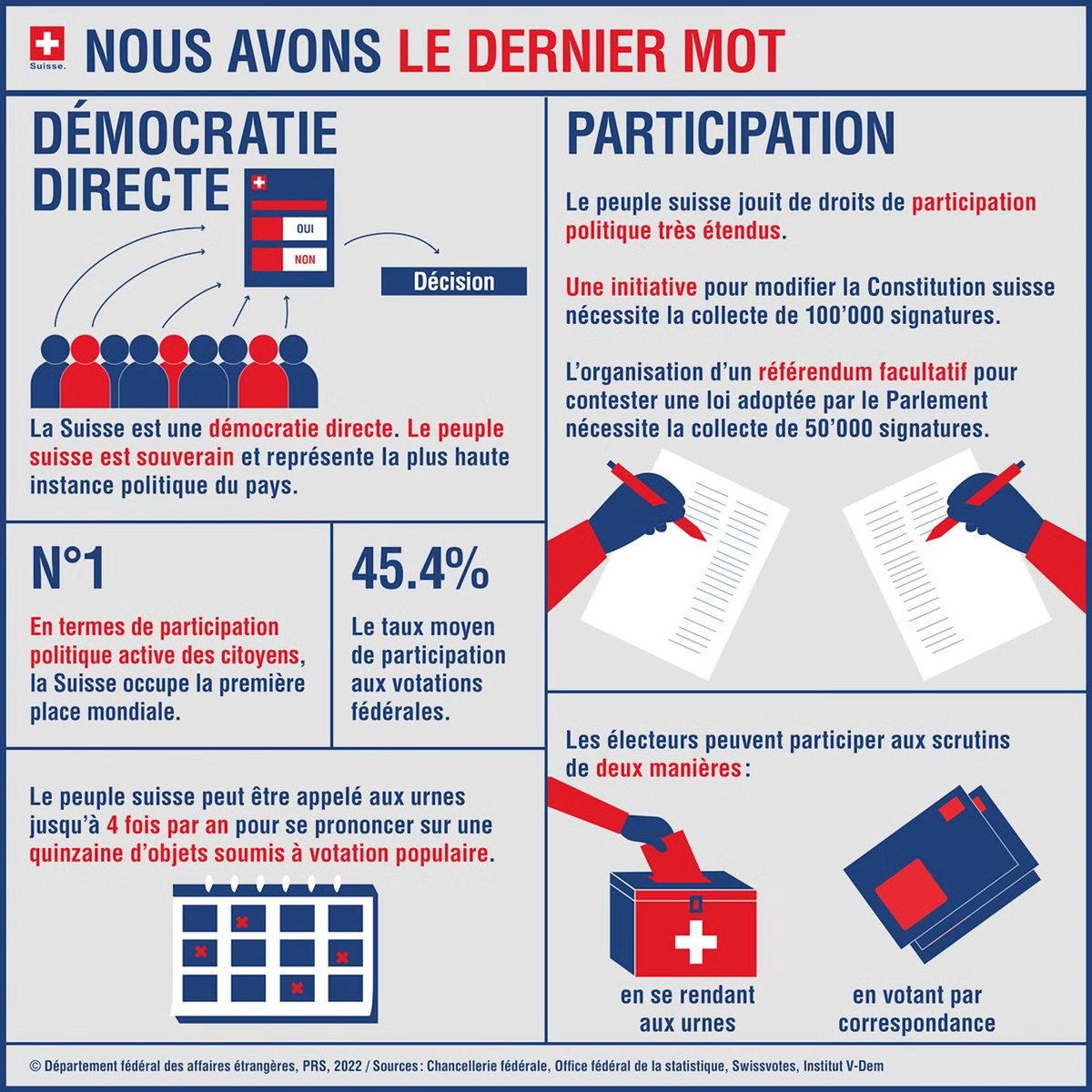
les peuples savent décider . Edit -Copy -Paste le système de vos voisins. Democratie Directe en France and dans toute la UE
https://t.co/mqqrAdRRu0
@MLP_officiel les peuples savent décider . Edit -Copy -Paste le système de vos voisins. Democratie Directe en France and dans toute la UE
https://t.co/mqqrAdSpjy
O Judiciário conta com os impostos do povo para bancar supersalários e penduricalhos.
Já o povo não pode contar com o Judiciário para se proteger da criminalidade.
Is There a Better Way? My Journey into Swiss Democracy
For the best part of two decades, I have found myself living in a country that practises citizen-led direct democracy. Not simply a country where citizens are invited to participate in elections or occasionally express an opinion, but one where they have genuine constitutional powers to influence and decide what happens to them. And importantly, those powers exist at all three levels of government: national, regional and local. In Switzerland, a citizen's vote can do considerably more than register an opinion. It can change the law, overturn legislation or bring about constitutional change.
Having spent the previous 40 years of my life in a predominantly representative political system, I naturally began asking myself a question: why was Switzerland doing so well compared with so many countries operating under purely representative systems? What was it about this country that made it different?
The answer I kept coming back to was direct democracy.
It was not the only reason, of course. Switzerland's success is the product of many factors, including its federal structure, economic policies, institutional stability and political culture.
But I could not escape the significance of something that was fundamentally different: the fact that ordinary citizens retained meaningful control over the decisions affecting their lives, not just at national level, but regionally and locally too.
Switzerland consistently performs exceptionally well across a remarkable range of international comparisons, whether measuring wealth, competitiveness, safety, peace, happiness, quality of life, environmental performance, salaries, infrastructure. low-crime rate, or innovation. It regularly occupies leading positions in global rankings. Its standard of living is among the world's highest, and its achievements are not confined to economic prosperity. There is something about the way the country is organised and governed that deserves much closer examination.
Having experienced both worlds, I could not simply ignore what I was seeing. I felt compelled to understand the Swiss system, to study it, and ultimately to write about it.
Eight books later, that journey has culminated in my latest work, The Swiss Democracy Dictionary.
My perspective is perhaps a little different from that of someone approaching the subject purely through an academic or political background. I am a businessman, running two Swiss companies, but I am also an exhibiting fine artist. What began as a hobby developed into something much more significant, with paintings sold around the world and work held in a number of Swiss institutions.
Perhaps it was the artist in me that made me particularly fascinated by the Swiss political system. An artist looks at the relationship between individual elements and the bigger picture, at how different components come together to create something greater than the sum of their parts. That is precisely what I have come to see in Switzerland's approach to democracy.
The Swiss system is not one isolated democratic mechanism. It is an ecosystem. Direct democracy, federalism, subsidiarity, local government, political compromise, citizen participation and constitutional safeguards all interact to make the system work.
With The Swiss Democracy Dictionary, I have attempted to capture that ecosystem as comprehensively as possible. Much like creating a painting, I wanted to bring together all the individual elements to produce a complete picture, one that explains not just what the Swiss system does, but how and why it works.
More importantly, I wanted to make that knowledge accessible to anyone interested in taking elements of the Swiss model and applying them within their own political system.
Because, despite its achievements, the Swiss model remains surprisingly unfamiliar to much of the world.
Most countries continue to operate within a familiar representative cycle. Political parties compete for power, manifestos are presented, promises are made and citizens vote. Then, having elected their representatives, the public largely steps aside.
If promises are abandoned, policies are imposed or decisions are made against the wishes of the electorate, there is often very little citizens can do about it until the next election, sometimes four or five years later.
Then the cycle begins again. A new government arrives, frequently undoing what the previous government put in place, and the process repeats. Political colours change, personalities change and rhetoric changes, but how much really changes?
Increasingly, one could argue that the underlying political and economic agendas have become remarkably similar across parties, despite their apparent ideological differences. The packaging changes, but the direction often remains much the same.
Is there a better way?
The Swiss Democracy Dictionary makes a compelling case that there is.
I appreciate that this can be difficult to accept, let alone believe, if you have never experienced anything different. When the system you live under is the only system you know, it is easy to assume that this is simply how democracy works. Elections, political parties, manifestos and parliamentary majorities become synonymous with democracy itself.
But after almost two decades living within the Swiss system, I can tell you that there is something different. And, in my experience, it is better.
The fundamental difference is that in your system, once you have voted, your ability to influence what happens next is often extremely limited.
In Switzerland, it isn't. You have constitutional tools to challenge your government, reject legislation and propose changes of your own. You do not have to wait for another election to make your voice count.
That is a profound difference in the relationship between the citizen and the state.
I suspect the book will frustrate some readers. In one sense, it is a mirror that you can hold up against the political system you currently live under. You may find yourself questioning why certain democratic rights are taken for granted in Switzerland but are largely unavailable in your own country. You may wonder why you have so little influence over decisions that have such a profound effect on your life.
But I also hope it will enlighten and refresh you. It introduces a different way of thinking about democracy, one that challenges many of the assumptions we have grown accustomed to accepting. It offers something that is increasingly missing from political debate: a reason to believe that things can be better, and practical examples of how they might be made better.
I am not suggesting that Switzerland is perfect. It isn't. It has its political disagreements, shortcomings, failed policies and challenges, just like every other country. Nor am I suggesting that every aspect of its system can simply be transplanted into another nation without consideration of its history, institutions and circumstances.
But I am saying something that I believe is considerably more important: there is a better way of doing democracy, and Switzerland provides the living example.
It is easy to criticise the political systems we live under. It is much harder to offer a workable alternative. If all we do is complain about what is wrong without identifying what could replace it, we are unlikely to make meaningful progress. Switzerland provides a starting point, a practical demonstration of how political power can be shared with citizens, how governments can be held more accountable and how society can be organised differently.
Of course, those who already hold political power are not necessarily going to welcome a system that gives more of it away. Power has a habit of protecting itself. Those who benefit from the existing arrangements may have little incentive to encourage people to examine alternatives. But we should not allow that to prevent us from looking.
Switzerland demonstrates that when citizens have meaningful power, democracy becomes more than the periodic act of choosing who governs them. It becomes an ongoing relationship between the people and those entrusted to represent them.
You may disagree with me. You may question my conclusions. That is entirely your right. But please don't take my word for any of this.
Look at Switzerland. Examine its institutions, its democratic mechanisms and its international achievements. Ask yourself why a country of just over nine million people has managed to create something that so many larger and wealthier nations have yet to replicate.
Then ask yourself one final question:
If there is a better way of doing democracy, why shouldn't you have it too?
#DirectDemocracy